

Table Of Content
- ⚡ Executive Summary
- What We Mean by “AI Literacy” (And What We Usually Get Wrong)
- The Real Gap: Capability vs Context
- Capability exists
- Context is missing
- Why Non-Metro India Experiences AI Differently
- 1. AI as Magic
- 2. AI as Threat
- 3. AI as Shortcut
- The Risk of Teaching AI Without Context
- What Contextual AI Literacy Actually Looks Like
- AI as Decision Support, Not Decision Authority
- Why Policy Narratives Often Miss This Reality
- The Role of Independent Knowledge Platforms
- 📋 Action Plan: Responsible AI Adoption
- Conclusion: India Does Not Need Faster AI Adoption. It Needs Better Understanding.
- FAQ: AI Literacy in India
- What is AI literacy in the Indian context?
- Why is AI literacy in India considered a context problem rather than a technology problem?
- What are the biggest misconceptions about artificial intelligence in India?
- How does AI literacy differ from digital literacy?
- Why is AI adoption more challenging in Tier 2 and Tier 3 cities in India?
- Can artificial intelligence replace human judgment in decision-making?
- What are the risks of teaching AI without ethical and contextual understanding?
- How should AI be responsibly used in everyday Indian life?
- What role should government and institutions play in AI literacy in India?
- Why is contextual AI literacy important for India’s future?
- How does Webverbal approach AI literacy differently?
AI Literacy in India is being discussed at unprecedented speed—but often through the wrong lens.
India’s conversation on Artificial Intelligence has accelerated rapidly. From government task forces and academic panels to corporate white papers and startup conferences, AI is increasingly framed as a question of capability.
⚡ Executive Summary
India faces a paradox: We have world-class Technical Capability (engineers, UPI) but lack Contextual Readiness. The danger isn’t that people won’t use AI; it’s that without context, they will view it as “Magic” or “Authority” rather than a tool.
- The “Meaning” Gap: AI literacy is currently framed as “skills” (prompting/coding). It needs to be framed as “judgment” (limitations/bias), especially for non-metro users.
- Decision Support vs. Authority: The critical shift needed is treating AI as a “Support System” for thinking, never as a replacement for human responsibility.
- The Tier-2 Reality: In smaller towns, AI is learned via WhatsApp forwards, leading to dangerous misconceptions (e.g., “AI knows everything”) that erode critical thinking.
Do we have enough engineers?
Do we have enough data?
Do we have access to advanced models?
These are important questions—but they are not the right ones.
Because India’s core challenge with AI is not technological readiness.
It is contextual readiness.
AI literacy in India is being framed as a skills problem when, in reality, it is a meaning problem. And unless this distinction is addressed, AI adoption will remain uneven, misunderstood, and in some cases, harmful—especially outside metropolitan and elite ecosystems.
What We Mean by “AI Literacy” (And What We Usually Get Wrong)
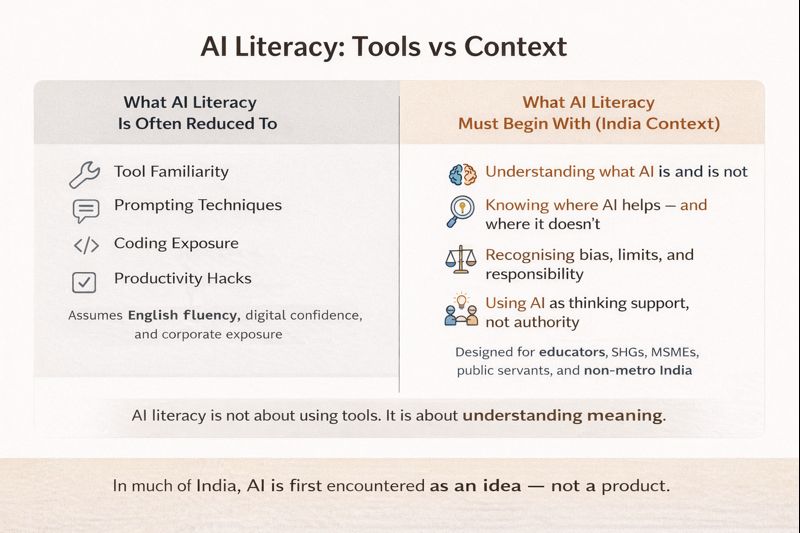
Globally, AI literacy is often reduced to:
- Tool familiarity
- Prompting techniques
- Coding exposure
- Productivity use cases
In India, this framing becomes even more distorted because it assumes:
- English fluency
- Digital confidence
- Corporate or academic environments
- Exposure to abstract concepts
For a large section of India—educators, SHG entrepreneurs, MSME owners, public servants, students in Tier 2 and Tier 3 towns—AI is not experienced as a tool. It is experienced as an idea, often loaded with fear, exaggeration, or confusion.
AI literacy, therefore, cannot begin with how to use tools.
It must begin with how to understand what AI actually is—and what it is not.
The Real Gap: Capability vs Context
India does not lack AI capability.
It lacks contextual translation.
Capability exists
- India has world-class engineers
- Strong AI research presence
- Rapid enterprise adoption
- Government-led digital public infrastructure
Initiatives such as Digital India, IndiaAI Mission, and the expansion of digital governance platforms reflect strong technological ambition and execution by the Government of India.
Context is missing
What is missing is a shared, grounded understanding of:
- Where AI meaningfully helps everyday decision-making
- Where it introduces bias or risk
- Where it should not be used at all
- Who remains accountable when AI is involved
Without this context, AI becomes either:
- Over-trusted
- Over-feared
- Or misused as a shortcut for judgment
Why Non-Metro India Experiences AI Differently
In non-metro India, AI is not encountered through product demos or research papers. It is encountered through:
- YouTube videos
- WhatsApp forwards
- Peer conversations
- Institutional instructions without explanation
This leads to three dominant perceptions:
1. AI as Magic
AI is seen as something that “knows everything” and must therefore be obeyed.
2. AI as Threat
AI is feared as a job destroyer or a surveillance tool.
3. AI as Shortcut
AI is assumed to replace thinking, effort, or responsibility.
None of these perceptions are accurate—but they are understandable in the absence of contextual education.
The Risk of Teaching AI Without Context
When AI is taught without context, several risks emerge:
- Blind trust in AI outputs
- Delegation of responsibility to systems that do not understand consequences
- Amplification of bias, especially in language, gender, caste, and economic assumptions
- Erosion of human judgment, particularly among first-time users
This is why AI literacy cannot be reduced to digital literacy or technical upskilling.
It is fundamentally a cognitive and ethical literacy challenge.
What Contextual AI Literacy Actually Looks Like
Contextual AI literacy starts with restraint.
It asks different questions:
- When should AI not be used?
- How do we verify AI outputs?
- Who remains responsible for decisions?
- How does bias enter systems trained on historical data?
- Why confidence from AI does not equal correctness?
This approach aligns closely with global responsible-AI frameworks, including those discussed by international institutions and increasingly echoed by Indian policymakers.
AI as Decision Support, Not Decision Authority
One of the most important contextual shifts India must make is this:
AI is a support system for thinking, not a replacement for judgment.
This distinction is crucial for:
- Educators guiding students
- Entrepreneurs making livelihood decisions
- Public officials interpreting information
- Citizens navigating services and schemes
AI can assist with:
- Structuring thoughts
- Exploring alternatives
- Improving clarity and communication
But it cannot:
- Understand lived consequences
- Make ethical trade-offs
- Bear responsibility
That burden always remains human.
Why Policy Narratives Often Miss This Reality
Policy discussions around AI understandably focus on:
- Infrastructure
- Regulation
- Global competitiveness
- Innovation leadership
However, without parallel investment in contextual literacy, policy intent risks being misunderstood at the ground level.
For AI to work for India—not just in India—there must be:
- Public-interest AI education
- Plain-language explanations
- Regionally grounded pedagogy
- Clear ethical boundaries
This is especially important as AI increasingly intersects with governance, education, and welfare delivery.
The Role of Independent Knowledge Platforms
This is where independent, non-commercial knowledge platforms have a unique responsibility.
They can:
- Observe without selling
- Explain without evangelising
- Critique without fear-mongering
- Translate without oversimplifying
At Webverbal, this belief underpins the Bharat Intelligence Series—an ongoing effort to study how technology interacts with India’s lived intelligence, not just its technical capacity.
📋 Action Plan: Responsible AI Adoption
Conclusion: India Does Not Need Faster AI Adoption. It Needs Better Understanding.
AI will continue to advance. Tools will improve. Access will expand.
But unless India invests in contextual understanding, AI literacy efforts will remain fragmented and uneven—benefiting a few while confusing many.
The real work ahead is not teaching India how to use AI.
It is helping India understand:
- What AI means
- Where it fits
- And where human judgment must remain non-negotiable
Because in a country as complex as India, technology alone has never been the limiting factor.
Context always has been.
FAQ: AI Literacy in India
What is AI literacy in the Indian context?
AI literacy in the Indian context refers to the ability to understand what artificial intelligence can and cannot do, how it affects everyday decisions, and how to use it responsibly within India’s social, linguistic, and economic realities. It goes beyond learning AI tools and focuses on judgment, verification, ethics, and accountability.
Why is AI literacy in India considered a context problem rather than a technology problem?
AI literacy in India is a context problem because most challenges arise from misunderstanding, overestimation, or fear of AI rather than lack of access to technology. Without cultural, linguistic, and real-world context, AI tools are often misused or blindly trusted, especially outside metropolitan and technical ecosystems.
What are the biggest misconceptions about artificial intelligence in India?
The most common misconceptions about AI in India are that it is either a magical system that knows everything, a threat that will replace all jobs, or a shortcut that removes the need for human thinking. These misconceptions stem from limited contextual education and overexposure to simplified or sensational narratives.
How does AI literacy differ from digital literacy?
Digital literacy focuses on using devices, software, and the internet, while AI literacy focuses on understanding decision-making systems, their limitations, bias, and ethical implications. AI literacy emphasises human responsibility, critical thinking, and verification rather than just technical usage.
Why is AI adoption more challenging in Tier 2 and Tier 3 cities in India?
AI adoption is more challenging in Tier 2 and Tier 3 cities because most AI education assumes English fluency, technical familiarity, and corporate exposure. In non-metro India, AI is often encountered through informal sources like social media, leading to confusion, fear, or unrealistic expectations without proper contextual guidance.
Can artificial intelligence replace human judgment in decision-making?
No, artificial intelligence cannot replace human judgment. AI systems generate responses based on patterns in data but do not understand consequences, ethics, or lived realities. Responsibility for decisions always remains with humans, especially in areas like education, governance, livelihoods, and public services.
What are the risks of teaching AI without ethical and contextual understanding?
Teaching AI without ethical and contextual understanding can lead to blind trust in AI outputs, amplification of bias, misuse of information, and erosion of human accountability. This is particularly risky in developing markets where AI is often seen as authoritative or unquestionable.
How should AI be responsibly used in everyday Indian life?
AI should be used in everyday Indian life as a support system for thinking, communication, and learning—not as a decision authority. Responsible use includes verifying outputs, understanding limitations, recognising bias, and ensuring that final decisions are made by humans.
What role should government and institutions play in AI literacy in India?
Government and institutions should focus on public-interest AI education that emphasises understanding, ethics, and responsibility rather than only skills or productivity. Clear communication, regional context, and plain-language explanations are essential to ensure AI benefits society broadly and equitably.
Why is contextual AI literacy important for India’s future?
Contextual AI literacy is important for India’s future because AI will increasingly influence education, governance, and livelihoods. Without shared understanding and ethical awareness, AI adoption may deepen inequality, increase misinformation, and reduce trust in institutions rather than empowering citizens.
How does Webverbal approach AI literacy differently?
Webverbal approaches AI literacy through a Bharat-first lens that prioritises context, dignity, and lived intelligence. Instead of promoting tools or trends, Webverbal focuses on explaining how AI interacts with real Indian realities—helping readers understand limits, risks, and responsible use.