
Table Of Content
- The $200B opportunity is not simply an online marketplace story.
- B2B e-commerce cannot simply copy the consumer checkout.
- Not every B2B category will digitise at the same speed.
- Manufacturing & MRO
- Steel, metals & building materials
- Farm-to-business supply
- Chemicals & technical products
- Four forces are making digital B2B commerce easier to build.
- Open networks could change who gets access to digital commerce.
- The next B2B platform may sell credit as much as products.
- The biggest opportunity may not be in India’s biggest cities.
- The 5 things a B2B marketplace must solve.
- What kind of B2B opportunity are you building?
- The opportunity is not simply “another B2B marketplace.”
- Five signals that could define India’s next B2B commerce cycle.
- Digital adoption will not erase the old B2B economy overnight.
- What could the next phase of B2B commerce look like?
- The real B2B opportunity
- How to read the numbers
- Keep exploring India’s changing business economy.
The opportunity is bigger than putting wholesale products online. Procurement, payments, credit, logistics and supplier discovery are all being rebuilt around digital infrastructure.
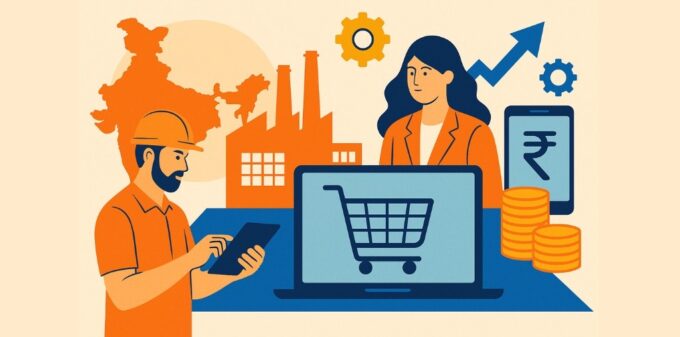
B2B e-commerce in India is moving beyond simple online marketplaces. The larger opportunity is the digitisation of the entire procurement journey — discovering suppliers, comparing products, placing bulk orders, arranging credit, managing invoices and coordinating delivery. That makes B2B commerce fundamentally different from consumer e-commerce.
Approximate digital B2B commerce market footprint used in the underlying WebVerbal analysis.
Market estimate; see methodology below.2030 opportunity estimate used in the underlying WebVerbal analysis.
Market projection; not a realised market-size figure.MSMEs referenced as a structural driver of India’s B2B digitisation opportunity.
Use current official MSME data when this figure is externally reused.The $200B opportunity is not simply an online marketplace story.
The important shift in Indian B2B commerce is not merely that businesses can buy products through websites or apps. It is that more of the transaction can become digitally visible and manageable.
Supplier discovery, price comparison, procurement records, digital payments, invoices, financing and logistics can increasingly connect to the same workflow.
Note: The bars above are a WebVerbal conceptual visualisation of the transaction journey, not market-share or penetration data.
B2B e-commerce cannot simply copy the consumer checkout.
A consumer may make a purchase in minutes. A business purchase can involve procurement teams, finance departments, technical approvals, negotiated prices, credit terms, quality checks and delivery requirements.
| Variable | B2C commerce | B2B commerce |
|---|---|---|
| Buyer | Usually an individual consumer | Business, procurement team or multiple stakeholders |
| Order | Usually smaller and standardised | Often bulk, negotiated or specification-driven |
| Price | Generally visible upfront | Can depend on quantity, relationship and credit terms |
| Payment | Mostly immediate | May involve credit, invoices or financing |
| Logistics | Parcel delivery | Bulk, freight, scheduled or specialised delivery |
| Trust | Reviews, brand and convenience | Quality, reliability, fulfilment and payment history |
Not every B2B category will digitise at the same speed.
The underlying WebVerbal analysis identifies several sectors where procurement characteristics can make digital platforms particularly useful.
Manufacturing & MRO
Standardised components, repeat procurement and large catalogues can make industrial maintenance and repair supplies suitable for digital discovery and repeat ordering.
Steel, metals & building materials
Price volatility, supplier discovery, freight coordination and quality documentation create opportunities for digital workflows.
Farm-to-business supply
Digital networks can connect agricultural production clusters with processors, institutional buyers and other commercial demand.
Chemicals & technical products
Documentation, product specifications and compliance requirements can make structured digital procurement particularly valuable.
Four forces are making digital B2B commerce easier to build.
Digital payment infrastructure reduces friction in business transactions and creates more digital transaction trails.
More formal digital records can make purchasing, accounting, reconciliation and financing easier to integrate into software.
Businesses can increasingly move from catalogue discovery to quotation, approval, ordering and repeat procurement within connected workflows.
AI can reduce manual work involved in product discovery, specification matching, RFQs, procurement communication and purchasing workflows.
Open networks could change who gets access to digital commerce.
ONDC is part of India’s wider experiment with open digital commerce. Its significance is not simply another marketplace. The larger idea is that buyers and sellers can interact through interoperable network participants rather than depending entirely on one closed platform.
For smaller businesses, the important question is whether open infrastructure can reduce the cost and complexity of becoming digitally discoverable.
The next B2B platform may sell credit as much as products.
One of the biggest structural differences between consumer and business commerce is working capital. A business can place an order today while receiving payment from its own customer weeks later.
This creates a role for trade finance, invoice financing and embedded financing alongside the marketplace itself.
The biggest opportunity may not be in India’s biggest cities.
India’s B2B economy is distributed across manufacturing clusters, wholesale markets, industrial towns, agricultural regions and thousands of small enterprises.
That creates a different opportunity from consumer internet: digitising businesses that already transact offline but have not yet moved their procurement, discovery or financing workflows online.
The 5 things a B2B marketplace must solve.
What kind of B2B opportunity are you building?
Select the problem closest to your business. This is a directional WebVerbal framework, not an investment recommendation.
The opportunity is not simply “another B2B marketplace.”
A new entrant competing only on catalogue size, discounts or GMV can become interchangeable with other platforms.
A more defensible model may solve one difficult category problem exceptionally well: procurement, quality verification, credit, logistics, compliance, inventory or a specific industrial workflow.
The strongest B2B businesses may therefore look less like traditional e-commerce companies and more like infrastructure for a particular industry.
Five signals that could define India’s next B2B commerce cycle.
Digital adoption will not erase the old B2B economy overnight.
Many Indian B2B transactions depend on relationships, credit history, personal negotiation and physical inspection. A digital interface does not automatically replace those relationships.
The realistic path may be a hybrid model where technology improves discovery and transaction efficiency while local trust, relationships and physical fulfilment continue to matter.
What could the next phase of B2B commerce look like?
This is a WebVerbal conceptual framework, not a market-size forecast.
The real B2B opportunity
India’s B2B e-commerce opportunity is not simply about moving wholesale transactions from offline to online. It is about making a fragmented business economy easier to discover, finance, transact with and coordinate.
How to read the numbers
This article combines the underlying WebVerbal market analysis with broader ecosystem observations. The figures used in the original analysis are not presented here as proprietary WebVerbal primary research.
- Existing WebVerbal B2B e-commerce market analysis forming the basis of the original article.
- Government and public digital-infrastructure sources relevant to digital payments, MSMEs and ONDC should be used when updating individual statistics.
- Market-size and CAGR figures are estimates unless supported by a clearly identified current research source.
- Conceptual visualisations in this article are labelled separately from market statistics and should not be interpreted as measured market penetration.
Editorial standard: WebVerbal distinguishes observed data, third-party estimates and its own analytical interpretation wherever possible.
Keep exploring India’s changing business economy.
WebVerbal studies the markets, consumers, founders, businesses and technologies reshaping Bharat.