Market selection
Choosing countries and customer segments requires evidence rather than assuming that every global market is equally attractive.



A WebVerbal initiative focused on helping Indian exporters, manufacturers, MSMEs and D2C businesses understand the shift from conventional export channels toward digitally enabled global commerce, combining market access, AI, localization, D2C positioning, logistics and export discipline.
This is the field-facing initiative within WebVerbal’s Initiatives portfolio concerned with the practical transition from Indian exporter to digitally enabled global seller.
The original programme narrative describes a capacity-building summit in Bhubaneswar focused on helping Odisha exporters understand cross-border e-commerce, AI-enabled global market access, platform-led commerce and D2C export economics. The source identifies FIEO, the Ministry of Commerce and the MSME Government of Odisha among the institutional ecosystem partners.
The initiative should therefore be understood as more than an article about exports. Its strategic territory is export capability: how Indian businesses can translate product capability into international digital demand while managing localization, compliance, logistics, pricing, customer experience and unit economics.
This page sits under WebVerbal Initiatives. It is deliberately distinct from WebVerbal’s broader research report on India’s cross-border e-commerce landscape, which provides the macro research context.
Global digital commerce changes the export question from “Can India manufacture this?” to “Can an Indian business reach, convert and serve the right international customer profitably?”
| Traditional export logic | Digital-first export logic | Capability required |
|---|---|---|
| Wholesale buyer | Marketplace or own D2C storefront | Digital merchandising and brand positioning |
| Product catalogue | Localized digital product experience | Content, SEO, translation and market intelligence |
| Bulk shipment | Parcel and hybrid fulfilment models | Landed-cost and logistics discipline |
| Relationship-led demand | Search, social and platform discovery | Customer and demand understanding |
| Export documentation | Documentation plus marketplace-country compliance | Compliance systems and operational accuracy |
| Price-led competition | Brand, differentiation and customer trust | D2C economics and brand-building capability |
Cross-border e-commerce is not simply “selling abroad online.” It is a business-model shift in which the exporter must understand the end customer, digital discovery, international pricing, fulfilment, returns, compliance and brand experience.
Product capability is only one part of export readiness. The initiative addresses the capability gaps between production and profitable international demand.
Choosing countries and customer segments requires evidence rather than assuming that every global market is equally attractive.
International customers need relevant language, imagery, positioning, product information and expectations — not merely an English translation.
Shipping, duties, taxes, marketplace fees, returns, payment costs and acquisition costs can change the economics of an otherwise attractive product.
Export documentation, product rules, HS classification and destination-market requirements must be treated as commercial infrastructure.
The source programme is organised around four practical capability areas. We retain them as the initiative’s core intervention model.
Understand marketplaces and D2C storefronts as routes to international consumers, rather than relying only on traditional wholesale channels.
Use generative AI as a decision-support layer for research, localization, catalogue work and international market understanding.
Reduce creative-production friction while maintaining product accuracy, brand consistency and market relevance.
Think in landed cost, fulfilment, fees, returns, pricing and contribution margin rather than headline selling price alone.
A reusable founder journey for evaluating cross-border readiness.
Identify a specific country, customer and demand problem.
Test category fit, competition, restrictions and price potential.
Calculate landed cost, fees, logistics, returns and contribution margin.
Adapt content, visual presentation, merchandising and customer experience.
Launch with disciplined compliance, fulfilment, measurement and iteration.
| Decision layer | Questions to answer | WebVerbal capability connection |
|---|---|---|
| Demand | Who buys? Why now? Which market? | Consumer Insights + Bharat Market Intelligence |
| Product | Is the product globally relevant and compliant? | Founder Decision Engine |
| Economics | Does the order remain profitable after landed costs? | Funding & Pitch Deck Playbooks + Growth Toolkit |
| Technology | Which digital and AI systems reduce execution friction? | India Stack & AI |
| Execution | Can the business repeat the process reliably? | Startup Guide + Growth Toolkit |
The four initiatives should reinforce one another without becoming duplicate pages.
The portfolio hub connecting WebVerbal’s real-world programmes, field interventions and ecosystem-building work.
Sibling initiative · AI & inclusionFocuses on practical AI access, voice-led interfaces and digital inclusion for grassroots entrepreneurs.
Sibling initiative · founder capabilityFocuses on entrepreneurial consciousness, decision quality, execution, ethics and founder development.
Sibling initiative · business capabilityConnects AI-integrated business development capability with practical digital participation for micro-entrepreneurs.
AI for Bharat addresses access to intelligence. Chetana addresses the quality of the entrepreneur. Cross-Border E-commerce Export addresses global market participation. Swayam addresses practical business capability. Together they form distinct but connected territories within WebVerbal Initiatives.
The initiative should not sit outside WebVerbal’s research architecture. It should feed and draw from it.
Macro research covering exports, imports, logistics, payments, compliance, platforms and global digital trade.
Digital infrastructureConnects digital public infrastructure, AI, commerce systems and India’s changing digital economy.
Commerce intelligenceConnects consumer demand, retail models, D2C economics and digital commerce behaviour.
Demand intelligenceUseful for understanding how consumer behaviour and trust translate into product and market decisions.
Founder intelligenceProvides the decision frameworks behind market selection, customer understanding, validation and execution.
ExecutionConnects global market entry with GTM, customer acquisition, retention, marketing and growth execution.
SignalsUseful for tracking emerging shifts in capital, consumers, founders, digital adoption and business models.
Parent intelligenceThe wider research layer that explains India’s changing markets, consumers, startups and digital infrastructure.
Once a founder has identified a viable export model, other WebVerbal opportunity and capability layers become relevant.
Connect export-oriented founders with funding, grants, accelerators, competitions and ecosystem opportunities.
ToolsPractical resources for validation, financial modelling, funding, growth, operations and founder execution.
CapitalRelevant when international expansion becomes part of a capital, market-sizing or investor-readiness strategy.
Founder guideBroader guidance for founders moving from validation into structured execution and growth.
The source page documents the Bhubaneswar programme context and identifies the export-training setting and institutional ecosystem.
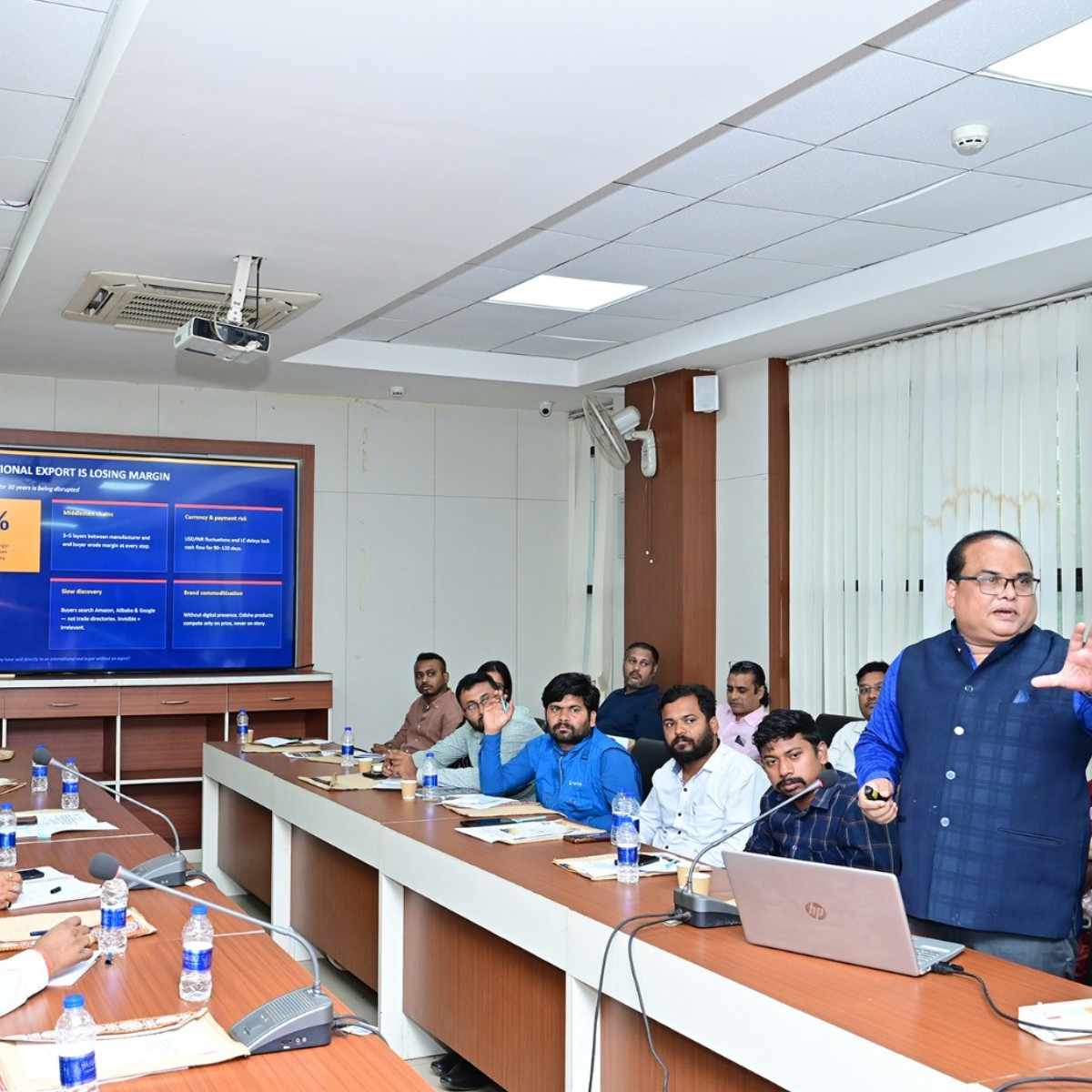
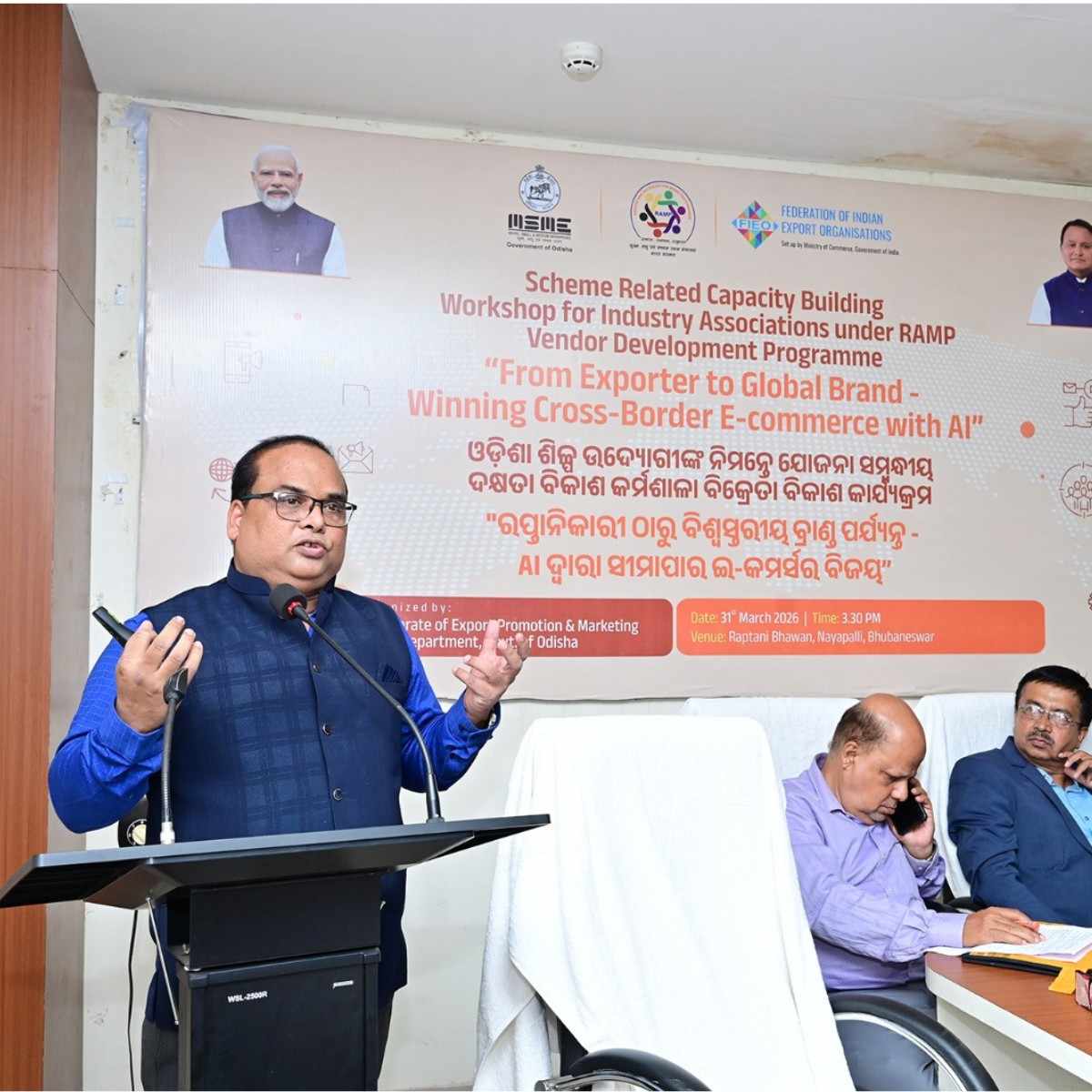
The initiative page documents the programme and its intended capability model. It should not automatically be read as proof that every participant achieved a specific export or revenue outcome. Measured participant outcomes should be added only when the programme evidence supports them.
Entity, programme and search-intent questions designed to make the initiative understandable to founders, institutions and AI systems.
The initiative is strengthened when field work and published intelligence are connected rather than treated as separate content silos.
Primary initiative source: this page preserves the original programme narrative supplied for the WebVerbal initiative.
Related WebVerbal research: Cross-Border E-commerce in India: Exports, Imports and Global Integration provides the broader market and infrastructure context. WebVerbal’s research covers exports, imports, logistics, payments, compliance and global digital trade.
Related AI research: WebVerbal’s Bharat AI Readiness Index documents the Swayam AI Business Development Programme and its AI-integrated business capability layer.
Our site uses cookies. By using this site, you agree to the Privacy Policy and Terms of Use.