Table Of Content
- Why Bharat and Tier-2 India Matter More Than Ever in 2025
- ⚡ Executive Summary
- What Is the “Bharat Economy”?
- Bharat vs Metro India: A Structural, Not Aspirational Divide
- Income Is Irregular, Not Lower
- Trust Beats Brand
- Community Over Individual Consumption
- Language Over UX
- The Rise of Tier-2 & Tier-3 Startup Ecosystems
- Why Tier-2 Startups Are Often More Sustainable
- Capital Efficiency vs Capital Access
- Sectors Dominating Bharat Innovation
- Bharat Consumers in 2025: How They Think, Trust, and Transact
- Trust Signals That Matter
- Price Sensitivity vs Value Sensitivity
- Social Proof Over Reviews
- “Jugaad UX” Often Wins
- Bharat’s Digital Infrastructure Stack: The Invisible Growth Engine
- Voice-First, Human-in-the-Loop & Trust-Based Tech Adoption
- Why Bharat Skipped the Keyboard Era
- Voice as a Trust Layer
- Human-in-the-Loop as a Business Model
- Why Fully Automated AI Struggles
- E-commerce in Bharat: Beyond Discounts and Delivery Speed
- Structural Differences
- The Role of Kiranas and Agents
- D2C vs Marketplace in Bharat
- Key Opportunities and Blind Spots for Founders Building for Bharat
- What Works
- What Repeatedly Fails
- The Cost of Misreading Bharat
- What the Bharat Economy Signals for India’s Next Decade
- Frequently Asked Questions
- What is the Bharat economy in India?
- Why are Tier-2 cities important for startups?
- How is Bharat consumer behavior different from metro India?
- Is Bharat ready for AI and digital products?
- Which sectors grow fastest in Tier-2 India?
- 📋 Founder’s Action Plan
- Editorial Note from Webverbal
Why Bharat and Tier-2 India Matter More Than Ever in 2025
For nearly two decades, India’s growth story was narrated through metro cities. Bengaluru, Mumbai, Delhi NCR, and Hyderabad became shorthand for innovation, consumption, and entrepreneurship. But by 2025, that narrative is no longer sufficient — or accurate.
⚡ Executive Summary
India’s next phase of economic expansion is shifting from saturated metros to Tier-2 and Tier-3 cities (Bharat), driven by digital public infrastructure, affordable data, and a new generation of first-time digital consumers.
- Metro Saturation: As acquisition costs rise in metros, growth depends on capturing the “Real India” market.
- Infrastructure: UPI and 5G have removed the friction that previously isolated rural economies.
- Distinct Behavior: Bharat consumers are evolving on a unique cultural trajectory, not just copying metro trends.
India’s next phase of economic expansion is not being driven by metros alone. It is being shaped by Tier-2, Tier-3, and semi-urban India, collectively referred to as Bharat. These regions are not merely “catching up” to metro India; they are evolving on different economic, cultural, and behavioral trajectories.
Several forces converge here:
- Saturation of metro demand and rising acquisition costs
- Expansion of digital public infrastructure
- Affordable smartphones and data access
- A new generation of first-time digital consumers
- Founders emerging from non-metro realities
In 2025, understanding Bharat is no longer optional. It is foundational for anyone building startups, products, or digital systems for India.
What Is the “Bharat Economy”?
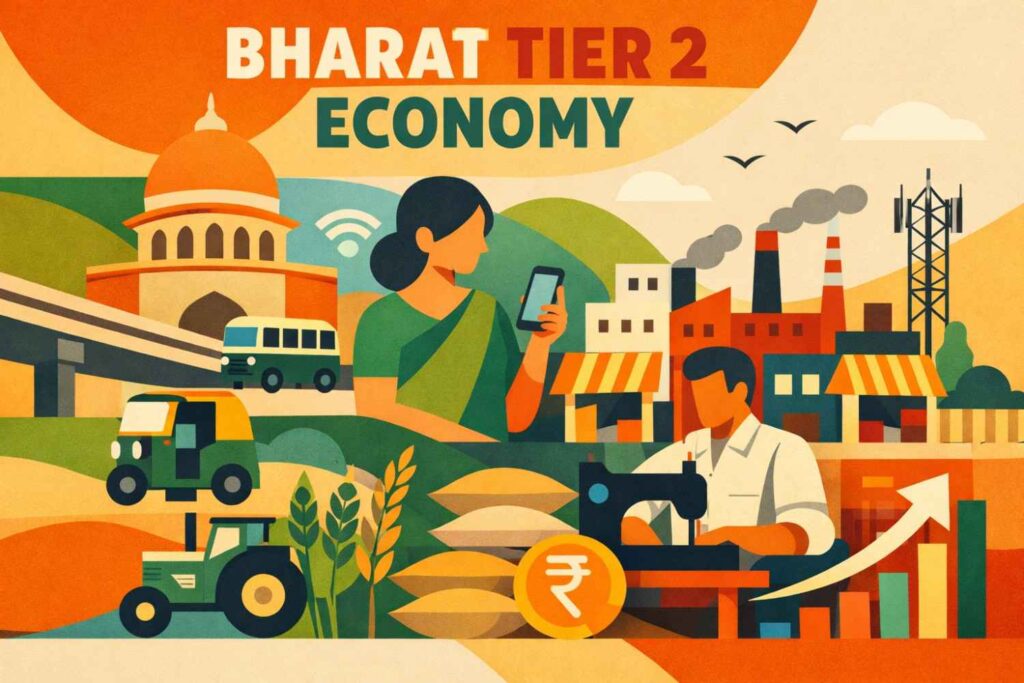
The Bharat economy refers to the non-metro economic engine of India, spanning Tier-2 cities, Tier-3 towns, semi-urban clusters, and rural regions that operate with hybrid characteristics of informality and digitization.
Unlike metro India, Bharat is defined less by income brackets and more by behavioral patterns:
- Irregular but resilient incomes
- Community-driven decision-making
- High trust in people over platforms
- Language-first engagement
- Strong offline–online interdependence
Bharat is not a demographic category. It is a contextual economy — shaped by culture, geography, access, and trust systems.
Bharat vs Metro India: A Structural, Not Aspirational Divide
The difference between Bharat and metro India is often misinterpreted as aspirational — as if Bharat is simply “behind.” In reality, the divide is structural.
Income Is Irregular, Not Lower
Bharat households may earn less annually, but their income is often diversified across agriculture, micro-businesses, seasonal work, and family enterprises. This creates cautious spending behavior, not weak purchasing power.
Trust Beats Brand
In metro India, branding and reviews influence decisions. In Bharat, visibility, familiarity, and recommendation matter more than abstract brand authority.
Community Over Individual Consumption
Purchases are often discussed within families or peer groups. This slows adoption but increases long-term loyalty once trust is established.
Language Over UX
English-first interfaces limit adoption. Local language, voice cues, and assisted journeys outperform polished but unfamiliar experiences.
These differences explain why many metro-designed startups struggle when expanding beyond Tier-1 cities.
The Rise of Tier-2 & Tier-3 Startup Ecosystems
By 2025, Tier-2 cities are no longer passive markets. They are active startup origins.
Several shifts are visible:
- Founders building for problems they personally understand
- Lower burn rates and higher capital efficiency
- Faster break-even cycles
- Stronger alignment with local demand
Why Tier-2 Startups Are Often More Sustainable
Operating in Tier-2 regions forces discipline. Marketing is less speculative, customer acquisition relies on trust networks, and operational waste is immediately visible.
Capital Efficiency vs Capital Access
While access to capital remains uneven, the startups that emerge from Bharat often compensate with execution clarity rather than scale obsession.
Sectors Dominating Bharat Innovation
- Agritech and supply-chain services
- Fintech distribution and assisted finance
- Local commerce enablement
- Edtech with hybrid or offline models
- Health access and diagnostics
These startups do not chase hypergrowth narratives. They chase relevance.
Bharat Consumers in 2025: How They Think, Trust, and Transact
Understanding Bharat consumers requires unlearning traditional consumer theory.
Trust Signals That Matter
Bharat consumers trust:
- Familiar faces
- Voice-based reassurance
- Physical presence
- Repeat visibility
Anonymous ratings or polished ads rarely outperform human validation.
Price Sensitivity vs Value Sensitivity
Bharat consumers are not cheap. They are risk-aware. They pay when value is clear, reversible, and socially validated.
Social Proof Over Reviews
A neighbor’s usage matters more than hundreds of reviews from unknown users.
“Jugaad UX” Often Wins
Assisted flows, callbacks, local agents, and simple interfaces outperform complex automation.
This explains why many global platforms fail to convert Bharat audiences despite high traffic.
Bharat’s Digital Infrastructure Stack: The Invisible Growth Engine
What makes Bharat’s growth possible is not just aspiration — it is infrastructure.
Over the last decade, India has quietly built foundational digital layers that reduce friction for non-metro users:
- Low-cost mobile internet
- Digital identity and verification systems
- Real-time payments
- Expanding logistics reach
- Interoperable commerce networks
These systems reduce dependency on private intermediaries and allow startups to scale trust-first models.
Importantly, Bharat adoption is not app-first. It is system-first. Users may not know the technology stack — but they feel its reliability.
Voice-First, Human-in-the-Loop & Trust-Based Tech Adoption
Bharat skipped several digital phases that metros went through.
Why Bharat Skipped the Keyboard Era
Typing in English was never intuitive for most users. Voice, images, and assisted navigation are more natural interfaces.
Voice as a Trust Layer
Voice creates familiarity. It reduces fear of mistakes and builds confidence among first-time users.
Human-in-the-Loop as a Business Model
Pure automation often fails in Bharat. Hybrid models — where humans assist, verify, or reassure — scale better and retain trust.
Why Fully Automated AI Struggles
Without cultural context, AI systems misinterpret intent, tone, and risk sensitivity. Human mediation remains essential.
Technology adoption in Bharat is not anti-AI. It is context-aware AI.
E-commerce in Bharat: Beyond Discounts and Delivery Speed
Bharat e-commerce is fundamentally different from metro e-commerce.
Structural Differences
- Higher reliance on cash or assisted payments
- Higher return sensitivity
- Lower tolerance for ambiguity
- Strong role of intermediaries and local sellers
The Role of Kiranas and Agents
Local retailers act as:
- Trust anchors
- Fulfillment points
- Educators
- Credit facilitators
Ignoring them often leads to failure.
D2C vs Marketplace in Bharat
D2C brands succeed when:
- They integrate local distribution
- They simplify choice
- They invest in post-purchase trust
Marketplace-led discovery still dominates early adoption.
Key Opportunities and Blind Spots for Founders Building for Bharat
What Works
- Localized onboarding
- Assisted commerce
- Transparent pricing
- Community validation
- Incremental trust-building
What Repeatedly Fails
- Copy-pasting metro playbooks
- Over-automation
- English-first experiences
- Growth-before-clarity
The Cost of Misreading Bharat
Founders often mistake slower adoption for lack of demand. In reality, it reflects deliberate decision-making.
What the Bharat Economy Signals for India’s Next Decade
Bharat is not a transitional phase. It is a parallel economic system that will increasingly shape India’s future.
Over the next decade:
- Consumption growth will outpace metros
- Startup innovation will decentralize
- Trust-based systems will outperform scale-only platforms
- Digital infrastructure will matter more than branding
India’s growth story will be incomplete without Bharat at its center.
Frequently Asked Questions
What is the Bharat economy in India?
It refers to India’s non-metro economic ecosystem shaped by local culture, trust, and hybrid digital adoption.
Why are Tier-2 cities important for startups?
They offer lower costs, deeper problem understanding, and more sustainable growth models.
How is Bharat consumer behavior different from metro India?
Bharat consumers prioritize trust, community validation, and risk reduction over convenience alone.
Is Bharat ready for AI and digital products?
Yes — when technology is contextual, assisted, and culturally aligned.
Which sectors grow fastest in Tier-2 India?
Fintech distribution, agritech, commerce enablement, health access, and vernacular education.
📋 Founder’s Action Plan
Editorial Note from Webverbal
The future of India will not be built by copying global models or extending metro assumptions.
It will be built by understanding context, trust, and ground reality.
Bharat is not behind.
It is building forward — differently.