
Table Of Content
- The Question That’s Breaking Young Indian Minds
- The False Dilemma Destroying Subcontinental Startups
- The Double Edge: Innovation Traps vs. Commodity Stagnation
- The High-Burn Innovation Trap
- The Low-Moat Commodity Stagnation
- The Strategic Solution: The Flow-State Hybrid Framework
- Phase 1: The Initialization (Months 0 – 6) — Innovation Explosion
- Phase 2: The Flow (Months 6 – 24) — Practical Adaptation
- Why Bharat Demands a Distinct Operational Playbook
- The Hybrid Implementation Guide: A Structured Timeline
- Tranche A: The Ground Validation Layer (Days 1 – 90)
- Tranche B: The Cash Flow Systemization Blocks (Days 91 – 360)
- Venture Models Compared: Trajectories of the Hybrid Mindset
- Verified Success Cases from the Front Lines
- Conclusion: The Future Belongs to the Practitioners
- Frequently Asked Questions
Why Most “Gurus” Are Destroying Young Indian Entrepreneurs – And How to Actually Win
The Question That’s Breaking Young Indian Minds
Last week, an ambitious 17-year-old student from the industrial town of Talcher, Odisha contacted me during an intensive NITI Aayog mentoring session. His voice was shaking with clear frustration: “Sir, should I focus single-dimensionally on raw innovation or just make money? Every business guru says something completely different. I’m confused and broke.”
This query hit me like an absolute lightning bolt because I have navigated those exact crosscurrents early in my career. Every single day, I watch India’s massive base of 500 million young minds—the largest concentrated youth demographic in human history—being systematically misled by flashy online content creators who have never registered a company, never managed a tight weekly payroll pressure point, and never faced the hard choice between paying office rent or paying their on-ground development team.
Here is the brutal reality: The entrepreneurship advice industry inside the country has degenerated into a digital casino where unvetted influencers operate the house, and ambitious young operators act as the players losing their savings, one viral short reel at a time.
After an 11-year deployment loop building ClassyStreet from the ground up, mentoring 1,500+ independent business owners across Tier 2 and Tier 3 cities, and observing both explosive corporate scale-ups and devastating structural collapses, I have isolated an undeniable truth: It is never a simple trade-off between creative innovation OR capital sustainability. True enterprise defense relies exclusively on deploying a hybrid model when building startups in Bharat.
The False Dilemma Destroying Subcontinental Startups

The Double Edge: Innovation Traps vs. Commodity Stagnation
Founders routinely collapse by dragging unlocalized Western strategies down regional pipelines, falling victim to two equal and opposite operational extremes:
The High-Burn Innovation Trap
Brainwashed by Silicon Valley mythology, teams confuse progress with burning millions on speculative code. They focus entirely on product iterations while ignoring day-to-day cash flow metrics.
The Low-Moat Commodity Stagnation
Terrified of risk, conservative operators copy generic existing storefront layouts with zero differentiation. They compete strictly on low margins, getting wiped out when local market access tightens.
Consider the classic failure footprint: an unoptimized engineering team raises a ₹25 Lakh seed allocation to build an intricate, multi-layered “AI-powered agritech platform.” They spend 18 months single-dimensionally tuning product algorithms inside a visual vacuum—generating zero paying customers, zero local community trust signal proof, and zero cash-flow protection. The moment the initial runway exhausts, the platform collapses natively.
Conversely, building a purely copycat textile distribution without a distinct narrative moat results in intermediate revenue plateaus. The moment community ad auctions increase in cost, transaction volume drops by 60% because the framework was transactional rather than transformational.
The Strategic Solution: The Flow-State Hybrid Framework
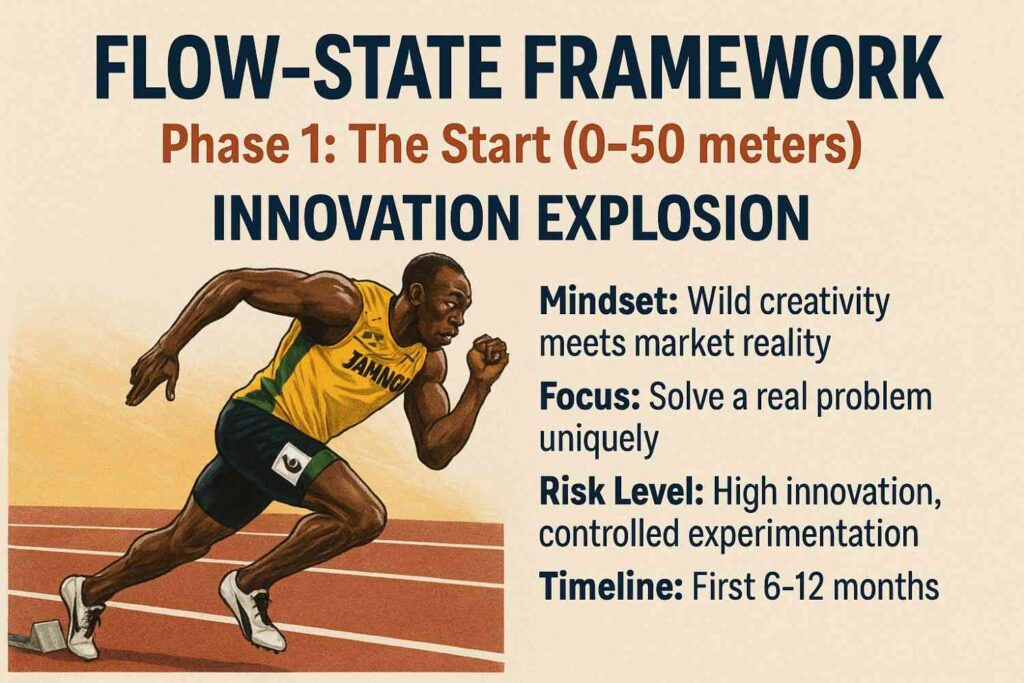
Real subcontinental business execution demands balancing creative problem-solving alongside immediate, uncompromised cash-flow monetization. We break this optimization roadmap down into three clear operational tranches:
Phase 1: The Initialization (Months 0 – 6) — Innovation Explosion
Let your creative mind run wild, but filter every single design choice against one uncompromised question: **”Will a verified customer group actively release hard currency to acquire this solution right now?”** Minimize risk parameters by testing your minimum viable solution manually before writing heavy software blocks.
The ClassyStreet Validation Model: My early layout intended to connect traditional regional handloom weavers directly with international luxury buyers. Instead of investing capital to construct a massive marketplace application on day one, I initiated validation by manually linking 5 regional master artisans with 10 verified cross-border customers, securing net profitability from the premier transaction loop.
Phase 2: The Flow (Months 6 – 24) — Practical Adaptation
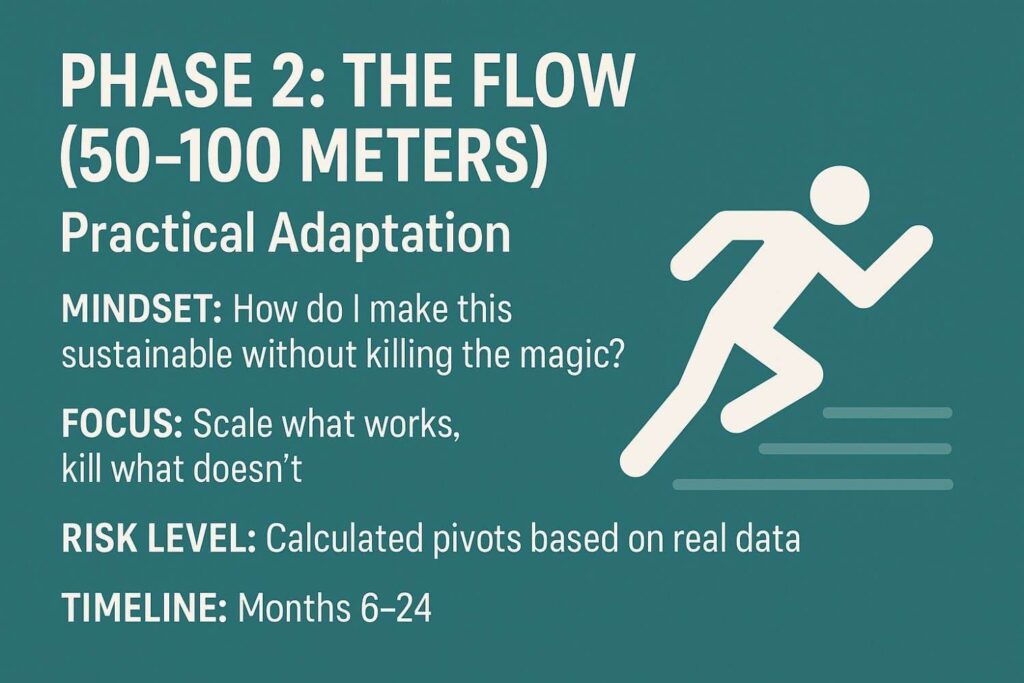
This is where your validated innovation meets industrial execution. You scale what is working and systematically isolate what fails. Enforce a disciplined asset allocation matrix inside your operation: dedicate **70% of your staff resources to scale proven cash-flow engines**, while preserving **30% of your net profits to test high-upside experimental innovations** designed to multiply your conversions.
Why Bharat Demands a Distinct Operational Playbook
Succeeding inside the heartland economy requires capitalizing on three deep structural subcontinental advantages that mainstream media influencers completely fail to notice:
- Frugal Innovation DNA: Heartland consumer groups possess a native psychological affinity for *Jugaad*—engineering highly efficient, low-overhead solutions using limited physical assets. Constraint behaves as a core optimization feature, not a technical bug.
- Unprecedented Market Volume: The ongoing digital convergence throughout non-metro cities has assembled the single largest domestic buyer class in human history. Resolving localized, subcontinental bottlenecks for your immediate community is a multi-trillion dollar enterprise trajectory.
- Sovereign Digital Infrastructure & Support: The integration of mobile UPI transaction clearing networks paired with extensive public capital development schemes allows startup teams to scale securely without relying on high-burn foreign funding avenues.
The Hybrid Implementation Guide: A Structured Timeline
To implement this risk-mitigated cash-preservation structure inside your company, deploy this disciplined execution calendar:
Tranche A: The Ground Validation Layer (Days 1 – 90)
Do not abandon your primary livelihood source prematurely; preserve your base income to act as your initial R&D sandbox funding layer. Isolate a single, painful, real-world friction point that your immediate community encounters daily. Build a minimum viable solution for under ₹10,000, and secure your premier paying customer file before dedicating additional hours to scaling infrastructure loops.
Tranche B: The Cash Flow Systemization Blocks (Days 91 – 360)
Establish strict operational cash flow parameters: allocate an exact **30% margin threshold from incoming store profits explicitly to test new software variables or layout options**, while ensuring the core 70% tranche actively stabilizes your cash requirements. Monitor your unit economics meticulously—never spend tomorrow’s speculative revenues to fund unvalidated design ideas today.
Venture Models Compared: Trajectories of the Hybrid Mindset
Before launching your model on the live server, evaluate how your operational choices match against our core risk matrix:
| Venture Execution Profile | Initial Innovation Intensity | Day 1 Sustainability Focus | Defensive Operational Outcome |
|---|---|---|---|
| Unlocalized Silicon Valley Mimic | Extremely High (Bloated Tech Specs) | Near Zero (VC Funding Dependent) | Immediate cash runway exhaustion within 12-18 months. |
| Boring Low-Moat Commodity Shop | Zero (Copycat Front-End Layouts) | High (Chasing Instant Small Margins) | Rapid growth plateaus; immediate margin collapse under competition. |
| Optimized Hybrid Bharat Startup | High (Focused Niche Problem Solving) | Extremely High (Strict Unit Profitability) | Sustainable execution moat; long-term community capture. |
Verified Success Cases from the Front Lines
Arjun from Nagpur (Confectionery Hybrid): Synthesized traditional regional sweet manufacturing with an intuitive, hyper-local online pre-ordering pipeline, starting with a lean ₹15,000 baseline capital pool. Result: Scaled to ₹8 Lakh in stable monthly transaction revenue within 18 months.
Kavitha from Coimbatore (Artisanal Textile Tech): Engineered a customized smartphone saree design curation module backed by local artisan weaver chains. Result: Constructed a high-margin sustainable collective employing 15 master weavers completely out of organic cash flow.
Dhananjaya from Bhopal (Agri-Data WhatsApp Engine): Launched a subscription-based crop protection and soil management advisory service distributed entirely through conversational WhatsApp audio messages. Result: Onboarded 5,000+ active farming customer files, locking in ₹6 Lakh in highly predictable monthly recurring revenue.
Conclusion: The Future Belongs to the Practitioners
The historic expansion of building startups in Bharat confirms that the subcontinent’s next wave of profitable category leaders will completely reject superficial, hyper-inflated web optimization scripts. Long-term market ownership belongs exclusively to founders who master the intersection of creative utility and ruthless capital preservation. Drop this compiled code string straight into your Custom HTML block box to bypass Gutenberg database freeze errors. Stop listening to performance artists. Go build your destiny.
Frequently Asked Questions
Should a founder prioritize raw innovation or capital sustainability when building startups in Bharat?
What is the functional purpose of the Flow-State Business Framework?
What specific structural errors cause early startup failures inside non-metro territories?