

Table Of Content
- Executive Summary: Navigating Wholesale Platform Selection
- E-B2B Horizon
- Generalist Volume
- Niche Specialization
- Rurban Distribution
- Understanding the Indian B2B Marketplace Landscape
- Ten Core Factors to Audit When Selecting Your B2B Partner
- 1. Target Industry & Category Product Fit
- 2. Buyer Intent Quality & Network Depth
- 3. Verification Systems and Trust Protections
- 4. Interface Simplicity & System Integration Ease
- 5. Cost Billing Configurations: Subscription vs. Commission
- The Strategic Platform Axis: Cost Models & Category Defaults Compared
- 6. Integrated Last-Mile Logistics Infrastructure
- 7. Embedded Supply Chain Credit Facilities
- 8. Dedicated Account Support & Dispute Triage
- 9. Scalability Options & International Trade Links
- 10. Ecosystem Community and Supplier Networking
- Critical Strategy Mistakes Startups Must Systematically Avoid
- The Founder’s Milestone Checklist: Pilot Lean, Then Scale
- Conclusion: Align Marketplace Architecture with Core Cash Realities
- Frequently Asked Questions
For any early-stage venture operating across the subcontinental grid, the initial 12 to 18 months focus single-dimensionally on cash baseline survival. Founders must run rapidly to test product utility, sign on high-intent repeat buyers, and expand net revenues without exhausting their initial seed runway. In this high-stakes entry timeline, selecting an optimized **B2B marketplace for startups** functions as a massive, capital-efficient distribution accelerator.
Rather than spending deep resources attempting to construct an independent sales workforce from scratch, builders now route their wholesale inventories straight through scaled commercial networks. From industrial component suppliers in Pune and textile production nodes in Surat to consumer staples wholesalers in Patna, the real economic growth engine is animating outside metro corridors. Leveraging the correct platform parameters allows emerging brands to plug directly into pre-established buyer syndicates.
Executive Summary: Navigating Wholesale Platform Selection
An institutional intelligence brief detailing the marketplace categories, variable cost models, and operational frameworks required to align your startup with the right B2B sales network:
E-B2B Horizon
The domestic digital wholesale trade sector is projected to clear a massive $125 Billion to $150 Billion capitalization footprint by 2030.
Generalist Volume
SaaS giants like IndiaMART supply wide discoverability across thousands of multi-industry clusters, operating primarily on visibility subscription fees.
Niche Specialization
Vertical platforms like Moglix (Industrial/MRO) and OfBusiness (Raw Materials) build heavy supply chain integration and embedded credit lines.
Rurban Distribution
Mobile-native platforms like Udaan re-engineer FMCG and fashion distribution down into Tier 2 and Tier 3 cities via simple chat-style interfaces.
Understanding the Indian B2B Marketplace Landscape
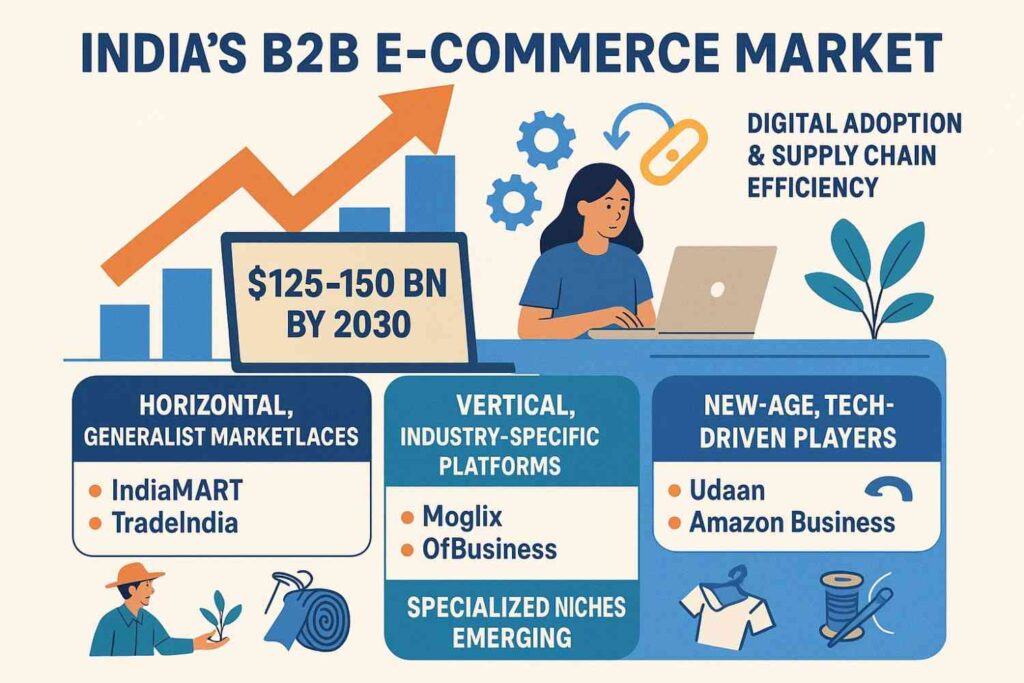
The subcontinental wholesale trade grid behaves as an entirely different machine compared to standard consumer retail channels. While consumer-facing networks focus heavily on individual impulse buying, fast home delivery parameters, and superficial marketing codes, business-to-business networks exist to resolve structural operational problems: bulk procurement safety, long-distance industrial logistics coordination, and working capital cash liquidity.
Independent sector data tracks establish that the e-B2B marketplace domain is scaling at an incredible pace, projected to pass a macro $125 Billion to $150 Billion milestone by 2030, driven by rapid technology adoption among regional small businesses.
Ten Core Factors to Audit When Selecting Your B2B Partner
1. Target Industry & Category Product Fit
Your primitive application filter must cross-examine the platform’s core vertical specialization. Startups processing industrial spares, factory consumables, or bulk manufacturing tools achieve superior margin safety on vertical platforms like Moglix or raw material registries like OfBusiness. Conversely, consumer packaged goods (FMCG) and fashion labels unlock rapid retail penetration by routing through mobile-native distribution engines like Udaan.
2. Buyer Intent Quality & Network Depth
Analyze the operational characteristics of the platform’s active buyer ecosystem. Founders must identify if a channel delivers serious, qualified business buyers or merely high volumes of casual retail browsers who drain sales resources without real transaction intent. Furthermore, look for networks that demonstrate geographic footprint depth across Tier 2, Tier 3, and deep heartland clusters where demand is expanding rapidly.
3. Verification Systems and Trust Protections
Inside the B2B landscape, a single fraudulent transaction or failed bulk shipment can destroy a startup’s early financial runway. Prioritize marketplaces that deploy rigorous buyer/seller e-KYC verification layers, transparent mutual rating indices, and secure escrow settlement networks to protect trade integrity.
4. Interface Simplicity & System Integration Ease
Complex, slow user interfaces create severe conversion drag. Evaluate the mobile application design format carefully. For example, platforms that use streamlined, messaging-style interfaces remove friction for regional small-town traders, while enterprise-focused networks must offer clean API integration points to sync with your internal ERP and inventory databases.
5. Cost Billing Configurations: Subscription vs. Commission
Wholesale networks capture transaction revenues across alternative models. Horizontal directories prioritize upfront subscription fees where you buy search visibility and raw lead generation packets. New-age platforms leverage direct transaction-based commission fees on every completed checkout. Founders must map out volume curves to ensure hidden ad costs or premium slot fees do not erode net margins.
The Strategic Platform Axis: Cost Models & Category Defaults Compared
Cross-examine how the nation’s premier B2B wholesale networks structure their billing frameworks and coordinate distribution channels:
| Wholesale Marketplace Node | Primary Pricing & Billing Model | India-Specific Operational Moat Focus |
|---|---|---|
| IndiaMART Platform | Subscription-Heavy Tiers | Maximizes raw directory visibility and wide lead generation across multi-industry SMEs. |
| TradeIndia Registry | Subscription-Heavy Slabs | Provides accessible entry cost boundaries with strong traditional links in export sectors. |
| Udaan Network | Transaction Commission-Based Slabs | Delivers high geographic distribution depth across Tier 2/3 lifestyle and grocery markets. |
| Amazon Business India | Transaction Commission Slabs | Enforces strict corporate compliance tools optimized for institutional procurement teams. |
| Moglix / OfBusiness | Hybrid Matrix + Credit Facilities | Integrates specialized heavy factory procurement logistics alongside embedded working capital lines. |
6. Integrated Last-Mile Logistics Infrastructure
Moving bulk tonnage freight across multi-state regions requires a completely different operational playbook than consumer parcel shipping. Ensure your shortlisted marketplace features verified partnerships with heavy-cargo logistics networks that can successfully process bulk warehouse drops, handle fragile industrial components, and manage complex reverse logistics loops efficiently.
7. Embedded Supply Chain Credit Facilities
Working capital liquidity operates as the lifeblood of small business trading networks. Platforms that embed structural financing solutions—such as automated invoice discounting via TReDS networks, secure Buy Now Pay Later (BNPL) credit lines, or flexible payment cycles matching harvest timelines—provide your startup with a powerful tool to lift checkout values instantly.
8. Dedicated Account Support & Dispute Triage
encountering an unresolved transaction issue or cargo delay at 2 AM can halt your production runway. Prioritize channels that assign hands-on customer account managers to your profile, ensure quick dispute resolution tracks, and offer educational training parameters to optimize listing performance.
9. Scalability Options & International Trade Links
Think beyond immediate initial transactions. Your chosen sales vehicle must support your long-term growth horizons, allowing your business to scale into advanced neighboring categories or tap into international global export trade streams seamlessly without hitting early software ceilings.
10. Ecosystem Community and Supplier Networking
Beyond digital listings, premier networks construct comprehensive corporate ecosystems. They coordinate supplier meetups, exclusive industry webinars, and regional trade conventions. For an early-stage startup, these intangible connection opportunities can completely outweigh minor commission fees.
Critical Strategy Mistakes Startups Must Systematically Avoid
Early-stage teams frequently execute incorrect platform selection loops due to four repeating operational errors:
- Chasing Cheap Subscription Fees over Serious Buyers: Opting for low-cost setups that feature zero buyer validation, leading to dead lead lists that burn sales hours.
- Chasing Lead Quantity over Conversion Intent: Flooding your database with hundreds of non-serious window shoppers instead of focusing on structured, qualified business buyers.
- Ignoring Long-Term Fulfillment Infrastructure Limits: Listing complex industrial cargo on platforms that lack specialized freight logistics networks, leading to severe transport friction.
- Neglecting Structural Payment and Escrow Escapes: Transacting outside secure escrow validation platforms, which leaves your startup vulnerable to bad trade debt leakage.
The Founder’s Milestone Checklist: Pilot Lean, Then Scale
To insulate your available capital runway and secure clear green-channel approval flags, execute this sequential platform check:
- Define the Target Buyer Segment clearly: Categorize whether your product targets deep-tier local traders, medium-sized manufacturing units, or institutional enterprise networks.
- Filter platforms by Category Specialization: Shortlist 2 to 3 networks that focus explicitly on your industry domain, matching generalist reach with vertical depth.
- Verify Live Buyer Quality metrics: Request a product demonstration or extract sample RFQ logs from the platform before paying for premium visibility tiers.
- Map Net Margin Protection Slabs: Run explicit projection calculations to ensure hidden ad costs or shipping logistics surcharges do not push your net profits into negative territory.
- Launch a Strict 60-Day Pilot: Place your initial inventory single-dimensionally on one chosen platform to evaluate transaction speeds and cash flow cycles cleanly before moving multi-platform.
Conclusion: Align Marketplace Architecture with Core Cash Realities
Choosing the right **B2B marketplace for startups** parameters remains the single most important action to unlock scalable wholesale distribution channels without burning early seed runway capital. Sustainable market share belongs exclusively to founders who evaluate platforms through structural ecosystem fit rather than superficial scale hype. Enforce clear pricing transparency, automate customer onboarding lines, and route your code files cleanly via our Custom HTML block to clear database errors natively. Go build your wholesale moat.
Frequently Asked Questions
Which is the best B2B marketplace for startups in India?
How do I evaluate whether IndiaMART or Udaan is better for my startup?
What hidden costs should founders calculate before listing on a B2B platform?