Table Of Content
- D2C Export Trends India: Harnessing Heritage for Global Markets
- Sector Opportunity Matrix
- Critical Insights: From Haat to High Street
- 1. The Ayurveda Explosion
- 2. The Handloom “Content” Moat
- 3. The Logistics Warning
- Frequently Asked Questions about D2C Exports
- Conclusion: The “Bharat” Opportunity is Global
- Citation
For decades, buying Indian Handloom or Handicrafts was often an act of charity—a “sympathy sale” to help a struggling artisan.
That era is over.
D2C Export Trends India are reshaping how we view these traditional crafts.
Today, brands like Jaypore, Suta, and Kama Ayurveda have proven that Indian craft isn’t just about heritage; it’s about luxury. The post-pandemic world is obsessed with “Clean Beauty,” “Sustainable Fashion,” and “Holistic Wellness”—trends that India has owned for 5,000 years. These movements correlate with the D2C Export Trends India.
D2C Export Trends India: Harnessing Heritage for Global Markets
But for a new founder, where is the real opportunity? Is it in selling clay pots to California, or turmeric lattes to Tokyo?
At Webverbal, we analyzed 7 key traditional sectors. We looked beyond the “culture” to the hard business metrics: Global Export Demand, Supply Chain Scalability, and Government Support (ODOP). The data shows that the next Indian unicorn might not be a SaaS company—it might be Saffron or Silk.
Here is the Artisan & D2C Market Pulse 2025.
Sector Opportunity Matrix
Analyze traditional sectors by Global Demand and Policy Support.
Critical Insights: From Haat to High Street
1. The Ayurveda Explosion
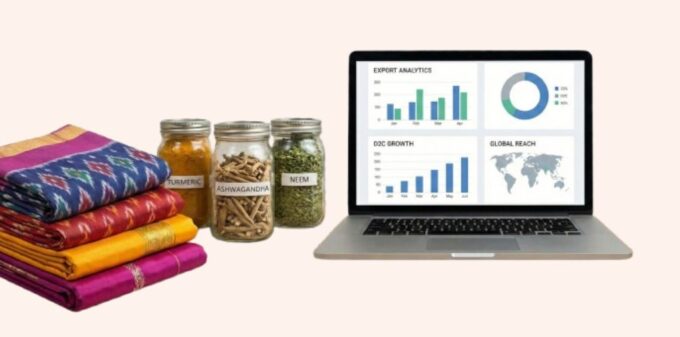
Ayurveda ranks #1 in our index (9.8 Demand Score). Why? Because the West is moving away from chemical-heavy cosmetics. For founders in Odisha or Kerala, this is the low-hanging fruit. The raw material (turmeric, neem, moringa) is in your backyard, and the customer is in New York paying $50 for a “Golden Latte.” The margin potential here is unmatched.
2. The Handloom “Content” Moat
Handloom scores highest on “Govt Support” due to aggressive ODOP (One District One Product) schemes. But its real power is Storytelling. A factory-made shirt has no story. A Sambalpuri Ikat saree takes 3 weeks to weave. In the age of Instagram Reels, that “Making Of” video is your strongest marketing asset. Handloom is natively viral content.
3. The Logistics Warning
A note of caution: While Terracotta and Pottery look beautiful, they score lowest on “Export Potential” (5.5) due to Logistics Fragility. Breakage rates during international shipping can kill your margins. If you enter this sector, your packaging innovation matters more than your product innovation.
Frequently Asked Questions about D2C Exports
Do I need an export license for small shipments?
Yes, you need an IEC (Import Export Code), which is a simple online registration. However, for small D2C orders (under ₹5 Lakhs), courier partners like DHL/FedEx often handle the customs paperwork for you.
What is the ODOP scheme?
ODOP (One District One Product) is a government initiative where specific districts are identified for specific products (e.g., Khurda for Textiles). Startups in these districts get priority subsidies, marketing support, and participation in international trade fairs.
Which platform is best for selling Indian crafts globally?
While Shopify is great for your own brand, marketplaces like Etsy and Amazon Global Selling are the best starting points because they already have millions of US/UK buyers looking for “handmade” goods.
Conclusion: The “Bharat” Opportunity is Global
The “Bharat” opportunity isn’t just about selling to small towns; it’s about selling from small towns to the world.
Your location in a Tier-2 or Tier-3 town is no longer a disadvantage—it is your sourcing advantage. You are closer to the weavers, the farmers, and the artisans than any Bangalore-based founder could ever be.
Next Step: Use this data to choose your niche, then apply for the grants listed in our Bharat Grant Tracker.
Citation
- Cite this Report: “D2C Export Trends: Artisan Market Pulse 2025.” Webverbal Originals. Available at:
webverbal.com/d2c-export-trends-india- Data Source: Export volume data from Ministry of Commerce & Industry and keyword search volume analysis.