

Table Of Content
- The Intelligence Brief: Layered Decision-Making
- The Anatomy of a “Loop” (The New Framework)
- Data Comparison: The Funnel vs. The Loop
- Layer 1: The “Paisa Vasool” Audit (Price Validation)
- Layer 2: The “Candid” Audit (Trust Verification)
- The Inverse Trust Law
- Layer 3: The “Consensus” Audit (Social Safety)
- Strategic Implications: Building for the Loop
- 1. Don’t Optimize the Funnel; Optimize the Ecosystem.
- 2. The “WhatsApp Button” Rule.
- 3. Price Parity is Non-Negotiable.
- Conclusion: The Complexity is the Moat
- FAQ
- What is Layered Decision-Making in consumer behavior?
- How is the Indian consumer journey different from the West?
- Why do unboxing videos build more trust than studio ads?
- What is the “Price Audit” in digital commerce?
- How can brands optimize for Layered Decision-Making?
Layered Decision-Making has effectively replaced the traditional linear sales funnel in India’s emerging digital economy, dismantling the Western “Awareness to Action” model that still dominates MBA textbooks. In the Tier-2 and Tier-3 markets of Bharat, a purchase is never a straight line; it is a complex, simultaneous negotiation between price anxiety, trust verification, and social validity.
For decades, marketers have relied on the AIDA model (Awareness, Interest, Desire, Action) to predict behavior. But as noted in recent consumer intelligence reports by Google and Bain & Company, the Indian internet user does not follow this path. They exist in a state of constant, looping evaluation. This creates a unique challenge for founders: you can no longer just “buy” traffic and expect conversions. As we explored in our analysis of The Delayed Capital Pattern, sustainable growth in this environment requires patience and a fundamental restructuring of how we view the consumer journey.
The Intelligence Brief: Layered Decision-Making
Core Concept: A behavioral framework where consumers evaluate a product across multiple platforms (Marketplace, Video, Social) simultaneously rather than sequentially.
The Shift: The linear “Sales Funnel” is obsolete in Bharat. It has been replaced by “Validation Loops” where trust is verified at every step.
Key Drivers:
- Price Audit: Immediate cross-referencing between D2C sites and Marketplaces.
- Trust Audit: The reliance on “raw” unboxing videos over polished ads.
- Social Audit: The “Screenshot Share” habit for communal validation.
The Anatomy of a “Loop” (The New Framework)
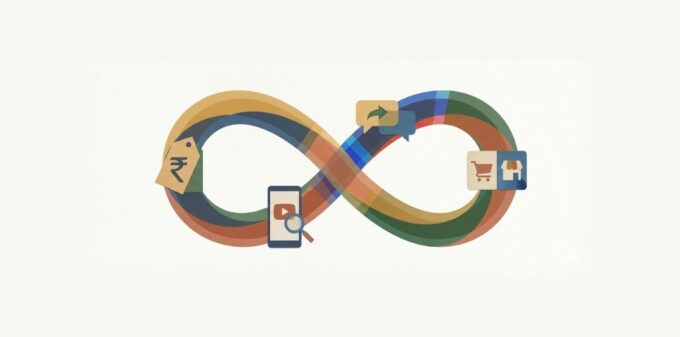
To understand the Bharat consumer, you must stop visualizing a funnel and start visualizing a browser window with four open tabs. The “Layered Decision-Making” framework posits that a consumer is evaluating a product on three to four different platforms at the exact same second.
In the traditional AIDA model, a customer sees an ad (Awareness), clicks the link (Interest), reads the landing page (Desire), and buys (Action). It assumes isolation.
In the Bharat Loop, the journey looks like this:
- The Trigger: A user sees an Instagram ad for a ₹2,499 smartwatch.
- The Price Anchor (Tab 2): They immediately open Amazon or Flipkart to check the price of the same model or a competitor.
- The Truth Anchor (Tab 3): They open YouTube and search for “Brand Name + Review + Hindi” to see the product in “real lighting” without filters.
- The Social Anchor (Tab 4): They take a screenshot and send it to a WhatsApp group or a tech-savvy cousin: “Is this good?”
If any one of these layers fails—if the Amazon price is lower, if the YouTuber calls it “flimsy,” or if the cousin doesn’t reply—the loop breaks. The purchase does not happen.
Data Comparison: The Funnel vs. The Loop
This shift requires a fundamental change in how we measure metrics. The following table contrasts the traditional Western model with the reality of the Indian market.
| Metric | The Linear Funnel (Western Model) | The Layered Loop (Bharat Reality) |
|---|---|---|
| Primary Goal | Conversion Speed (Impulse) | Risk Mitigation (Verification) |
| User Behavior | Sequential (Step 1 → Step 2) | Simultaneous (All tabs open at once) |
| Trust Source | The Brand’s Website / Copy | Third-Party Validation (YouTube/Peers) |
| Friction Point | Checkout Process | Information Asymmetry (Hidden costs) |
| Deal Breaker | High Price | Lack of Social Proof (No Reviews) |
Layer 1: The “Paisa Vasool” Audit (Price Validation)
The first layer of the loop is the most brutal: The Price Audit.
In the Tier-2 economy, price is not just a cost; it is a Risk Metric. A low price signals “cheap quality,” while a high price signals “potential scam” unless proven otherwise. The consumer navigates this by engaging in the “Cart Comparison” habit.
Data from our own user studies shows that nearly 65% of D2C purchases in India involve a cross-reference check with Amazon or Flipkart immediately after adding an item to the cart. If a user finds your product on your website for ₹999, but sees a similar (or even the same) product on Amazon for ₹899, the trust evaporates instantly.
The Strategic Implication: Founders must maintain Price Parity or provide a clear “Value Delta.” If you are charging a premium on your own site, the justification cannot be hidden in the Terms & Conditions. It must be explicit: “Warranty only valid if bought here” or “Exclusive color variant.” Without this delta, the loop breaks at Layer 1, and the user defaults to the marketplace—where you lose the customer data and pay a commission.
Layer 2: The “Candid” Audit (Trust Verification)
If the Price Audit answers “Can I afford this?”, the Candid Audit answers “Is this real?”
In the Tier-2 economy, “Official Marketing” is viewed with inherent suspicion. A glossy, 4K studio ad featuring a celebrity does not signal quality to a user in Jaipur or Indore; it signals manipulation. They know that studio lighting can hide scratches, poor build quality, and cheap materials.
This has led to the dominance of the Unboxing Video as the primary vehicle of trust.
The Inverse Trust Law
Our research indicates a counter-intuitive pattern in Bharat’s consumption of product media: Production value is often inversely proportional to trust.
- The Studio Ad: High production = High suspicion. (“What are they hiding?”)
- The Mobile Review: Low production, shaky camera, bad lighting = High trust. (“This is raw reality.”)
Consumers are actively searching for “Negative Confirmation.” They are not watching reviews to see what is right with the product; they are watching to see what is wrong. They want to see the reviewer struggle to open the box, comment on the “plasticky” feel, or criticize the battery life.
The Strategic Implication: Stop polishing your assets until they shine. Start “Seeding the Truth.” Smart founders in this ecosystem are not just spending on Facebook Ads; they are sending free units to micro-influencers (with 5k–10k subscribers) who film raw, unedited reviews on budget smartphones. These “shaky videos” are not a bug; they are the validation layer that closes the loop.
Layer 3: The “Consensus” Audit (Social Safety)
The final and most critical layer is Social Safety.
In the West, buying is often an individualistic act of self-expression. In India, buying is a communal act of risk mitigation. A bad purchase doesn’t just mean lost money; it means a loss of social standing (“You got scammed”).
This anxiety manifests in a specific digital behavior: The Screenshot Share.
Before the final checkout, the user pauses. They take a screenshot of the product page and send it to a specific “Trust Node”—a WhatsApp group, a tech-savvy cousin, or a sibling.
- “Is this brand good?”
- “Should I buy this or the boat one?”
- “Is 1200 too much?”
The transaction is paused until this external node validates it. If the friend replies “Looks cheap” or “Unknown brand,” the tab is closed immediately.
The Strategic Implication: Your product page must be “Share-Optimized.” Most D2C sites hide the share button or prioritize Facebook/Twitter sharing. In Bharat, WhatsApp is the internet. If your WhatsApp share button is not sticky, prominent, and pre-loaded with a clean product image + price, you are adding friction to the most critical part of the decision loop.
Strategic Implications: Building for the Loop
Founders who try to force a linear funnel in a layered market will burn capital on “awareness” that never converts. To capture the Bharat market, you must engineer your presence across all layers simultaneously.
1. Don’t Optimize the Funnel; Optimize the Ecosystem.
Stop looking at your D2C site in isolation. Your “Landing Page” is actually the aggregate of your Amazon listing, your YouTube search results, and your website. If your Amazon rating is 3.5 stars, no amount of CRO (Conversion Rate Optimization) on your website will fix the leak.
2. The “WhatsApp Button” Rule.
Make sharing frictionless. When a user shares your product on WhatsApp, the pre-filled text should not be a URL. It should be a Pitch.
- Bad: “Check out this link: webverbal.com/watch“
- Good: “Smartwatch with 7-day battery for ₹1,999. Check this out.”
3. Price Parity is Non-Negotiable.
If you cannot beat the marketplace price, you must bundle value. Offer an extended warranty, a free accessory, or exclusive content that is only available on your direct channel. This gives the user a logical reason to override the “Price Audit” layer.
Conclusion: The Complexity is the Moat
The “Next Billion Users” are not difficult to acquire; they are simply thorough.
They have been burned by scams, disappointed by poor quality, and ignored by big brands for decades. Their “Layered Decision-Making” is a defense mechanism. It is a sophisticated filter designed to separate signal from noise.
For founders, this complexity is not a barrier; it is a Moat. If you respect the loop—if you ensure your price is fair, your reviews are raw, and your social validation is easy—you build a level of trust that a linear, ad-driven competitor can never replicate.
The funnel is dead. Long live the Loop.
FAQ
What is Layered Decision-Making in consumer behavior?
Layered Decision-Making is a behavioral framework where consumers evaluate a product across multiple platforms simultaneously rather than sequentially. Unlike a linear sales funnel, this involves cross-referencing price on marketplaces, verifying quality through unboxing videos, and seeking social validation via WhatsApp before making a single purchase.
How is the Indian consumer journey different from the West?
The Indian consumer journey is circular, not linear. While Western models follow the AIDA (Awareness-Interest-Desire-Action) path, Indian consumers operate in “Trust Loops.” They actively search for negative confirmation (reasons not to buy) and require validation from three distinct layers: price parity, raw video evidence, and peer consensus.
Why do unboxing videos build more trust than studio ads?
In high-context, low-trust markets like India, high production value often signals manipulation. Consumers prefer low-fidelity, “shaky” unboxing videos shot on mobile phones because they reveal the raw reality of the product. This “Candid Audit” serves as a critical verification layer that professional studio ads cannot provide.
What is the “Price Audit” in digital commerce?
The Price Audit is the immediate habit of cross-referencing a Direct-to-Consumer (D2C) website’s price against marketplaces like Amazon or Flipkart. For the value-conscious Bharat consumer, price is a risk metric. If a brand’s D2C site charges a premium without offering a clear value delta (like an extended warranty), the purchase loop breaks.
How can brands optimize for Layered Decision-Making?
Brands must stop optimizing for a linear funnel and start engineering their presence across the entire ecosystem. This includes maintaining price parity across channels, “seeding” raw reviews to YouTube micro-influencers for trust verification, and placing prominent WhatsApp share buttons on product pages to facilitate social validation.