
Table Of Content
- 🚀 Strategic Key Takeaways
- 1. The Anatomy of Quick Commerce
- The Dark Store Model
- 🛠️ Semantic Power-Up: D2C Pitch Strategy
- 2. Top Quick Commerce Companies in India (2026)
- 3. The Business Model: How Do They Make Money?
- 📊 Q-Commerce Order Margin Estimator
- 📐 Strategic Reference
- 4. Challenges & The Kirana Co-existence
- ⚖️ Evaluate Your Startup’s Readiness
- 5. Future Trends: What Happens in 2026 and Beyond?
- The Final Step: Capitalizing on the Q-Commerce Boom
- Step 1: Self-Diagnose the Leaks
- Step 2: Engage Premium Advisory
- Step 3: Deploy to Vetted Investors
- ❓ Frequently Asked Questions (FAQs)
India’s retail landscape is executing a structural shift faster than any other global market. A few years ago, consumers were comfortable waiting several days for an online order. Today, millions of Indians expect groceries, medicines, mobile chargers, and personal care products to arrive within minutes. This behavioral pivot has fueled the explosive rise of quick commerce companies in India, fundamentally altering the economics of retail and logistics.
What began as a localized grocery delivery experiment has evolved into a multi-billion-dollar industry. Government frameworks like ONDC (Open Network for Digital Commerce) are simultaneously decentralizing digital trade, but the hyper-convenience layer is currently dominated by private venture-backed giants investing heavily in “dark store” infrastructure.
For D2C founders, FMCG brands, and logistics operators, adapting to this 10-minute ecosystem is no longer optional—it is mandatory for survival. However, successfully integrating into these networks requires complex margin math. If you are a founder preparing to raise capital around this ecosystem, utilizing expert Startup Pitch Deck Services is critical to accurately model your quick commerce unit economics for institutional investors.
🚀 Strategic Key Takeaways
- The Dark Store Backbone: Quick commerce relies entirely on hyper-local micro-fulfillment centers (dark stores) strategically placed within 2–4 km radii of dense consumer demand.
- Beyond Groceries: While staples built the habit, the industry’s profitability is now driven by high-margin categories like electronics, cosmetics, and D2C impulse purchases.
- Data is the Moat: Delivery speed can be replicated with capital. The true competitive advantage of these platforms lies in localized AI demand forecasting and real-time inventory precision.
1. The Anatomy of Quick Commerce
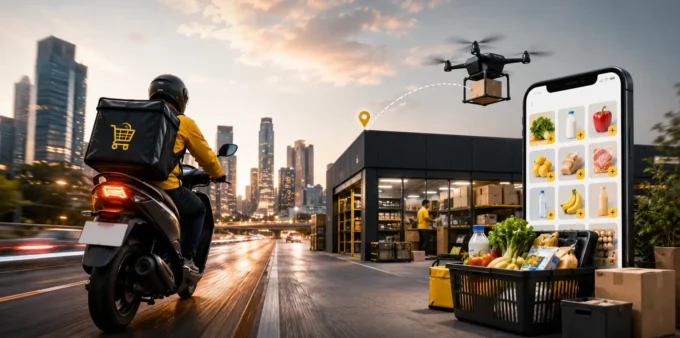
Quick Commerce (Q-Commerce) is a retail fulfillment model that enables products to be delivered within 10 to 30 minutes of order placement. Unlike traditional ecommerce (like standard Amazon or Flipkart operations), which relies on massive centralized warehouses located outside city limits, quick commerce companies operate through a decentralized grid of neighborhood nodes.
The Dark Store Model
A “dark store” is a small fulfillment center designed exclusively for processing online orders. It is closed to the public. When an order drops, the system maps the closest dark store, associates pick and pack the specific SKUs within two minutes, and route-optimization software immediately assigns an available rider for last-mile delivery.
🛠️ Semantic Power-Up: D2C Pitch Strategy
Are you a D2C brand trying to raise money to scale on these platforms? Learn exactly how to map out your channel margins and slotting fees in our dedicated guide: How to Build a D2C Quick Commerce Pitch Deck.
2. Top Quick Commerce Companies in India (2026)
The Indian quick commerce market is aggressively contested by a handful of highly capitalized platforms fighting for urban market share.
| Platform | Parent Company | Core Strengths & Focus |
|---|---|---|
| Blinkit | Zomato | The current market volume leader. Deeply integrated with Zomato’s massive user base, possessing the densest dark-store network and extremely strong FMCG partnerships. |
| Zepto | Independent | Built entirely natively for the 10-minute promise. Exceptionally strong urban consumer adoption, youth-focused branding, and highly optimized inventory turns. |
| Swiggy Instamart | Swiggy | Leverages Swiggy’s existing, massive delivery fleet infrastructure. Rapidly expanding into Tier-2 markets and dominating household essentials cross-selling. |
| Flipkart Minutes | Walmart / Flipkart | The aggressive new entrant blurring the lines. Backed by massive supply chain muscle, heavily expanding into high-AOV electronics, mobile accessories, and appliances. |
| BigBasket BB Now | Tata Group | Combines deep traditional grocery sourcing capabilities with Q-comm speed. Holds immense trust for fresh produce and agricultural staples. |
3. The Business Model: How Do They Make Money?
A common misconception is that these platforms make money primarily on delivery fees. In reality, the unit economics are far more complex, requiring multiple revenue streams to offset the brutal cost of 10-minute logistics.
- Product Retail Margins: The baseline profit from buying wholesale and selling at MRP (or slight discounts).
- Brand Advertising (Retail Media): This is the profit engine. FMCG and D2C brands pay heavy premiums for sponsored search results, banner placements, and priority visibility inside the app.
- Slotting Fees: Brands pay “rent” simply to have their SKUs stocked inside premium dark stores.
- Surge & Convenience Fees: Dynamic pricing applied during peak hours, rain, or late-night deliveries.
📊 Q-Commerce Order Margin Estimator
For Platforms and Brands: Calculate the actual net margin of a quick commerce order by deducting the core operational variables.
$Net Margin = AOV – (COGS + Commission Fee + Delivery Cost)$
Net Profit per Order:
₹0📐 Strategic Reference:
Are you a D2C founder trying to figure out if your pricing model can survive quick commerce scaling? Run your full multi-channel numbers through our comprehensive Unit Economics Simulator.
4. Challenges & The Kirana Co-existence
The ultimate question is: Will quick commerce kill the local Kirana store?
The reality is a nuanced coexistence. Kirana stores remain deeply embedded in the Indian retail fabric due to relationship-based informal credit cycles and hyper-localized trust. Quick commerce captures the “emergency” and “convenience premium” market.
However, the Q-commerce model faces intense internal challenges:
1. Capex Intensity: Opening a dark store is expensive. Scaling across Tier-2 cities requires burning massive venture capital before achieving operational density.
2. Inventory Complexity: A dark store has limited shelf space. Predicting exactly which SKUs will sell in a 3km radius tomorrow requires world-class AI, or else cash gets trapped in dead inventory.
⚖️ Evaluate Your Startup’s Readiness
Are you building a logistics or D2C business in this space? Test if your foundational operations can survive institutional scrutiny by utilizing the Startup Readiness Test.
5. Future Trends: What Happens in 2026 and Beyond?
The industry is rapidly shifting from the “growth at all costs” era to the “path to profitability” era.
- Expansion Beyond Groceries: Margins on tomatoes are terrible. Margins on a ₹1,500 trimmer or premium cosmetics are excellent. Expect all platforms to heavily prioritize electronics, beauty, and fashion accessories.
- Tier-2 Penetration: Growth in Tier-1 metros will eventually plateau. The next battleground will be cities like Jaipur, Coimbatore, Bhubaneswar, and Indore, requiring platforms to map new localized Total Addressable Markets (TAM).
- Private Labels: To increase profitability, platforms will aggressively launch their own “in-house” brands for basic staples, directly competing with FMCG suppliers.
The Final Step: Capitalizing on the Q-Commerce Boom
If you are building a consumer brand or an ancillary logistics tech startup to serve this booming ecosystem, raising institutional capital requires a flawless narrative. You must prove to VCs that you understand this specific margin stack.
Step 1: Self-Diagnose the Leaks
Before you pitch your D2C or logistics startup to investors, run your existing presentation through our Pitch Deck Audit Tool to ensure your unit economics align with current Q-commerce realities.
Step 2: Engage Premium Advisory
Stop guessing what investors want to see. Partner with our expert advisory team via Webverbal Pitch Deck Services to build an institutional-grade financial narrative that justifies your venture valuation.
Step 3: Deploy to Vetted Investors
Once your compliant, defensible pitch deck is finalized, we seamlessly onboard you to the Mybrandpitch ecosystem, matching you directly with active institutional funds investing in the Indian consumer space.
❓ Frequently Asked Questions (FAQs)
What is the difference between quick commerce and traditional ecommerce?
Quick commerce focuses on the rapid delivery (10-30 minutes) of high-demand, high-frequency items using hyperlocal dark stores. Traditional ecommerce utilizes massive centralized warehouses for a wider catalog, resulting in 1-7 day delivery times.
Which are the leading quick commerce companies in India?
As of 2026, the market is aggressively dominated by Blinkit (Zomato), Zepto, Swiggy Instamart, BigBasket BB Now (Tata Group), Flipkart Minutes, and Amazon Now.
How do quick commerce platforms actually make a profit?
While they charge delivery and convenience fees, the bulk of their profit margin comes from retail media (brands paying for advertising and search visibility within the app) and dark store slotting fees.
Are quick commerce platforms replacing local kirana stores?
Not entirely. While quick commerce captures the convenience and emergency-purchase market, kirana stores remain deeply embedded in the ecosystem due to localized trust, credit cycles, and community relationships. Consumers use both channels for different needs.