

Table Of Content
- Executive Summary: Startup Financial Projections Explained
- What Are Startup Financial Projections?
- The Four Core Components of Startup Financial Projections
- Revenue Forecast
- Expense Forecast
- Cash Flow Forecast
- Profit and Loss Projection
- My Observation After Reviewing Founder Pitch Decks
- Why Investors Care About Financial Projections More Than Most Founders Realize
- Investors Are Evaluating Assumptions, Not Numbers
- Financial Projections Reveal Founder Thinking
- Investors Use Financial Projections to Assess Risk
- Cash Flow Often Matters More Than Profitability
- The Investor Question Behind Every Projection
- My Observation From Founder Fundraising Conversations
- The Four Financial Projections Every Startup Needs
- 1. Revenue Forecast: How Money Enters the Business
- Investor Perspective
- 2. Expense Forecast: The Cost of Building Growth
- Investor Perspective
- 3. Cash Flow Forecast: The Startup Survival Metric
- Investor Perspective
- 4. Profit and Loss Projection: The Path to Sustainability
- Investor Perspective
- How These Four Projections Work Together
- My Observation After Reviewing Founder Financial Models
- A Simple Financial Projection Example for an Indian Startup
- Example Startup
- Year 1: Market Validation Phase
- Revenue Projection
- Expense Projection
- Profit & Loss
- Investor Observation
- Year 2: Growth Phase
- Revenue Projection
- Expense Projection
- Profit & Loss
- Investor Observation
- Year 3: Expansion Phase
- Revenue Projection
- Expense Projection
- Profit & Loss
- Three-Year Projection Summary
- What Investors Are Actually Evaluating
- A Better Way to Think About Financial Projections
- My Observation From Founder Pitch Reviews
- The 7 Financial Projection Mistakes Investors Immediately Notice
- Mistake #1: Starting With a Revenue Target Instead of Customer Assumptions
- Investor Perspective
- Mistake #2: Assuming Unrealistic Growth Rates
- Investor Perspective
- Mistake #3: Ignoring Customer Acquisition Costs
- Investor Perspective
- Mistake #4: Underestimating Operating Expenses
- Investor Perspective
- Mistake #5: Ignoring Cash Flow
- Investor Perspective
- Mistake #6: Building Projections Without Market Validation
- Investor Perspective
- Mistake #7: Treating Financial Projections as a Fundraising Exercise
- A Quick Founder Self-Audit
- My Observation From Founder Fundraising Conversations
- Bharat Reality: Why Startup Forecasts Often Fail in India
- Adoption Often Takes Longer Than Expected
- MSME Payment Cycles Can Disrupt Cash Flow
- Distribution Costs Are Frequently Underestimated
- Regional Markets Behave Differently
- Bharat Founders Have a Unique Advantage
- My Observation From Working With Bharat Entrepreneurs
- Financial Projections in Your Startup Pitch Deck
- What Investors Want to See
- Final Thoughts: Great Financial Projections Are Assumptions Made Visible
- FAQ
- What are startup financial projections?
- How far into the future should startup financial projections go?
- What do investors look for in startup financial projections?
- How do founders estimate startup revenue projections?
- What financial statements should be included in a startup pitch deck?
- How accurate should startup financial projections be?
One of the quickest ways to lose investor confidence is to present ambitious revenue numbers without explaining where those numbers come from.
A founder walks into a fundraising meeting and confidently declares:
“We expect to generate ₹5 crore in revenue next year.”
The investor nods and asks a simple question:
“How did you calculate that?”
The founder pauses.
What sounded impressive a moment ago suddenly becomes difficult to defend.
This scenario plays out more often than most entrepreneurs realize.
Many first-time founders spend months refining products, building pitch decks, and preparing investor presentations. Yet when discussions shift toward startup financial projections, confidence often gives way to assumptions.
If you have already read our guide on Startup TAM SAM SOM: How Investors Evaluate Markets, you may have noticed a recurring theme throughout fundraising conversations. Investors are rarely evaluating numbers in isolation. They are evaluating the thinking behind those numbers.
The same principle applies to startup financial projections.
Most founders believe financial projections are about predicting the future.
Investors view them differently.
To investors, financial projections are a window into how founders think about growth, customer acquisition, pricing, operating costs, cash flow, and business sustainability.
This is why startup financial projections remain one of the most scrutinized sections of any investor pitch deck.
Founders preparing for fundraising often spend significant time perfecting slide design while spending very little time validating the assumptions behind their revenue forecasts. In reality, investors are usually far more interested in the assumptions than the spreadsheet itself.
If you are preparing for investor meetings, building a fundraising strategy, or refining your financial model, our Startup Pitch Deck Services can help structure investor-ready financial narratives, projections, and growth assumptions that stand up to investor scrutiny.
For additional guidance on financial planning and business forecasting, founders can also explore resources published by Startup India Portal, which offers practical frameworks for budgeting, forecasting, and business planning.
Over the years, one pattern has consistently stood out to me while reviewing founder presentations and fundraising discussions.
The founders who attract the strongest investor interest are rarely the ones presenting the most aggressive financial forecasts.
They are usually the founders who can clearly explain:
• Where revenue will come from
• How customers will be acquired
• What growth assumptions are being made
• Which costs will increase as the business scales
• How long the company can survive before needing additional capital
In other words, investors are not looking for perfect predictions.
They are looking for credible assumptions.
Understanding that distinction can dramatically improve the quality of your fundraising conversations.
In this guide, we will break down startup financial projections from a founder’s perspective, explore how investors evaluate financial forecasts, examine common mistakes that weaken investor confidence, and discuss how first-time founders can build financial projections that are both realistic and compelling.
Executive Summary: Startup Financial Projections Explained
If you only remember five things from this article, remember these:
• Startup financial projections are not predictions. They are assumptions about how a business could grow under specific conditions.
• Investors rarely expect projections to be perfectly accurate. They want to understand the logic behind revenue, expenses, customer acquisition, and growth assumptions.
• Every startup financial model should include four core elements: revenue projections, expense projections, cash flow projections, and profit and loss forecasts.
• Cash flow is often more important than profitability during the early stages of a startup because it determines how long the business can survive before raising additional capital.
• Realistic assumptions build more investor confidence than aggressive forecasts that lack supporting evidence.
The strongest financial projections are not built by asking:
“How much revenue do we want to achieve?”
They are built by asking:
“How many customers can we realistically acquire, how much will they pay, and what will it cost to serve them?”
That distinction is what separates investor-ready financial projections from optimistic guesswork.
Throughout this guide, we will explore how investors evaluate startup financial projections, examine common forecasting mistakes, walk through a practical Indian startup example, and discuss how founders can build financial models that strengthen fundraising conversations.
What Are Startup Financial Projections?
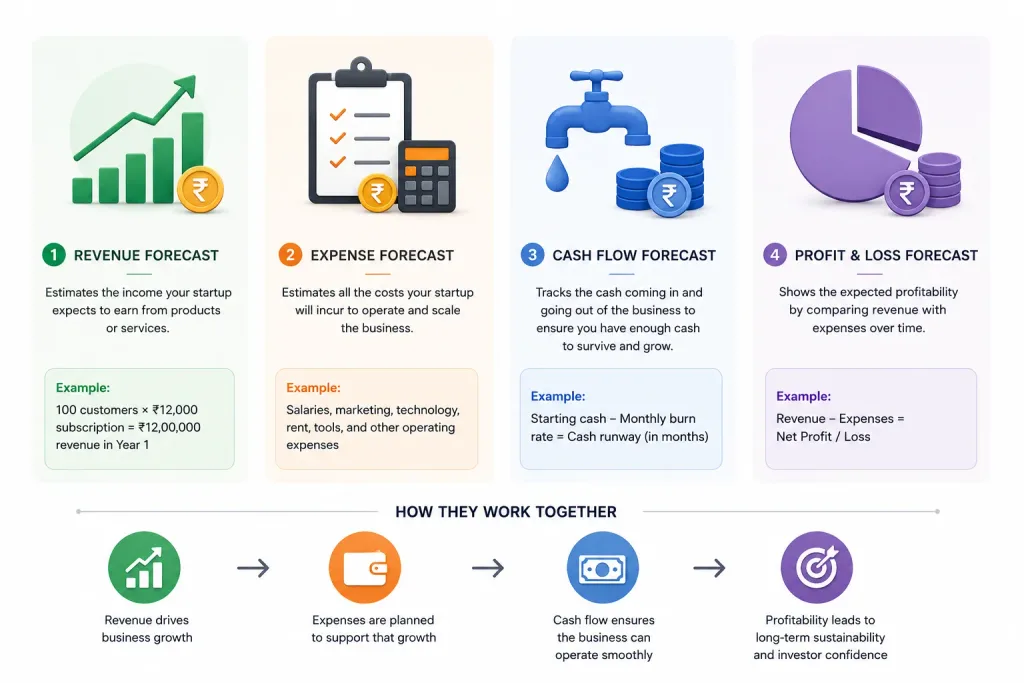
At their core, startup financial projections are estimates of how a business is expected to perform financially over a future period.
These projections help founders answer some of the most important questions in business:
• How much revenue can the startup generate?
• What expenses will the company incur?
• How much cash will be required to operate?
• When can the business become profitable?
• How much funding may be needed in the future?
While financial projections are often associated with fundraising, they are equally important for strategic decision-making. They help founders evaluate growth opportunities, hiring plans, marketing investments, and operational risks before committing resources.
Contrary to popular belief, startup financial projections are not about predicting the future with precision.
No investor expects a startup’s three-year forecast to be perfectly accurate.
Markets change.
Customer behavior evolves.
Competition emerges.
Economic conditions shift.
What investors expect is a thoughtful framework that demonstrates how the founder thinks about growth and resource allocation.
The Four Core Components of Startup Financial Projections
Every startup financial model typically includes four key elements.
| Financial Projection | What It Measures | Why It Matters |
|---|---|---|
| Revenue Forecast | Expected sales and income | Indicates growth potential |
| Expense Forecast | Expected operating costs | Shows cost management and scalability |
| Cash Flow Forecast | Cash entering and leaving the business | Determines business survival |
| Profit & Loss Projection | Expected profitability | Helps evaluate long-term sustainability |
Each of these projections answers a different investor question.
Revenue Forecast
A revenue forecast estimates how much money the startup expects to generate from customers.
Revenue projections are usually based on:
• Number of customers
• Pricing model
• Customer growth assumptions
• Sales conversion rates
• Market expansion plans
For example, if a SaaS startup expects to acquire 100 paying customers at ₹12,000 annually, projected revenue would be ₹12 lakh for the year.
Simple.
But investors will immediately ask:
“Why do you believe you can acquire 100 customers?”
This is why assumptions matter as much as the numbers themselves.
Expense Forecast
Growth always comes with costs.
Expense projections estimate the resources required to operate and scale the business.
Common startup expenses include:
• Salaries and team costs
• Marketing and advertising
• Software subscriptions
• Technology infrastructure
• Office and operational expenses
• Customer support
Many founders underestimate expenses while overestimating revenue.
Investors see this mistake frequently.
A realistic expense forecast often increases credibility more than an ambitious revenue forecast.
Cash Flow Forecast
Cash flow measures the movement of money in and out of the business.
This is often the most important financial projection for early-stage startups.
A company can be profitable on paper and still run out of cash.
That is why investors closely examine cash flow forecasts.
Questions they often ask include:
• How much cash is available today?
• How quickly is the startup spending money?
• When will additional funding be required?
• How long is the runway?
In many cases, cash flow determines survival.
Profit and Loss Projection
A Profit and Loss (P&L) projection combines revenue and expenses to estimate profitability.
This forecast helps founders and investors understand:
• Gross margins
• Operating margins
• Break-even timelines
• Long-term sustainability
While profitability may not be the immediate goal for every startup, investors still want to understand the path toward sustainable economics.
My Observation After Reviewing Founder Pitch Decks
One pattern consistently appears in early-stage fundraising conversations.
Founders often treat financial projections as an accounting exercise.
Investors treat them as a strategic thinking exercise.
The spreadsheet itself is rarely the most important part.
What matters is whether the founder can confidently explain the assumptions behind every major number.
Because ultimately, startup financial projections are not about forecasting the future.
They are about demonstrating that the founder understands the business well enough to plan for it.
Why Investors Care About Financial Projections More Than Most Founders Realize
Imagine two founders presenting their startups to the same investor.
Founder A says:
“We expect revenue to reach ₹10 crore within three years.”
Founder B says:
“We expect revenue to reach ₹10 crore within three years based on acquiring 5,000 customers, an average annual contract value of ₹20,000, a customer retention rate of 85%, and a sales conversion rate of 4%.”
Both founders are projecting the same revenue.
Yet one appears significantly more credible.
Most investors would rather fund Founder B.
Not because the forecast is larger.
But because the reasoning is stronger.
This distinction lies at the heart of how investors evaluate startup financial projections.
Contrary to what many first-time founders believe, investors are rarely focused on whether your projections turn out to be perfectly accurate.
They know they won’t be.
Every startup operates in an environment filled with uncertainty.
Markets evolve.
Customers behave unpredictably.
Competitors emerge.
Technology changes.
Economic conditions shift.
Investors understand all of this.
What they are trying to evaluate is whether the founder understands the business well enough to navigate that uncertainty.
Investors Are Evaluating Assumptions, Not Numbers
One of the most important lessons founders learn during fundraising is that investors do not actually invest in spreadsheets.
They invest in the assumptions behind those spreadsheets.
When reviewing financial projections, investors often ask questions such as:
• How were customer acquisition targets determined?
• What pricing assumptions support revenue growth?
• What marketing budget is required to acquire customers?
• How quickly can the business scale operations?
• What happens if growth slows down?
• When will additional capital be required?
These questions are rarely about accounting.
They are about business understanding.
A strong financial projection tells investors:
“This founder understands how the business works.”
Financial Projections Reveal Founder Thinking
Every financial model tells a story.
The question is whether that story feels believable.
For example:
A founder projects revenue growth from ₹10 lakh to ₹5 crore in two years.
An investor immediately asks:
“What changed?”
If the founder cannot explain the drivers behind the growth, confidence begins to decline.
However, if the founder can connect growth to:
• Customer acquisition plans
• New market expansion
• Product launches
• Strategic partnerships
• Improved retention
the projection becomes much more credible.
Investors understand that growth is rarely accidental.
It is usually the result of specific strategic decisions.
Investors Use Financial Projections to Assess Risk
Every investment involves risk.
Financial projections help investors understand the nature of that risk.
Some of the questions investors seek to answer include:
• How much capital will the company consume?
• How long will current funding last?
• What milestones can be achieved before the next funding round?
• What are the biggest financial risks facing the business?
• How sensitive are projections to changes in assumptions?
The stronger the financial model, the easier it becomes for investors to evaluate these risks.
This is why detailed assumptions often matter more than optimistic outcomes.
Cash Flow Often Matters More Than Profitability
Many founders focus heavily on projected profits.
Investors frequently focus on cash flow.
Why?
Because startups do not fail when they become unprofitable.
Startups usually fail when they run out of cash.
A startup may show strong future profitability projections while still requiring significant capital to reach that point.
This is especially common in:
• SaaS startups
• Marketplace businesses
• Consumer internet startups
• Deep-tech ventures
• Manufacturing businesses
Investors therefore pay close attention to:
• Monthly burn rate
• Cash runway
• Funding requirements
• Working capital needs
Understanding these metrics demonstrates financial maturity.
The Investor Question Behind Every Projection
Although investors review revenue, expenses, and profitability forecasts, many are ultimately asking a single question:
“Can this founder build a scalable business?”
Financial projections help answer that question.
They reveal:
• Business model strength
• Revenue potential
• Cost structure
• Growth economics
• Funding requirements
• Long-term sustainability
This is why financial projections often influence valuation discussions, fundraising decisions, and investor confidence.
My Observation From Founder Fundraising Conversations
One pattern repeatedly stands out.
Founders often assume investors want aggressive forecasts.
In reality, experienced investors are usually more impressed by realistic assumptions than ambitious numbers.
A founder projecting ₹1 crore in revenue with strong logic often appears more investable than a founder projecting ₹20 crore without evidence.
Investors understand that projections will change.
What they want to see is disciplined thinking.
Because ultimately, financial projections are not a test of forecasting ability.
They are a test of business understanding.
And the founders who understand their businesses most deeply are often the founders who earn the greatest investor confidence.
The Four Financial Projections Every Startup Needs
Many first-time founders assume that startup financial projections are simply revenue forecasts.
In reality, investors expect a much broader view of the business.
A startup may show impressive revenue growth and still fail because of poor cash management, uncontrolled expenses, or unrealistic profitability assumptions.
This is why investor-ready financial projections typically include four interconnected components:
- Revenue Forecast
- Expense Forecast
- Cash Flow Forecast
- Profit and Loss Projection
Together, these projections help founders understand how a business grows, scales, and survives.
1. Revenue Forecast: How Money Enters the Business
Revenue projections estimate how much income the startup expects to generate over a specific period.
This is often the first number investors look at.
However, experienced investors rarely focus on the revenue figure itself.
Instead, they ask:
“Where will this revenue come from?”
A strong revenue forecast is usually built from:
• Customer acquisition assumptions
• Pricing strategy
• Product or service demand
• Retention rates
• Expansion opportunities
For example, imagine a SaaS startup selling software subscriptions to MSMEs.
Assumptions:
• 100 customers in Year 1
• Annual subscription fee: ₹12,000
Projected Revenue:
100 × ₹12,000
= ₹12 lakh
This calculation is simple.
What matters is whether the founder can justify acquiring those 100 customers.
Investor Perspective
Revenue projections become far more credible when they are linked to customer acquisition logic rather than arbitrary growth targets.
2. Expense Forecast: The Cost of Building Growth
Every rupee of revenue requires resources.
Expense projections estimate how much the startup will spend while operating and scaling.
Common startup expenses include:
• Salaries and team costs
• Marketing and customer acquisition
• Software subscriptions
• Cloud infrastructure
• Professional services
• Office and operational expenses
Many founders unintentionally underestimate expenses during fundraising.
This creates unrealistic profitability forecasts.
Investors often stress-test expense assumptions because costs tend to increase as businesses grow.
For example:
A founder projects revenue growth from ₹20 lakh to ₹2 crore.
An investor may ask:
“How many additional employees will be required to support that growth?”
This is why expenses must scale logically alongside revenue.
Investor Perspective
Aggressive revenue forecasts paired with flat expenses often raise immediate concerns.
Growth usually requires investment.
3. Cash Flow Forecast: The Startup Survival Metric
Of all financial projections, cash flow is often the most important for early-stage startups.
Revenue measures sales.
Profit measures earnings.
Cash flow measures survival.
A startup can generate revenue and still run out of money.
This happens more often than founders realize.
Cash flow forecasts track:
• Cash entering the business
• Cash leaving the business
• Available operating capital
• Future funding requirements
Investors closely examine:
• Monthly burn rate
• Cash runway
• Funding milestones
• Working capital needs
Consider two startups:
Startup A:
Profitable on paper but waiting 120 days for customer payments.
Startup B:
Less profitable but receives payments immediately.
Startup B may actually be financially healthier.
This is why investors pay close attention to cash flow forecasts.
Investor Perspective
Cash flow reveals how long a startup can survive before needing additional capital.
4. Profit and Loss Projection: The Path to Sustainability
Profit and Loss (P&L) projections combine revenue and expenses to estimate profitability.
A P&L forecast typically shows:
• Revenue
• Cost of Goods Sold (COGS)
• Gross Profit
• Operating Expenses
• Net Profit or Loss
Investors use P&L forecasts to evaluate:
• Business economics
• Gross margins
• Scalability
• Long-term sustainability
A startup may not be profitable during its early years.
Investors generally understand this.
What they want to see is a realistic path toward sustainable economics.
For example:
Year 1:
Revenue: ₹12 lakh
Expenses: ₹24 lakh
Net Loss: ₹12 lakh
Year 3:
Revenue: ₹1.2 crore
Expenses: ₹90 lakh
Net Profit: ₹30 lakh
This progression tells a story about business maturity.
Investor Perspective
Profitability matters less than understanding when and how profitability can be achieved.
How These Four Projections Work Together
One of the biggest mistakes founders make is viewing these forecasts independently.
In reality, they are interconnected.
Revenue growth influences expenses.
Expenses influence profitability.
Profitability influences cash flow.
Cash flow influences fundraising requirements.
This relationship is why investors evaluate financial projections as a system rather than a collection of spreadsheets.
| Financial Projection | Primary Purpose | Investor Question |
|---|---|---|
| Revenue Forecast | Estimate sales growth | Can the business generate demand? |
| Expense Forecast | Estimate operating costs | Can growth be supported efficiently? |
| Cash Flow Forecast | Measure liquidity | Can the company survive? |
| Profit & Loss Projection | Measure sustainability | Can the company become economically viable? |
My Observation After Reviewing Founder Financial Models
One pattern consistently appears in early-stage startups.
Founders spend most of their energy building revenue forecasts.
Investors spend most of their energy evaluating everything around the revenue forecast.
Customer acquisition costs.
Hiring assumptions.
Cash requirements.
Margins.
Retention.
Burn rate.
These factors often determine whether a projection feels credible.
The strongest financial models are rarely the ones with the largest numbers.
They are usually the ones where every number has a clear explanation behind it.
Because ultimately, investors are not looking for optimistic spreadsheets.
They are looking for evidence that the founder understands the financial mechanics of the business they are building.
A Simple Financial Projection Example for an Indian Startup
By this point, the concepts behind startup financial projections may seem straightforward.
However, many founders struggle when they sit down to build their first financial model.
The reason is simple.
Most articles explain financial projections theoretically.
Investors evaluate them practically.
To bridge that gap, let’s walk through a simplified example of how a first-time founder might build financial projections for an Indian SaaS startup.
Example Startup
Imagine a startup offering inventory management software to small manufacturing businesses and MSMEs across India.
The company charges:
₹12,000 per customer annually
The founders believe they can acquire customers through:
• Direct outreach
• Industry associations
• Referral partnerships
• Digital marketing
Now let’s build a simple three-year financial forecast.
Year 1: Market Validation Phase
The startup focuses on acquiring its first 100 customers.
Revenue Projection
100 Customers
× ₹12,000 Annual Subscription
= ₹12 Lakh Revenue
Expense Projection
Founder Salaries: ₹3 Lakh
Technology Infrastructure: ₹2 Lakh
Marketing: ₹3 Lakh
Operations & Administration: ₹2 Lakh
Miscellaneous Costs: ₹2 Lakh
Total Expenses:
₹12 Lakh
Profit & Loss
Revenue:
₹12 Lakh
Expenses:
₹12 Lakh
Net Profit:
₹0
The company reaches operational break-even but generates limited surplus cash.
Investor Observation
At this stage, investors are less concerned about profitability and more interested in validating customer demand.
Questions they may ask include:
• How were the first 100 customers acquired?
• What is the customer acquisition cost?
• What is the retention rate?
• Are customers actively using the product?
These questions often matter more than revenue itself.
Year 2: Growth Phase
With product validation achieved, the startup begins scaling.
Assumption:
400 Customers
Revenue Projection
400 × ₹12,000
= ₹48 Lakh Revenue
Expense Projection
Additional Team Members: ₹12 Lakh
Marketing & Sales: ₹10 Lakh
Technology Costs: ₹5 Lakh
Operations: ₹5 Lakh
Administrative Costs: ₹3 Lakh
Total Expenses:
₹35 Lakh
Profit & Loss
Revenue:
₹48 Lakh
Expenses:
₹35 Lakh
Net Profit:
₹13 Lakh
At this stage, investors begin evaluating scalability.
The business is showing evidence that growth can occur without costs increasing at the same rate as revenue.
Investor Observation
This is often where investors examine:
• Customer retention
• Revenue per customer
• Sales efficiency
• Gross margins
• Market expansion potential
They are trying to determine whether growth can continue beyond the initial customer base.
Year 3: Expansion Phase
The startup expands into multiple regions and increases sales capacity.
Assumption:
1,000 Customers
Revenue Projection
1,000 × ₹12,000
= ₹1.2 Crore Revenue
Expense Projection
Expanded Team: ₹30 Lakh
Marketing & Growth: ₹20 Lakh
Technology Infrastructure: ₹10 Lakh
Operations & Support: ₹10 Lakh
Administrative Costs: ₹5 Lakh
Total Expenses:
₹75 Lakh
Profit & Loss
Revenue:
₹1.2 Crore
Expenses:
₹75 Lakh
Net Profit:
₹45 Lakh
The startup now demonstrates a clear path toward sustainable growth.
Three-Year Projection Summary
| Metric | Year 1 | Year 2 | Year 3 |
|---|---|---|---|
| Customers | 100 | 400 | 1,000 |
| Revenue | ₹12 Lakh | ₹48 Lakh | ₹1.2 Crore |
| Expenses | ₹12 Lakh | ₹35 Lakh | ₹75 Lakh |
| Net Profit | ₹0 | ₹13 Lakh | ₹45 Lakh |
This is the type of high-level summary many investors expect to see in a startup pitch deck.
What Investors Are Actually Evaluating
Most founders assume investors focus on the final revenue number.
In reality, investors often focus on the assumptions behind the forecast.
For example:
An investor reviewing this model may ask:
• Why will customer growth increase from 100 to 400?
• What marketing channels support that growth?
• What is the expected customer acquisition cost?
• What happens if growth is slower than expected?
• How much capital is required to reach 1,000 customers?
These questions reveal an important truth.
Investors are not evaluating spreadsheets.
They are evaluating business logic.
A Better Way to Think About Financial Projections
Many founders begin financial forecasting by asking:
“How much revenue do we want to achieve?”
A more effective approach is:
“How many customers can we realistically acquire?”
Once customer acquisition assumptions become clear, revenue forecasts become easier to defend.
This approach naturally aligns financial projections with:
• TAM, SAM, and SOM analysis
• Customer acquisition strategy
• Market opportunity
• Revenue model
• Fundraising plans
This is one reason investors often compare financial projections against other sections of the pitch deck.
The story must remain consistent.
My Observation From Founder Pitch Reviews
One pattern repeatedly stands out.
The strongest founders rarely build financial projections from desired outcomes.
They build them from operational realities.
They start with:
• Customer acquisition
• Pricing
• Retention
• Costs
• Team growth
The financial model then emerges naturally.
The weakest projections usually start with a large revenue target and work backwards to justify it.
Investors can often spot the difference within minutes.
And that difference frequently determines whether a fundraising conversation progresses to the next stage.
The 7 Financial Projection Mistakes Investors Immediately Notice
Most investors do not expect startup financial projections to be perfectly accurate.
They understand that forecasting the future is inherently uncertain.
What concerns investors is not inaccuracy.
It is weak thinking.
Over time, investors develop a strong ability to identify projections that are built on assumptions versus projections that are built on wishful thinking.
Here are seven mistakes that consistently raise investor concerns during fundraising conversations.
Mistake #1: Starting With a Revenue Target Instead of Customer Assumptions
Many founders begin financial forecasting by deciding how much revenue they want to achieve.
For example:
“We want to reach ₹10 crore in annual revenue within three years.”
The problem is that revenue does not appear on its own.
Revenue is a result of:
• Customers acquired
• Pricing strategy
• Retention rates
• Sales effectiveness
• Market demand
Strong financial models begin with customer assumptions.
Weak financial models begin with revenue goals.
Investor Perspective
Investors trust customer-based forecasts far more than revenue-based forecasts.
Mistake #2: Assuming Unrealistic Growth Rates
One of the most common red flags in startup pitch decks is aggressive revenue growth without supporting evidence.
For example:
Year 1 Revenue: ₹10 Lakh
Year 2 Revenue: ₹2 Crore
Year 3 Revenue: ₹20 Crore
Growth of this magnitude is possible.
However, investors immediately ask:
“What operational changes will make this happen?”
If growth assumptions cannot be supported by hiring plans, customer acquisition channels, partnerships, or market expansion, credibility begins to decline.
Investor Perspective
Growth should be ambitious but explainable.
Mistake #3: Ignoring Customer Acquisition Costs
Revenue projections often look attractive when customer acquisition costs are ignored.
Unfortunately, acquiring customers usually requires investment.
Common acquisition costs include:
• Digital advertising
• Sales teams
• Referral incentives
• Events and partnerships
• Content marketing
• Lead generation
Many founders focus on revenue while underestimating the cost of generating that revenue.
Investors rarely make this mistake.
Investor Perspective
The cost of acquiring customers is often as important as the revenue generated from those customers.
Mistake #4: Underestimating Operating Expenses
Another common mistake involves assuming expenses will remain relatively flat while revenue grows rapidly.
In reality, growth typically requires:
• Additional employees
• Customer support
• Technology infrastructure
• Operational systems
• Management resources
Investors often stress-test expense forecasts to ensure they scale realistically alongside growth.
When revenue increases dramatically while expenses remain unchanged, projections begin to appear unrealistic.
Investor Perspective
Growth without corresponding operational investment often signals weak planning.
Mistake #5: Ignoring Cash Flow
Many first-time founders focus entirely on revenue and profitability.
Investors frequently focus on cash flow.
Why?
Because startups run out of cash long before they run out of ideas.
A business may appear profitable on paper while struggling with:
• Delayed customer payments
• Inventory requirements
• Working capital constraints
• Upfront operating costs
This is particularly important in sectors such as:
• Manufacturing
• E-commerce
• Retail
• Enterprise SaaS
• B2B Services
Investor Perspective
Cash flow determines how long a startup can survive.
Mistake #6: Building Projections Without Market Validation
Financial projections should reflect market reality.
Yet many founders create forecasts before validating customer demand.
Questions investors often ask include:
• How many customers have been interviewed?
• Is there evidence of willingness to pay?
• Are pilot customers using the product?
• Has pricing been tested?
Without validation, financial projections become assumptions layered on top of assumptions.
Investor Perspective
Validation strengthens forecasts.
Speculation weakens them.
Mistake #7: Treating Financial Projections as a Fundraising Exercise
This is perhaps the most overlooked mistake.
Many founders build financial models solely because investors expect to see them.
As a result, projections become disconnected from actual business decisions.
Strong founders use financial projections to guide:
• Hiring decisions
• Pricing strategies
• Marketing investments
• Expansion plans
• Fundraising requirements
• Cash management
When projections become part of strategic planning, their quality improves dramatically.
A Quick Founder Self-Audit
Before presenting financial projections to investors, ask yourself:
✓ Can I explain every major assumption?
✓ Do customer acquisition targets feel realistic?
✓ Are expenses aligned with growth plans?
✓ Have I considered cash flow requirements?
✓ Can I defend my pricing assumptions?
✓ Have I validated customer demand?
✓ Would I personally invest based on these projections?
If several answers are “No,” the model likely requires refinement.
My Observation From Founder Fundraising Conversations
One pattern consistently stands out.
The founders who generate the strongest investor confidence rarely present the most aggressive forecasts.
They present the most logical forecasts.
Investors know projections will change.
They know markets evolve.
They know unexpected challenges emerge.
What they are evaluating is whether the founder understands the business deeply enough to adapt when those changes occur.
Because ultimately, financial projections are not a test of optimism.
They are a test of business understanding.
And that understanding often becomes one of the strongest indicators of founder readiness.
Bharat Reality: Why Startup Forecasts Often Fail in India
One of the biggest reasons startup financial projections fail is not because founders lack ambition.
It is because reality rarely follows a spreadsheet.
This challenge becomes even more pronounced in India, where customer behavior, market maturity, infrastructure, and adoption rates vary significantly across regions.
A financial model that appears realistic in Bengaluru may behave very differently in Bhubaneswar, Indore, Guwahati, Ranchi, or Jaipur.
This is why Bharat-focused founders must go beyond generic forecasting frameworks and incorporate local realities into their projections.
Adoption Often Takes Longer Than Expected
Many first-time founders assume that customers will adopt their solution as soon as they recognize its value.
In practice, adoption is often slower.
Potential customers may need:
• Product demonstrations
• Multiple follow-ups
• Internal approvals
• Budget allocation
• Trust-building
• Peer validation
A startup may project acquiring 1,000 customers within a year.
The market may require two years to reach the same milestone.
This is not necessarily a product problem.
It is often a market education challenge.
MSME Payment Cycles Can Disrupt Cash Flow
Many Bharat-focused startups serve MSMEs, retailers, distributors, manufacturers, and service businesses.
These customer segments often operate on extended payment cycles.
For example:
A startup may invoice a customer today.
Payment may arrive:
30 days later.
60 days later.
Sometimes even 90 days later.
Revenue may appear healthy on paper.
Cash flow may tell a completely different story.
This is one reason investors frequently examine cash flow projections separately from revenue projections.
Distribution Costs Are Frequently Underestimated
Acquiring customers outside major metro cities often requires more than digital marketing.
Founders may need:
• Field sales teams
• Local partnerships
• Training programs
• Community engagement
• Regional support networks
These costs can significantly influence customer acquisition economics.
A financial model built solely on digital acquisition assumptions may underestimate the resources required to scale across Bharat.
Regional Markets Behave Differently
India is not a single market.
Customer expectations vary significantly across states, industries, and demographics.
Factors influencing startup growth include:
• Language preferences
• Digital literacy
• Smartphone penetration
• Purchasing power
• Infrastructure availability
• Competitive alternatives
The strongest founders account for these differences before building growth forecasts.
Bharat Founders Have a Unique Advantage
While these realities create forecasting challenges, they also create opportunities.
Founders operating close to their customers often possess insights that do not appear in market reports.
They understand:
• Local buying behavior
• Community influence
• Regional market gaps
• Customer pain points
• Distribution realities
These insights often produce more accurate forecasts than generic industry data.
My Observation From Working With Bharat Entrepreneurs
One pattern consistently stands out.
Founders who spend time speaking directly with customers usually build stronger financial projections than founders who rely entirely on spreadsheets.
Customer conversations reveal:
• Real purchasing behavior
• Budget constraints
• Adoption barriers
• Retention drivers
• Expansion opportunities
The most reliable forecasts are often built from customer understanding rather than financial modeling.
In Bharat, that understanding can become one of the most powerful competitive advantages a founder possesses.
Financial Projections in Your Startup Pitch Deck
Even the strongest financial model has limited value if it cannot be communicated clearly to investors.
This is why startup financial projections should be presented strategically within a pitch deck.
Investors do not expect to see a 20-tab spreadsheet during an initial pitch.
They want a concise overview of the key financial assumptions driving the business.
A strong financial slide typically includes:
• Revenue projections for the next three years
• Major growth assumptions
• Customer acquisition expectations
• Key expense categories
• Funding requirements
• Expected milestones
The goal is not to overwhelm investors with data.
The goal is to demonstrate that growth assumptions are supported by logic.
Many investors will eventually request detailed financial models during due diligence.
However, the pitch deck should focus on clarity rather than complexity.
What Investors Want to See
A compelling financial projection slide answers three questions:
- How will the startup generate revenue?
- How will the business scale?
- How much capital is required to achieve key milestones?
When these questions are answered clearly, financial projections become a powerful confidence-building tool.
Final Thoughts: Great Financial Projections Are Assumptions Made Visible
Many first-time founders approach startup financial projections as a forecasting exercise.
Experienced investors view them differently.
They understand that no founder can predict the future with complete accuracy.
Markets change.
Customers change.
Technology changes.
The purpose of financial projections is not to eliminate uncertainty.
The purpose is to demonstrate thoughtful planning.
Throughout this guide, we explored:
• What startup financial projections are
• Why investors care about them
• The four financial projections every startup needs
• A practical Indian startup example
• Common forecasting mistakes
• Bharat-specific realities
• How financial projections fit into fundraising
The most important lesson is simple.
Investors are rarely looking for perfect numbers.
They are looking for credible assumptions.
A founder who can confidently explain customer acquisition, pricing, expenses, cash flow, and growth drivers will almost always create a stronger impression than a founder presenting ambitious forecasts without supporting logic.
In many ways, financial projections are a reflection of founder thinking.
They reveal how deeply a founder understands the business, the market, and the journey ahead.
As you prepare your next financial model or investor pitch deck, remember:
Great financial projections are not predictions.
They are assumptions made visible.
And the quality of those assumptions often determines the quality of your fundraising conversations.
FAQ
What are startup financial projections?
Startup financial projections are estimates of a company’s future financial performance based on assumptions about revenue, expenses, customer growth, cash flow, and profitability. Investors use these projections to evaluate a startup’s growth potential, scalability, and funding requirements.
How far into the future should startup financial projections go?
Most investors expect startups to provide financial projections covering the next three years. Early-stage startups typically present annual forecasts, while more mature startups may include monthly projections for the first 12 months and annual projections thereafter.
What do investors look for in startup financial projections?
Investors focus less on the actual numbers and more on the assumptions behind them. They evaluate customer acquisition plans, pricing strategies, revenue growth assumptions, expense forecasts, cash flow management, and the startup’s path toward sustainability.
How do founders estimate startup revenue projections?
Founders should begin with customer acquisition assumptions rather than revenue targets. Revenue projections are typically calculated by estimating the number of customers, average revenue per customer, pricing models, retention rates, and expected growth over time.
What financial statements should be included in a startup pitch deck?
A startup pitch deck should generally include revenue projections, expense forecasts, cash flow estimates, and a high-level profit and loss forecast. Investors typically request more detailed financial models during the due diligence stage.
How accurate should startup financial projections be?
No investor expects startup financial projections to be perfectly accurate. The goal is not to predict the future but to demonstrate logical thinking, realistic assumptions, and a clear understanding of how the business plans to grow and manage resources.