Table Of Content
- 🚀 Executive Summary: The 30-Second Read
- Defining the Landscape: Tier 1 vs. Tier 2 vs. Tier 3
- The India to Bharat Spectrum
- Tier 1
- Tier 2
- Tier 3
- Decoding the Psyche of the ‘Bharat’ Consumer
- 1. The “Paisa Vasool” Mentality (Value ≠ Cheap)
- 2. Trust is Transferred, Not Assumed
- 3. The Aspiration-Access Gap
- Where the Money is Flowing: Top 3 Boom Sectors (2025-26)
- 1. D2C Fashion & Lifestyle: The “Streetwear” Revolution
- 2. Fintech: The “Credit on QR” Wave
- 3. EdTech 2.0: The “Phygital” Correction
- Navigating the Roadblocks: The Real Challenges of Tier 2/3 (And How to Fix Them)
- 1. The Logistics Nightmare: Address Ambiguity & Last-Mile Costs
- 2. The “RTO” (Return to Origin) Killer
- 3. The Talent Gap: Hiring for ‘Bharat’
- The Final Word: The Decade of ‘Bharat’ is Here
- FAQ
- Which are the best Tier 2 cities for startups in India in 2026?
- How does consumer behavior differ between Tier 1 and Tier 2 cities?
- Is the Cost of Customer Acquisition (CAC) lower in non-metro markets?
- What business ideas are most profitable for Tier 3 towns?
The rapid rise of Tier 2 and 3 markets in India is reshaping the entire economic landscape of the country. For the last decade, the Indian startup story was monopolized by just three hubs: Bengaluru, Delhi-NCR, and Mumbai. The narrative was simple: build in the metros, sell to the metros.
But that story is officially over.
While Tier 1 cities battle market saturation and soaring Customer Acquisition Costs (CAC), a quiet revolution has taken over the rest of the nation. According to data from Startup India, nearly 50% of recognized startups now emerge from non-metro cities. The next wave of unicorns will not just be built for the top 1%; they will be built for the aspiring millions in Tier 2 and 3 markets in India—from the smart city avenues of Bhubaneswar to the industrial hubs of Surat.
This is not a prediction; the shift has already happened.
🚀 Executive Summary: The 30-Second Read
- The Shift: Indian startups are moving from saturated Metros (Tier 1) to high-growth Tier 2 and 3 markets like Bhubaneswar and Indore.
- The Psychology: Rural consumers are not seeking “cheap” products; they are “Value Maximizers” seeking durability and trust.
- Top Sectors (2026): The biggest opportunities are in D2C Fashion (Identity-based), Fintech (Credit for MSMEs), and Hybrid EdTech.
- The Challenge: Success depends on solving Last-Mile Logistics and reducing RTO (Return to Origin) rates through local partnerships.
Drive this change is the massive success of the Digital India initiative. In these regions, “digital adoption” is no longer a buzzword—it is a daily reality. Thanks to the world’s cheapest data rates and the explosion of UPI, the consumer in a Tier 3 town is no longer waiting for trends to trickle down. They are consuming 4K content, demanding global-standard products, and transacting online with a hunger that metro markets lost years ago.
However, winning in these regions requires more than just translating an app into Hindi. It requires understanding the unique psychology of “Bharat”—a consumer who prioritizes trust over trends and value over discounts.
At Webverbal, we don’t just analyze these markets from a distance; we understand their pulse from the ground up. This guide is your definitive roadmap to understanding the economics, the psychology, and the massive business opportunity of Tier 2 and 3 markets in India in 2026.
Defining the Landscape: Tier 1 vs. Tier 2 vs. Tier 3
To understand the market opportunity, we must first define the demographics. While definitions vary by government body, for brands and startups, the classification is best understood through population size, economic maturity, and consumer sentiment.
The Comparison Table:
The India to Bharat Spectrum
Tier 1
Established hubs; Highly saturated; Extreme CAC (Customer Acquisition Cost).
Convenience-driven early adopters with low brand loyalty. Willing to pay a premium for time.
Bengaluru, Mumbai, Delhi-NCR, Hyderabad.
Tier 2
Rapid urbanization and infrastructure boom. High disposable income growth.
Highly aspirational and brand-conscious, but fiercely value-seeking (“Paisa Vasool” mindset).
Bhubaneswar, Jaipur, Indore, Surat, Chandigarh.
Tier 3
Semi-urban and rural hubs where unorganized retail still commands dominance.
Deeply trust-driven. Community and micro-influencers matter more than polished ad campaigns.
Bolangir, Madurai, Anand, Shimla, Udaipur.
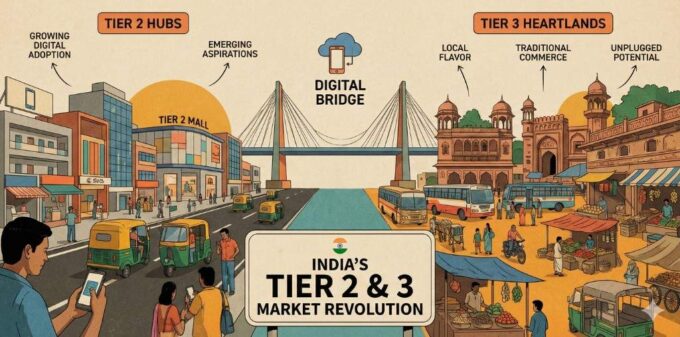
The lines are blurring. Digital adoption in a Tier 3 town like Bolangir often mirrors Tier 2 behavior regarding content consumption (YouTube/Instagram), even if purchasing power differs. This “digital bridge” is where the biggest startup opportunities lie.
Decoding the Psyche of the ‘Bharat’ Consumer
To win in Tier 2 and 3 markets, founders must unlearn the biases of Metro India. The consumer in a town like Bolangir or Madurai operates on a different psychological framework than a consumer in South Mumbai. It is not a difference of intelligence; it is a difference of context, community, and trust.
Here are the three psychological pillars that drive buying decisions in these markets:
1. The “Paisa Vasool” Mentality (Value ≠ Cheap)
There is a dangerous misconception that Tier 2/3 consumers only want “cheap” products. This is false. They are Value Maximizers, not Price Minimizers.
- The Psychology: In a Metro, a consumer might buy a ₹500 t-shirt for a specific event. In Tier 2, a consumer will happily pay ₹1,500 for a shirt if they perceive it is durable, high-status, and multi-purpose.
- The Lesson: Do not fight on price wars. Fight on durability, utility, and the “value-add” you bring to their life.
2. Trust is Transferred, Not Assumed
In Tier 1 cities, trust is institutional (e.g., “I trust Amazon’s return policy”). In Tier 2 and 3 cities, trust is relational and social.
- The “Mohalla” Effect: Word-of-mouth is the most potent marketing channel. If one influential person in a community approves a brand, the entire cluster follows. Conversely, one bad experience spreads like wildfire.
- The Role of Influencers: They don’t look at celebrity influencers in Mumbai. They look at “Micro-Influencers” in their region—people who look like them and speak their dialect.
- The Insight: Use vernacular testimonials. A video review in Odia or Hindi carries 10x more weight than a polished English ad.
3. The Aspiration-Access Gap
The digital revolution (Jio/5G) has democratized aspiration, but physical access hasn’t kept up.
- The Psychology: A teenager in a Tier 3 town watches the same Instagram Reels as a teenager in Delhi. They want the same sneakers, the same gadgets, and the same skincare. They are aware of the trends but often cannot find them in local brick-and-mortar shops.
- The FOMO Factor: They are actively looking for brands that bridge this gap—brands that treat them with the same dignity and speed of delivery as metro customers.
💡 Webverbal Expert Insight: “The biggest mistake startups make is offering a ‘Lite’ version of their app or product for Tier 2 markets. This is an insult to the user’s intelligence. They want the full experience, simplified for their bandwidth, not diluted in value.”
Where the Money is Flowing: Top 3 Boom Sectors (2025-26)
The “Bharat” opportunity is not evenly distributed. While every sector is growing, three specific industries have reached an inflection point where infrastructure, aspiration, and spending power have collided to create massive scale.
1. D2C Fashion & Lifestyle: The “Streetwear” Revolution
- The Shift: Tier 2 India has moved beyond “Need-Based” clothing to “Identity-Based” fashion.
- The Trend: The explosion of Instagram Reels has homogenized fashion tastes. A Gen Z student in Bhubaneswar wants the same oversized tees and cargo pants as a creator in Mumbai.
- Key Growth Driver: “Drop Culture” in Small Towns. Limited edition drops create FOMO (Fear Of Missing Out). Brands that offer “Metro Aesthetics” at “Tier 2 Prices” (₹699-₹999 range) are seeing 300% YoY growth.
- Search Insight: High volume for “streetwear brands under 1000” and “party wear for men online” from non-metro IPs.
2. Fintech: The “Credit on QR” Wave
- The Shift: UPI solved payments (Velocity). The next wave is solving credit (Liquidity).
- The Trend: Embedded Finance. Small shop owners (Kiranas) in Tier 3 towns don’t want complex bank loans. They want “Buy Now Pay Later” options integrated directly into their supplier apps.
- Key Growth Driver: The Rise of “Sachet Insurance” & Lending. Micro-loans (₹500 to ₹5,000) for daily needs are witnessing lower default rates in close-knit Tier 3 communities compared to anonymous metro borrowers.
- Search Insight: Rising queries for “instant loan app without cibil” and “daily collection loan” in regional languages.
3. EdTech 2.0: The “Phygital” Correction
- The Shift: The “Tablet-only” model died. The “Hybrid Center” model is booming.
- The Trend: Parents in Tier 2 cities trust physical classrooms but demand digital quality teachers. They are paying premiums for “Smart Tuition Centers” where the student goes to a physical center, but the ‘Star Faculty’ teaches via live stream from Kota or Delhi.
- Key Growth Driver: Job-Ready Skilling. Unlike metros where students learn coding for “hobbies,” Tier 3 students learn it for “survival” and “migration.” English speaking and specialized technical skills (Data Entry, Video Editing) are high-intent categories.
🚀 Webverbal Founder’s Note: “I have seen this shift personally in Odisha. In 2020, people used the internet to ‘save money’ (finding deals). In 2026, they are using the internet to ‘make money’ (upskilling, creator economy, reselling). Founders who build tools for this ‘Income Generation’ mindset will win the decade.”
Read our analysis on the EdTech giant Physicswallah.
Navigating the Roadblocks: The Real Challenges of Tier 2/3 (And How to Fix Them)
The opportunity in Tier 2 and 3 markets is massive, but the operational reality is brutal. Founders often fail not because of a lack of demand, but because they try to force-fit “Metro Playbooks” into “Bharat” realities.
Here are the three biggest hurdles and the proven playbooks to solve them.
1. The Logistics Nightmare: Address Ambiguity & Last-Mile Costs
- The Challenge: In a metro, an address is structured (e.g., “Flat 402, Building A”). In a Tier 3 town or village, an address might be “Behind the old Shiva temple, near the yellow house.” This leads to delivery failures and high operational costs.
- The Solution:Hyper-Local Partnerships.
- Do not rely solely on national courier algorithms. Partner with local grocery stores or Kirana shops to act as “Pick-up Points.”
- Use WhatsApp Location sharing to pin exact coordinates during the order confirmation process.
2. The “RTO” (Return to Origin) Killer
- The Challenge: Cash on Delivery (COD) is the preferred mode of payment (often 60-70% of orders), but it comes with a high rejection rate. Customers might refuse the parcel at the door, doubling your logistics cost.
- The Solution:The “High-Touch” Verification Model.
- Implement an automated IVR call or a WhatsApp message to confirm the order immediately after placement.
- Incentivize pre-paid orders with a small “Trust Discount” (e.g., “Pay via UPI and save ₹50 instantly”).
3. The Talent Gap: Hiring for ‘Bharat’
- The Challenge: While you can find operational staff in smaller towns, finding senior tech talent or seasoned product managers who want to relocate to a Tier 3 city is difficult.
- The Solution:The Hub-and-Spoke Model.
- Keep your Core Operations & Sales teams in the Tier 2/3 city (lower cost, higher market context).
- Hire your Tech & Product teams remotely or in a nearby metro hub.
- Example: A startup based in Bhubaneswar might have its dev team in Hyderabad but its entire sales force on the ground in Odisha.
🛡️ Webverbal Reality Check: “I have seen many startups burn millions trying to change consumer behavior (e.g., forcing people to stop using COD). You cannot change behavior overnight. You must build around it. If they want COD, give them ‘Open Box Delivery’ to build trust, rather than forcing them to pay online.”
The Final Word: The Decade of ‘Bharat’ is Here
The distinction between “India” (the metros) and “Bharat” (the rest) is rapidly dissolving. The consumer in Bolangir is no longer five years behind the consumer in Bengaluru—they are just one click away.
For founders and investors, the window to enter these markets as a “first mover” is closing. The next Amazon, the next Zomato, and the next Nykaa will not just serve the top 1% of the population. They will be built on the dusty roads and bustling markets of Tier 2 and 3 cities.
The question is no longer if you should enter these markets. The question is: Do you have the empathy and the patience to build for them?
At Webverbal, we believe the future belongs to those who look beyond the skyscrapers.
FAQ
Which are the best Tier 2 cities for startups in India in 2026?
While the list is extensive, the top emerging hubs for startups include Bhubaneswar, Indore, Jaipur, Surat, and Coimbatore. These cities offer the perfect balance of robust digital infrastructure, lower operational costs compared to metros, and a rapidly growing talent pool, making them ideal for early-stage ventures.
How does consumer behavior differ between Tier 1 and Tier 2 cities?
The primary difference lies in motivation. Tier 1 (Metro) consumers often prioritize convenience and time-saving (e.g., 10-minute delivery). In contrast, consumers in Tier 2 and 3 markets in India prioritize value and trust. They are willing to wait longer for delivery if the product offers better durability (“Paisa Vasool”) or comes recommended by their local community.
Is the Cost of Customer Acquisition (CAC) lower in non-metro markets?
Yes, significantly. Digital advertising costs (CPM/CPC) are often 30-40% lower when targeting non-metro IP addresses. However, while acquiring a user is cheaper, retaining them requires high-quality service, as brand loyalty in these markets is hard-earned but long-lasting.
What business ideas are most profitable for Tier 3 towns?
Sectors bridging the “Access Gap” are highly profitable. This includes Phygital EdTech (hybrid tuition centers), Agri-Fintech (credit for farmers), Vernacular Content Platforms, and D2C Fashion that brings metro-style trends to affordable price points.