
Table Of Content
- 🚀 Executive Summary: The 30-Second Read
- The India to Bharat Spectrum
- Tier 1 Nodes
- Tier 2 Hubs
- Tier 3 Clusters
- Decoding the Psyche of the Regional Consumer
- Where the Capital is Flowing: Top 3 Boom Sectors
- Navigating the Roadblocks: Ground Realities & Fixes
- Conclusion: Empathy, Patience, and the Long Moat
- Frequently Asked Questions Regarding Regional Indian Markets
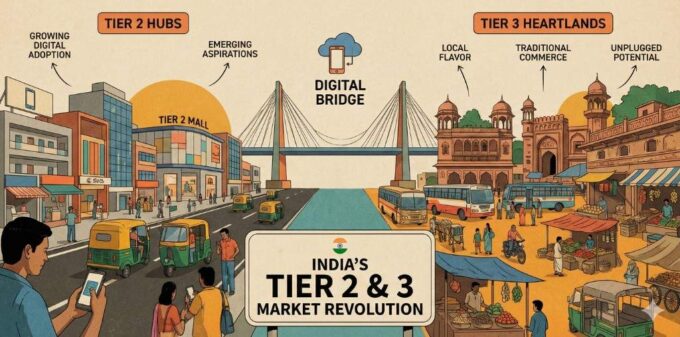
The rapid expansion tracking across tier 2 and 3 markets in India is fundamentally reshaping the entire structural commerce landscape of the sub-continent. For the last decade, the macro narrative of Indian entrepreneurship was heavily monopolized by just three localized tech centers: Bengaluru, Delhi-NCR, and Mumbai. The legacy strategy was singularly focused: incorporate inside metropolitan clusters to service high-density urban checkouts.
But that localized narrative has officially collapsed.
While traditional Tier 1 cities battle high customer acquisition costs (CAC), structural merchant attrition, and conversion saturation, a quiet distribution revolution has captured the rest of the nation. Data metrics from Startup India verify that nearly 50% of recognized innovative entities now emerge from non-metro sectors. The upcoming tranches of profitable Indicorn scale leaders are not being engineered for elite metropolitan demographics; they are built for the aspiring millions entering the transaction grid across tier 2 and 3 markets in India—from the smart city corridors of Bhubaneswar out to the rising industrial manufacturing zones of Surat.
🚀 Executive Summary: The 30-Second Read
- The Macro Shift: Modern enterprise infrastructure is relocating away from Tier 1 zones toward high-velocity tier 2 and 3 markets like Bhubaneswar and Indore.
- The Consumer Psyche: Regional buyers are not scanning the web for low-grade cheap products; they act as strict Value Maximizers prioritizing durability and trust.
- The Growth Drivers: The primary monetization vectors center around identity-focused D2C fashion, embedded fintech credit, and localized phygital skilling ecosystems.
- The Operational Moat: Success relies completely on optimizing last-mile address ambiguity and reducing high Return-to-Origin (RTO) penalty overloads through hybrid fulfillment networks.
Accelerating this transition is the comprehensive deployment of the central Digital India initiative. Across these regional perimeters, digital onboarding is no longer a peripheral marketing trend—it serves as an absolute daily operational reality. Fuelled by highly competitive data clearings and the ubiquity of unified transaction networks (UPI), consumers across Tier 3 hubs are no longer waiting for fashion or retail trends to trickle down. They are actively consuming high-bandwidth media streams, demanding global-standard product components, and settling bills online with a transactional velocity that saturated metro markets lost years ago.
However, establishing a defensible presence within these growth hubs requires vastly more than translating a landing page into regional dialects. It requires an uncompromised understanding of the unique psychology governing Bharat—a consumer class that systematically prioritizes long-term relational trust over passing internet trends and verified asset value over temporary discount vouchers.
At Webverbal, we do not analyze these markets from a distance; we map their operational data loops directly from the ground up. This manual functions as your definitive go-to-market architecture to master the economics, the user behavior, and the massive non-dilutive scaling opportunities of tier 2 and 3 markets in India.
The India to Bharat Spectrum
Tier 1 Nodes
Legacy urban clusters; Extreme capital burn rates; Saturated client channels; Escalating Customer Acquisition Costs (CAC).
Convenience-driven individual shoppers displaying low baseline brand loyalty; willing to pay premium tickets for time-saving applications.
Tier 2 Hubs
Rapid municipal urbanization; Heavy public infrastructure boom; Surging disposable family income pools.
Highly aspirational, status-conscious, and brand-aware, but enforces fierce value-seeking verification metrics.
Tier 3 Clusters
Semi-urban market nodes where traditional unorganized merchant structures command dominant category shares.
Deeply trust-driven buyers; consumer loops rely heavily on direct word-of-mouth validation and local network approval signatures.
The boundaries separating these segments are dissolving rapidly. Digital consumption patterns inside Tier 3 centers like Bolangir frequently mirror Tier 2 behavioral metrics due to the homogenization of content streams (via YouTube and Instagram arrays), even when baseline disposable wallets vary. This shared digital aspiration is exactly where the high-value startup moats are hiding.
Decoding the Psyche of the Regional Consumer
Winning consumer transactions across tier 2 and 3 markets in India requires builders to abandon the biases embedded within urban tech models. The regional buyer operates on a different framework: they are value maximizers, not simple price minimizers. A buyer in a non-metro corridor will willingly invest a higher ticket in an item if they verify its durability, utility, and status alignment.
Furthermore, trust within these tiers is strictly relational and social rather than institutional. While metro users trust a central app’s anonymous algorithm, regional buyers rely on the *Mohalla Effect*—where direct peer validation and local merchant references dictate conversion cycles. Using dialect-tailored communication channels and localized video testimonials carries vastly more weight than a polished English ad campaign. They demand the full quality experience of modern commerce, simplified for their bandwidth and wrapped in authentic local validation loops.
Where the Capital is Flowing: Top 3 Boom Sectors
The monetization opportunities inside the Bharat digital frontier are clustering around three primary verticals where infrastructure readiness and consumer spending power have converged:
- 1. D2C Fashion & Lifestyle (Identity Commerce): Regional India has graduated from commodity utility clothing to high-intent identity expression. The democratization of social media feeds means a student in Bhubaneswar expects immediate access to the same aesthetic drops as a creator inside Mumbai, driving massive volume for brands supplying premium styles within accessible ₹699-₹999 price thresholds.
- 2. Embedded Fintech (The Credit Wave): While transaction networks solved basic payment velocity, the current frontier is resolving micro-liquidity. Small retail networks (Kiranas) across Tier 3 towns demand embedded finance solutions integrated directly inside their supplier apps, preferring decentralized credit lines over rigid commercial bank processes.
- 3. EdTech 2.0 (The Phygital Hybrid Shift): Pure abstract tablet-instruction models have lost consumer trust. Parents across Tier 2 cities are allocating premium budgets to smart hybrid tuition centers that blend physical, supervised study spaces with live-streamed instruction from top-tier national faculty networks. They view skilling strictly through an income-generation lens.
Ecosystem Case Reference: To evaluate how these operational timelines and phygital growth tracks scale on-ground, read our corporate case analysis tracking the growth of Physicswallah.
Navigating the Roadblocks: Ground Realities & Fixes
While the volume across tier 2 and 3 markets in India is vast, the operational logistics are unforgiving. Overcoming address ambiguity requires stepping away from standard global mapping metrics and deploying hyper-local pickup points using local neighborhood networks. Confirming deliveries via direct WhatsApp location coordinates ensures delivery tracking success.
Additionally, managing high Cash on Delivery (COD) dependency requires a structured verification model. Deploying interactive automated IVR confirmation calls immediately post-checkout and incentivizing upfront UPI clearings with targeted trust discounts can radically insulate your margins from high Return-to-Origin (RTO) penalty overloads. Successful organizations do not try to alter customer behavior overnight; they build modular architectures designed to accommodate it.
Conclusion: Empathy, Patience, and the Long Moat
The historical separation dividing urban India from regional Bharat is disappearing. Capturing sustainable position across the emerging markets of the country means setting aside superficial growth hacking scripts and committing to long-term community relationship building. Let the clean backend code systems and structured data graphs index across your domains over the coming cycles. The future belongs to those who look past the urban skyscrapers to build lasting equity down on the dusty roads of the real economy.
Frequently Asked Questions Regarding Regional Indian Markets
Which are the best Tier 2 cities for startups in India in 2026?
How does consumer behavior differ between Tier 1 and Tier 2 cities in India?
Is the Cost of Customer Acquisition (CAC) lower in non-metro markets?