

Table Of Content
- Why a Winning Pitch Deck Has Become a Critical Growth Asset for Modern Startup Founders
- Investor Attention Is Limited
- Storytelling Creates Investor Trust
- Validation Matters More Than Hype
- Clear Communication Improves Funding
- Why Pitch Decks Matter More Than Ever
- What Investors Actually Look For in a Winning Pitch Deck
- 1. Is the problem real and urgent?
- 2. Does the founder deeply understand the market?
- 3. Is the solution differentiated?
- 4. Can this become a scalable business?
- 5. Why is this team uniquely positioned to win?
- Ideal Pitch Deck Structure for Startup Fundraising
- 1. Vision Slide
- Weak Opening
- Strong Opening
- 2. Problem Slide
- Example
- 3. Solution Slide
- 4. Product Demo or Screenshots
- 5. Market Opportunity
- Investors Prefer
- 6. Business Model
- “How do you make money?”
- 7. Traction Slide
- 8. Competitive Landscape
- 9. Go-To-Market Strategy
- 10. Financial Projections
- 11. Funding Ask
- 12. Team Slide
- Common Pitch Deck Mistakes That Kill Investor Interest
- Too Much Text
- Feature Obsession
- Weak Storytelling
- Unrealistic Market Claims
- Poor Design
- The Psychology Behind a Powerful Pitch Deck
- 1. Reduces Investor Confusion
- 2. Creates Market Excitement
- 3. Builds Founder Credibility
- What Modern Investors Prefer in 2026
- The Best Pitch Decks Feel Simple
- A Simple Narrative Framework You Can Follow
- Final Thoughts
- Frequently Asked Questions About Winning Pitch Decks
- What makes a winning pitch deck for investors?
- How do founders write a powerful startup pitch deck?
- What is the ideal pitch deck structure for startup fundraising?
- Why are pitch deck examples important for founders?
- What do investors expect in a VC pitch deck?
- How can startups raise funding more effectively?
Every startup founder eventually faces one defining challenge: explaining their vision in a way that instantly creates belief.
That is what a winning pitch deck does.
A powerful pitch deck is not just a presentation. It is a psychological bridge between uncertainty and conviction. Investors are not merely investing in slides. They are investing in clarity, market understanding, execution capability, and founder confidence.
In today’s AI-driven and attention-fragmented startup ecosystem, founders are competing not only against other startups but against noise itself. Investors review hundreds of decks every month. Most are forgotten within minutes.
The startups that stand out are the ones that communicate:
- A painful and urgent problem
- A believable solution
- Real market opportunity
- Early validation
- Strong storytelling
- Founder-market fit
- A scalable business model
At Webverbal’s Indian Startup Founder Playbook, we increasingly observe that modern investors prefer pitch decks that are concise, data-backed, visually clean, and narrative-driven rather than overly technical or feature-heavy.
According to Y Combinator and insights shared by leading venture capital firms, the best startup decks simplify complexity and communicate momentum with precision.
Why a Winning Pitch Deck Has Become a Critical Growth Asset for Modern Startup Founders
In today’s startup ecosystem, a winning pitch deck is far more than a fundraising presentation. It has evolved into a strategic storytelling framework that helps founders communicate market opportunity, traction, scalability, and founder conviction with clarity. Modern investors increasingly prefer startup pitch deck presentations that are concise, visually clean, data-backed, and narrative-driven rather than overly technical or feature-heavy. Whether you are preparing a seed funding pitch deck, building a startup fundraising deck, or learning how to write a pitch deck for investors, the ability to simplify complexity into a compelling narrative has become a major competitive advantage.
Investor Attention Is Limited
A powerful pitch deck helps founders explain business clarity quickly. Most investors review hundreds of startup investor presentation decks every year, making concise storytelling increasingly important.
Storytelling Creates Investor Trust
The best pitch deck examples combine emotional clarity, market understanding, traction, and execution capability instead of overwhelming investors with technical jargon.
Validation Matters More Than Hype
Strong VC pitch deck presentations usually include traction metrics, customer insights, business model validation, realistic projections, and a scalable go-to-market strategy.
Clear Communication Improves Funding
Founders learning how to raise funding for startup growth often discover that a structured pitch deck for investors matters more than flashy animations or excessive design complexity.
Why Pitch Decks Matter More Than Ever
A pitch deck today serves multiple purposes simultaneously:
- Investor introduction tool
- Strategic storytelling framework
- Internal clarity document
- Partnership presentation
- Accelerator application asset
- Media narrative foundation
- Team alignment mechanism
For early-stage startups, especially founders from Tier 2 and Tier 3 India, a strong pitch deck can often compensate for lack of network access.
Because when your story becomes clear, opportunities travel faster.
What Investors Actually Look For in a Winning Pitch Deck
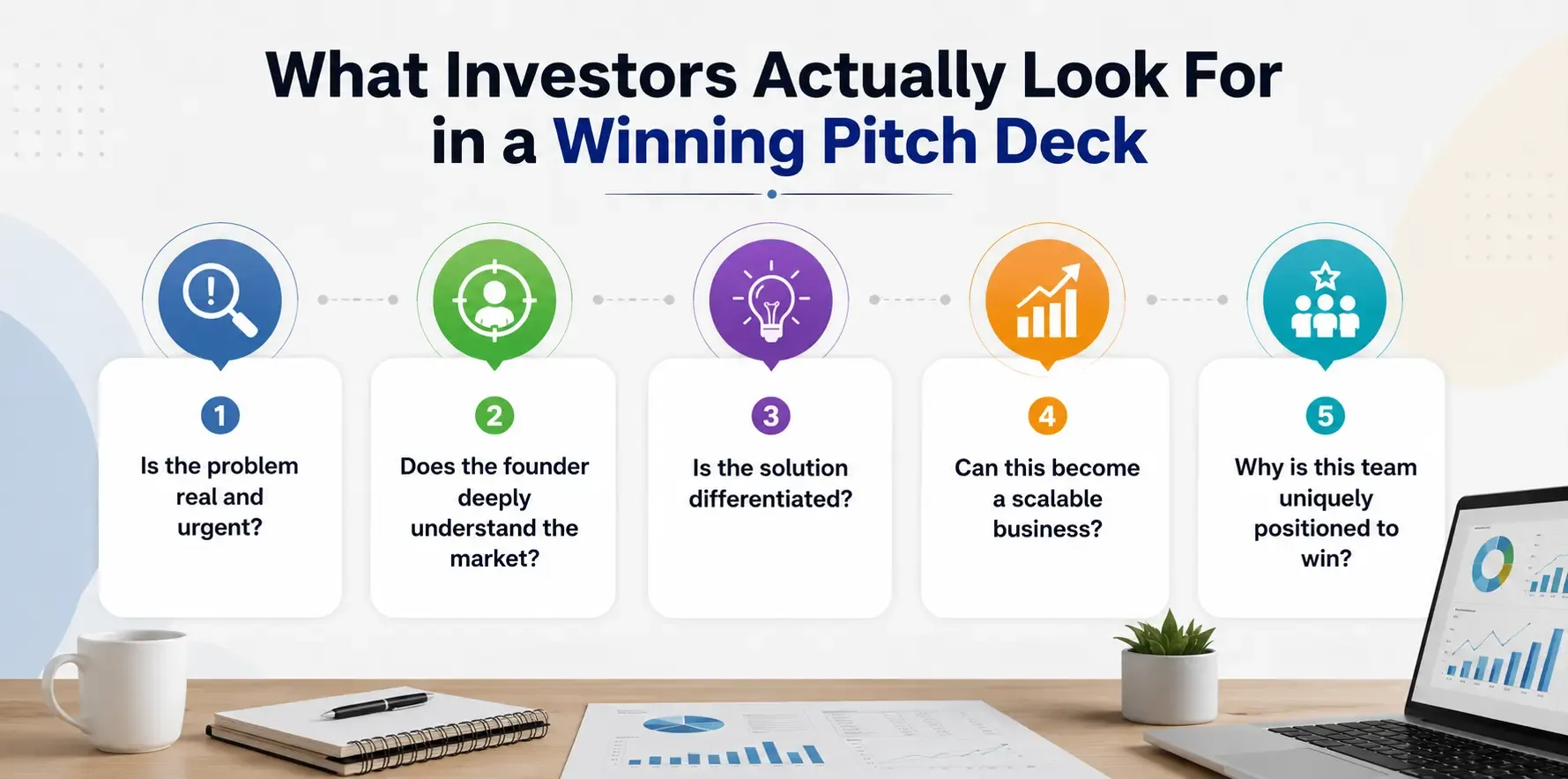
Most founders believe investors care mainly about the idea.
In reality, investors evaluate five deeper questions:
1. Is the problem real and urgent?
2. Does the founder deeply understand the market?
3. Is the solution differentiated?
4. Can this become a scalable business?
5. Why is this team uniquely positioned to win?
A winning pitch deck answers these questions naturally without overwhelming the audience.
Ideal Pitch Deck Structure for Startup Fundraising
The most effective decks typically contain 10–15 slides.
Here is the structure that consistently works across accelerators, angel networks, and VC firms.
1. Vision Slide
This is your opening statement.
Do not start with features.
Start with mission clarity.
Weak Opening
“We built an AI-powered marketplace platform.”
Strong Opening
“We are building financial access infrastructure for underserved Bharat entrepreneurs.”
A strong vision immediately communicates ambition and direction.
2. Problem Slide
This is one of the most important slides in your entire deck.
You must clearly explain:
- What problem exists
- Who faces it
- Why current solutions fail
- Why this problem matters now
The strongest problem slides use:
- Market statistics
- Founder insights
- User interviews
- Behavioral patterns
- Industry inefficiencies
Example
“Over 60 million Indian MSMEs still struggle to access structured investor visibility despite contributing nearly 30% to India’s GDP.”
That instantly creates seriousness.
3. Solution Slide
Now show how your startup solves the problem.
Avoid technical jargon.
Focus on outcomes.
Explain:
- What your product does
- How it improves user experience
- Why it is better
- Why users care
Investors buy transformation, not features.
4. Product Demo or Screenshots
This slide creates tangibility.
Show:
- Dashboard screenshots
- Product workflow
- Mobile interface
- User journey
- Before vs after experience
Modern investors prefer visual clarity over long explanations.
If your UI looks confusing, investor confidence drops immediately.
5. Market Opportunity
This slide tells investors whether your startup can become large enough.
You should clearly explain:
- TAM (Total Addressable Market)
- SAM (Serviceable Available Market)
- SOM (Serviceable Obtainable Market)
Instead of unrealistic “we capture 1% of a trillion-dollar market” assumptions, show realistic bottom-up calculations.
Investors Prefer:
- Customer volume estimates
- Pricing logic
- Expansion strategy
- Market growth trends
6. Business Model
This slide answers one core question:
“How do you make money?”
Clearly explain:
- Pricing structure
- Revenue streams
- Subscription logic
- Commission models
- Enterprise pricing
- Unit economics
A confusing business model kills investor confidence faster than almost anything else.
7. Traction Slide
This is where belief starts forming.
Even small traction matters.
Show:
- Revenue growth
- User growth
- Partnerships
- Pilot customers
- Retention
- Testimonials
- Waitlists
- Engagement metrics
Investors love momentum.
Even 500 highly engaged users can be more impressive than 50,000 inactive users.
8. Competitive Landscape
Never say:
“We have no competitors.”
That signals lack of market understanding.
Instead explain:
- Existing alternatives
- Market gaps
- Your differentiation
- Your unfair advantage
Strong competitive advantages include:
- Proprietary data
- Distribution advantage
- Founder expertise
- Community trust
- Local market insight
- Operational efficiency
9. Go-To-Market Strategy
This slide explains how you will acquire customers.
Modern investors expect clarity around:
- Customer acquisition channels
- Content strategy
- Partnerships
- Sales motion
- Community-led growth
- Paid acquisition
- Viral loops
- Referral systems
For Indian startups, distribution often matters more than technology itself.
10. Financial Projections
Keep projections ambitious but believable.
Include:
- Revenue forecast
- Expense forecast
- Burn rate
- Runway
- Gross margins
- Break-even timeline
Avoid fantasy numbers without explanation.
11. Funding Ask
This slide should clearly state:
- How much capital you are raising
- What the money will be used for
- Expected runway
- Key milestones
Example:
“We are raising ₹2 crore to scale distribution, strengthen product infrastructure, and achieve 1 lakh active users.”
Simple and direct works best.
12. Team Slide
Investors often invest in founders before products.
Highlight:
- Founder experience
- Industry expertise
- Execution background
- Previous achievements
- Complementary skills
This is especially powerful when founders have:
- Domain credibility
- Deep local understanding
- Operational resilience
- Founder-market fit
Common Pitch Deck Mistakes That Kill Investor Interest
Too Much Text
Investors scan quickly.
Your slides should support conversation, not replace it.
Feature Obsession
Founders often over-explain technology.
Investors care more about:
- Market
- Distribution
- Scalability
- Economics
- Timing
Weak Storytelling
The best decks create emotional progression:
Problem → Urgency → Solution → Validation → Opportunity → Scale
Unrealistic Market Claims
Avoid:
“If we capture 2% of India…”
Investors hear this constantly.
Use grounded numbers instead.
Poor Design
Messy decks signal messy execution.
Modern decks should be:
- Minimal
- Visually balanced
- Mobile-friendly
- Consistent
- Easy to skim
The Psychology Behind a Powerful Pitch Deck
A winning pitch deck does three things simultaneously:
1. Reduces Investor Confusion
Clarity builds trust.
2. Creates Market Excitement
Investors want large outcomes.
3. Builds Founder Credibility
Confidence comes from structured thinking.
The deck itself becomes evidence of execution quality.
What Modern Investors Prefer in 2026
Investor expectations have evolved dramatically.
Today’s strongest pitch decks include:
- Clear market timing
- AI leverage strategy
- Distribution moat
- Founder authenticity
- Data-backed storytelling
- Real customer insight
- Lean execution proof
Especially in India, investors are increasingly interested in:
- Bharat-focused startups
- MSME infrastructure
- AI-enabled services
- Financial inclusion
- Creator economy
- Climate innovation
- Rural digitization
- Consumer behavior intelligence
The Best Pitch Decks Feel Simple
Founders often think complexity creates sophistication.
The opposite is true.
The most powerful startup decks simplify difficult ideas so clearly that investors instantly understand:
- The opportunity
- The timing
- The scalability
- The founder conviction
That simplicity is rare.
And valuable.
A Simple Narrative Framework You Can Follow
Here is a clean storytelling structure founders can use:
- This problem exists.
- Millions face it.
- Existing solutions are broken.
- We built a better approach.
- Early users already validate it.
- The market opportunity is large.
- Our model is scalable.
- Our team understands this deeply.
- We now need capital to accelerate growth.
That is essentially what every great pitch deck communicates.
Final Thoughts
A winning pitch deck is not about flashy animations or beautiful templates.
It is about strategic clarity.
The best founders learn how to compress vision, market understanding, execution capability, and conviction into a short narrative that investors can immediately understand and trust.
In many ways, your pitch deck becomes the first test of your leadership.
Because if a founder cannot clearly explain:
- the problem,
- the opportunity,
- the economics,
- and the future,
investors naturally question whether the company itself has clarity.
The startups that raise capital effectively are usually the ones that communicate with precision.
And in the modern startup world, clarity has become a competitive advantage.
Frequently Asked Questions About Winning Pitch Decks
Learn how to write a pitch deck that captures investor attention, improves startup fundraising opportunities, and builds a powerful startup storytelling narrative for modern venture capital and angel investment environments.
What makes a winning pitch deck for investors?
A winning pitch deck clearly explains the problem, solution, market opportunity, traction, business model, and growth strategy in a concise and visually clean format. The best investor pitch deck presentations combine data-backed insights with strong startup storytelling to help investors quickly understand why the startup deserves funding.
How do founders write a powerful startup pitch deck?
Founders learning how to write a pitch deck should focus on clarity rather than complexity. A powerful pitch deck usually includes slides covering the problem, solution, traction, market size, competitive landscape, business model, financial projections, and funding ask. A strong startup presentation deck should simplify difficult ideas into a compelling narrative investors can understand quickly.
What is the ideal pitch deck structure for startup fundraising?
The ideal pitch deck structure for startup fundraising typically includes 10–15 slides. These slides often cover vision, customer problem, product solution, traction metrics, go-to-market strategy, market opportunity, business model, financials, team, and funding requirements. Whether it is a startup fundraising deck or a seed funding pitch deck, clarity and flow are extremely important.
Why are pitch deck examples important for founders?
Studying successful pitch deck examples helps founders understand how leading startups communicate market opportunity, traction, and investor value. Many successful startup investor presentation decks from companies like Airbnb and Uber show that simple storytelling often performs better than overly technical presentations.
What do investors expect in a VC pitch deck?
Investors reviewing a VC pitch deck usually look for large market potential, strong founder-market fit, scalable business models, early traction, and realistic financial projections. Modern investors prefer concise and narrative-driven startup pitch deck presentations rather than feature-heavy documents filled with unnecessary technical details.
How can startups raise funding more effectively?
Founders searching for how to raise funding for startup growth should focus on building trust through traction, storytelling, market understanding, and execution capability. A professionally designed pitch deck for investors can significantly improve the chances of attracting angel investors, venture capital firms, accelerators, and strategic partners.