

Table Of Content
“10 minutes? Impossible.” That was the consensus. Industry veterans laughed. They said Indian traffic would kill it. They said the unit economics were a fantasy. But while the giants were busy debating the logic, two 19-year-old Stanford dropouts were busy coding the logistics.
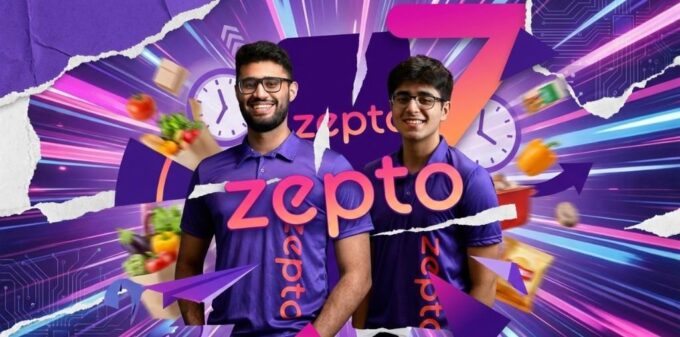
This visual case study explores the Zepto success story—how Aadit Palicha and Kaivalya Vohra turned a “pandemic experiment” into India’s fastest-growing unicorn. We decode the “Dark Store” strategy and the ruthless execution behind the Zepto business model that forced Swiggy and Zomato to rewrite their own playbooks.
The Speed of Now
Decoding Zepto: How two teenagers dropped out of Stanford to build India’s fastest company during a global lockdown.
The Lockdown Pivot
Aadit Palicha and Kaivalya Vohra, both 19, are stuck in Mumbai during COVID. They were supposed to be at Stanford studying Computer Science.
Instead, they struggle to get groceries. They launch KiranaKart, trying to partner with local stores. It fails to scale.
10 Minutes or Nothing
They realize the “Kirana” model is too slow. They pivot to the Dark Store model—mini-warehouses optimized for speed.
Zepto is born. They promise delivery in 10 minutes. The industry calls it a gimmick. The customers call it magic.
Quick Commerce Wars
Giants like Swiggy (Instamart) and Zomato (Blinkit) wake up. A fierce battle for “share of wallet” begins.
Critics predict the bubble will burst. Zepto doubles down on technology to optimize “Pack Time” to under 60 seconds.
Defying the Winter
While funding dries up globally (the “Funding Winter”), Zepto raises $200 Million.
They become India’s First Unicorn of 2023 with a valuation of $1.4 Billion. The “gimmick” is now a category leader.
The Path to Profit
Zepto moves beyond groceries into “Zepto Cafe” and electronics.
The focus shifts from pure speed to EBITDA positive unit economics. They are preparing for one of the most anticipated tech IPOs.
The Dark Store Revolution: Valuing Time Over Money
Zepto didn’t just deliver groceries; they delivered a habit change. Before them, Indian e-commerce was about “Discounts.” Zepto proved that the modern Indian consumer cares more about “Time.”
By perfecting the Dark Store model—mini-warehouses located every 2 kilometers—they solved the “last mile” puzzle that had baffled logistics companies for a decade. They proved that if you can give people back 20 minutes of their day, price becomes secondary. In the end, Zepto didn’t just win a market share; they created an entirely new category.
Read Next: Zepto conquered speed, but another startup conquered “Trust” in a way no one expected. Listen to the story of The Sound of Trust: When a Box Spoke for a Billion.
Reference: Discover how the government supports young innovators like these at the official Startup India Portal.
Decoding the Zepto Model
How does Zepto actually manage 10-minute delivery?
Zepto relies on the Dark Store model. These are not regular shops, but optimized mini-warehouses located in high-demand neighborhoods. They use advanced technology to predict demand and pack orders in under 60 seconds, allowing the remaining 9 minutes for the rider to travel short distances (usually 1-2 km).
Who are the founders of Zepto?
Zepto was founded by Aadit Palicha and Kaivalya Vohra. They were childhood friends who grew up in Mumbai and both dropped out of Stanford University’s Computer Science program to return to India and build their startup during the COVID-19 pandemic.
What is the difference between Zepto and Blinkit/Instamart?
While Blinkit (Zomato) and Instamart (Swiggy) started as food delivery or general delivery apps and pivoted to groceries, Zepto was built from the ground up exclusively for quick commerce. This “native” focus allowed them to optimize their supply chain and tech stack specifically for speed from day one.
Is the Quick Commerce model profitable?
It is challenging, but Zepto has shown that high order density and advertising revenue can lead to profitability. By 2025, Zepto began achieving EBITDA positivity in key mature markets by increasing the average order value (AOV) and introducing platform fees and ad monetization.