
Table Of Content
They called it a “Cash Furnace.” In 2016, financial analysts predicted the death of food tech in India. They said the unit economics would never work, that the “cash burn” was unsustainable, and that Indian customers would never pay for delivery. Deepinder Goyal didn’t blink.
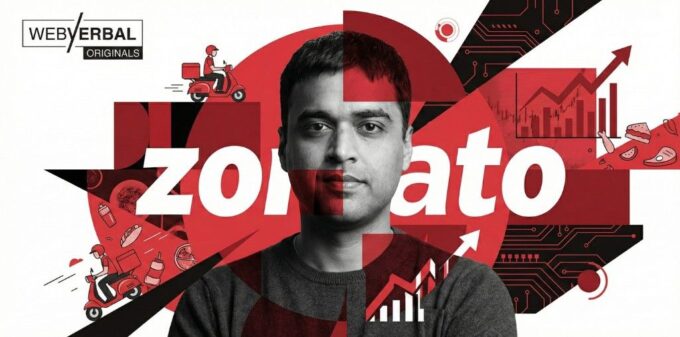
This visual timeline decodes the complete Zomato success story—analyzing how a simple menu-scanning website morphed into a logistics giant. From surviving the “TinyOwl” era crash to staging a historic IPO, this is the breakdown of the Zomato business model and the relentless pivots that built an empire.
The Hunger for Reinvention
Decoding Zomato: How Deepinder Goyal turned a menu-scanning website into India’s first profitable Unicorn, surviving layoffs, wars, and doubters.
Foodiebay Begins
Working at Bain & Co, Deepinder Goyal notices colleagues queuing just to see the cafeteria menu. He scans it and puts it online.
“Foodiebay” is born. It wasn’t about delivery; it was about Discovery. He solves a simple problem with zero tech overhead.
The Burn Years
Zomato expands aggressively to 24 countries. But the unit economics don’t work. The delivery war with Swiggy begins.
Deepinder is forced to lay off hundreds of employees. Critics write Zomato off. He pivots, focusing on “Gold” (Dining Out) to fund the Delivery wars.
India’s First Tech IPO
Zomato becomes the first Indian unicorn to list on the stock exchange. The IPO is oversubscribed 38 times.
It marks a cultural shift. Loss-making tech companies can be public. Zomato sets the benchmark for the entire ecosystem.
Acquiring Blinkit
Stock plummets to ₹40. Investors panic when Zomato acquires the loss-making Blinkit for $570M.
They call it “bad capital allocation.” Deepinder calls it the future. He bets everything on Quick Commerce, ignoring the market noise.
Eternal & Profitable
The gamble pays off. Blinkit becomes larger than the food business in value. Zomato reports consistent profits.
Deepinder restructures the company into “Eternal”—a house of brands (Food, Blinkit, District, Hyperpure). The “Menu Scanner” is now a logistics empire.
The “Blinkit” Gamble: Survival of the Fastest
Zomato’s survival wasn’t luck; it was a refusal to stay static. When the core food delivery business faced saturation, Goyal didn’t hoard cash—he spent it. The acquisition of Blinkit was controversial, criticized, and expensive. But it was necessary.
Deepinder Goyal understood early that the modern Indian consumer doesn’t just hunger for food; they hunger for instant gratification. By embracing Quick Commerce, Zomato has successfully reinvented itself from a food app to a hyper-local “everything” app, proving that in the Indian startup ecosystem, you are either quick or you are dead.
Read Next: Zomato entered Quick Commerce to fight a specific enemy—two teenagers who promised delivery in 10 minutes. Read their story in [The Speed of Now: How Zepto Turned 10 Minutes into a Billion Dollars].
Reference: This massive logistics network operates under strict safety standards. Learn more about food safety compliance at FSSAI (Government of India).
Decoding the Zomato Strategy
Why was the Blinkit acquisition considered a gamble?
At the time (2022), Blinkit (formerly Grofers) was burning cash and the Quick Commerce model was unproven. Zomato’s own stock had crashed. Investors feared that buying a loss-making entity would drag Zomato down further. However, Deepinder Goyal saw it as a supply-chain synergy that would eventually eclipse food delivery.
What is “Zomato Eternal”?
“Eternal” is the internal rebranding of Zomato into a “House of Brands” structure. Instead of just one app, the company now operates multiple distinct businesses: Zomato (Food), Blinkit (Quick Commerce), Hyperpure (B2B Supplies), and District (Going Out/Events), each with its own CEO.
How did Zomato achieve profitability when others failed?
Zomato focused on increasing the “Take Rate” (commission) from restaurants and introduced “Platform Fees” for customers. They also optimized their delivery costs and grew their B2B arm (Hyperpure) to create a more integrated, high-margin ecosystem compared to pure-play delivery rivals.