

Table Of Content
- Executive Summary: The True Cost of Digital Processing
- Visible Slabs
- The Refund Penalty
- The Sovereign Tax
- Mitigation Moats
- How Subcontinental Payment Processing Fees Actually Work
- The Anatomy of Hidden Fintech Costs: The Double-Refund Trap
- Comparing the Best Payment Gateways in India: Technical Fee Slabs
- Practitioner Tactics to Reduce Processing Fees and Protect Margins
- The Long-Term Capital Impact Mapped
- Conclusion: Margin Control Over Vanity Volume
- Conclusion: Reclaim Authority Over Your Cash Yield
- Frequently Asked Questions
Operating metrics inside the subcontinental digital trade grid are inherently razor-thin, yet unoptimized architectures allow transaction processing systems to quietly shave off your net capital runway. As an independent direct-to-consumer (D2C) founder, your core focus remains single-dimensionally fixed on marketing optimization, product craftsmanship, and warehouse logistics. However, neglecting the hidden cost layers embedded across alternative checkout aggregators operates as a severe financial mistake.
Isolating the best payment gateways in India is not an exercise in tracking surface features; it demands a thorough top-to-bottom audit of variable merchant discount rates (MDR), hidden tax implications, and reverse transaction penalties. These micro-fees present a silent capital burn, draining your operating margins order after order.
Executive Summary: The True Cost of Digital Processing
An institutional-grade fintech matrix mapping the explicit fee mechanics, double-refund liabilities, and hidden markups commanding subcontinental e-commerce checkouts:
Visible Slabs
Standard domestic checkout fees maintain a baseline 1.8% to 2.2% MDR floor across leading aggregators, mounting heavily on credit lines.
The Refund Penalty
Canceling transactions triggers a double-fee leakage: gateways withhold the initial MDR charge and enforce an additional processing fee.
The Sovereign Tax
Every digital transaction fee incurs a mandatory 18% GST ledger tax, quietly adding immediate friction to net store operating margins.
Mitigation Moats
Founders can preserve net runway by running micro-deposit verifications, incentivizing mobile UPI trails, and executing custom volume pricing hacks.
How Subcontinental Payment Processing Fees Actually Work
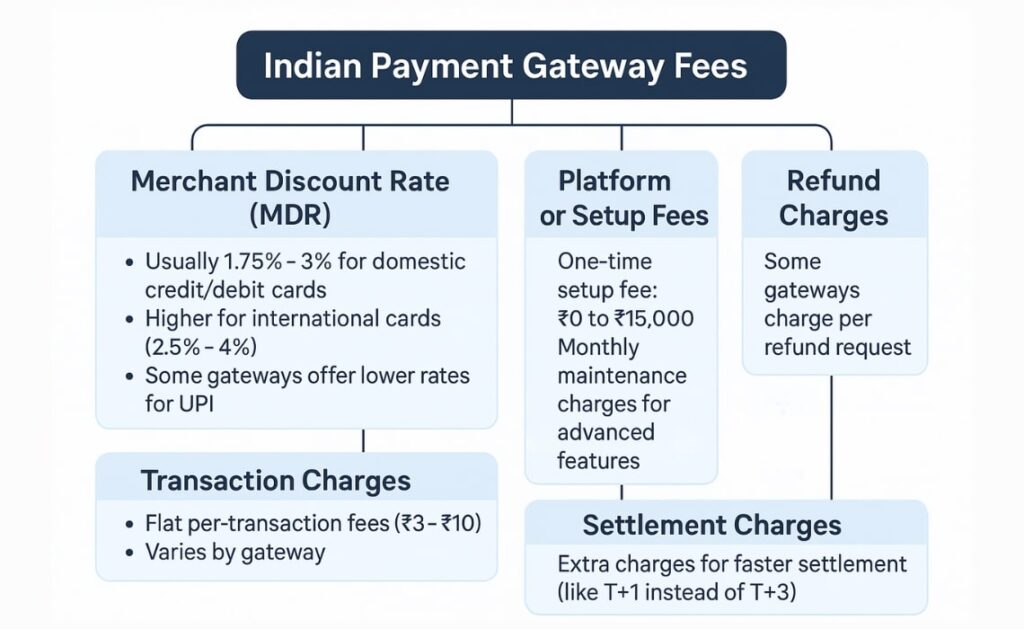
A digital transaction gateway connects your front-end store theme to banking networks and card processors to complete customer transactions. While alternative software clearings look small on paper, the middleman structure demands variable capital splits. The baseline pricing framework comprises four core operational expense blocks:
- Merchant Discount Rate (MDR): The base percentage cut tracking from 1.75% to 3.0% on standard credit or debit cards, scaling up to 4.0% for cross-border international clearings.
- Mandatory Sovereign Tax: An ironclad 18% GST tax levied directly on top of all accrued gateway transaction fees, compounding your baseline financial friction.
- Fulfillment Settlement Penalties: Extra percentage points (frequently up to an additional 1.0%) charged to bypass standard T+2 windows and trigger instant liquidity.
- Chargeback Investigation Costs: High-ticket retrieval fines (₹300 to ₹500 per instance) applied when a buyer opens an official bank dispute.
The Anatomy of Hidden Fintech Costs: The Double-Refund Trap
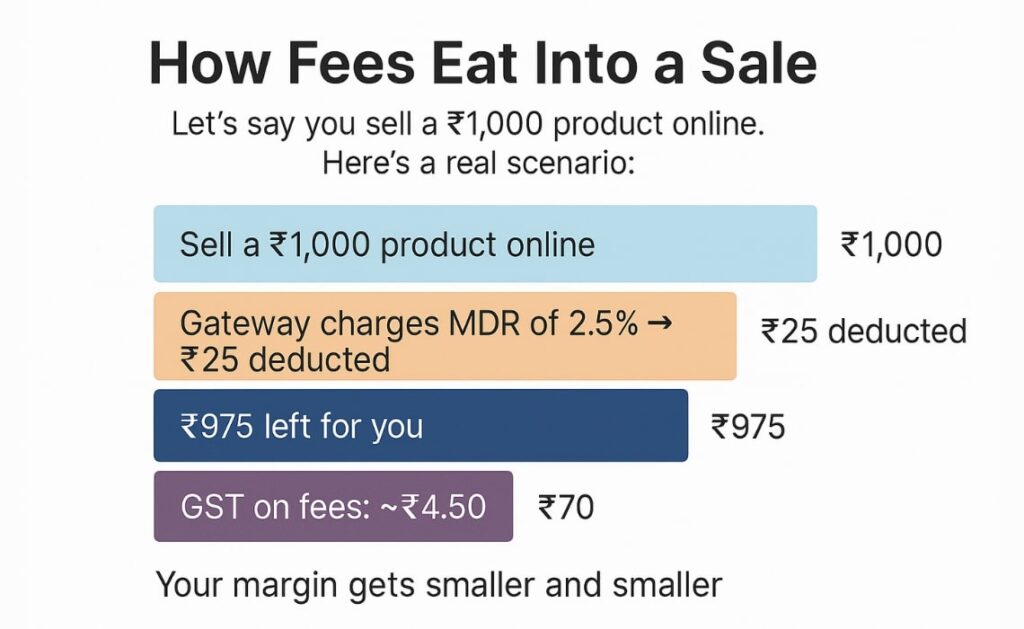
The most severe cash leakage bootstrapped operations overlook is the double-refund transaction penalty. When a direct retail brand cancels a transaction due to customer change of mind or warehouse shipping delays, the aggregator does not reverse their initial percentage cut. Instead, they withhold the original MDR fee and enforce an additional flat charge to route the capital back to the buyer.
You lose structural capital on a net zero sale. In a business where net margins hover at a strict 8% to 12% ceiling, processing thousands of unvetted cancellations creates a silent path to bankruptcy.
Comparing the Best Payment Gateways in India: Technical Fee Slabs
To accurately structure your checkout configurations and select a sustainable processing partner, track the technical fee slabs across prominent aggregators:
| Fintech Processing Gateway | Domestic Card Base MDR | Mobile UPI Interface Slab | Cross-Border Currency Markup | Standard Settlement Latency |
|---|---|---|---|---|
| Razorpay Engine | ~2.0% (Flat baseline tier) | 0% – 1% (Interface custom dependent) | ~3.0% (Plus bank exchange rate markups) | Standard T+2 rolling business cycle ledger clearing |
| Cashfree Framework | ~2.1% (Standard fee) | 0% (Turnkey infrastructure tier) | ~3.5% (Enforced on foreign card networks) | Standard T+2 rolling business cycle ledger clearing |
| PayU India Rails | 1.8% – 2.2% (Volume tier scale) | 0% (Standard optimization parameters) | ~3.0% – 4.0% (Dependent on source country currency) | Standard T+2 rolling business cycle ledger clearing |
Practitioner Tactics to Reduce Processing Fees and Protect Margins
Founders do not have to passively accept margin erosion. Implement these five operational fee hacks to secure your capital yield:
- Execute Custom Volume Negotiations: Once your gross store transaction volume passes a steady metric of ₹5 Lakhs monthly, bypass automated registration tiers. Approach your account manager with projected growth statements to secure custom lower MDR slabs.
- Incentivize High-Velocity UPI Trails: Prioritize mobile UPI interface choices across your store layout. Direct peer networks clear checkout lines at near-zero friction, lowering payment-related abandonment rates by 71%.
- Reject Instant Settlement Capital Penalties: Unless your startup operates inside a severe cash-crunch window, refuse the 1.0% speed surcharge and wait out the standard T+2 business cycle for ledger clearings.
- Minimize Reverse Logistics via Address Verification: Eradicate double-refund leakages by running automated validation scripts over bad address fields before printing shipping tags, ensuring intent verification early.
- Run Comparative Gateway Testing: Onboard a dual-gateway routing engine to continuously split test transaction processing success ratios between alternative aggregators, shifting traffic to the most cost-effective node.
The Long-Term Capital Impact Mapped
Let’s calculate the cumulative financial weight on a standard asset store processing ₹50 Lakhs in annualized gross revenue. A standard unoptimized stack averages a 2.5% MDR deduction, absorbing ₹1,25,000 in baseline fees. When you compound ₹10,000 in refund request penalties, ₹15,000 in speed surcharges, and a mandatory ₹24,300 in sovereign GST bills, your net capital loss ticks to ₹1,74,300. That stands as a massive **3.5% tax on your gross merchandise value (GMV)**, wiping out a significant block of your profit margin.
Conclusion: Margin Control Over Vanity Volume
Long-term enterprise scaling inside the country is never achieved by focusing single-dimensionally on gross sales volume. Protecting your cash reserves demands a rigorous focus on unit economic yield and payment infrastructure costs. Align your checkout paths to favor zero-friction public networks, audit your monthly processing statements for hidden currency conversions, and route your code scripts cleanly via our Custom HTML block to clear database parser fragmentation errors.
Conclusion: Reclaim Authority Over Your Cash Yield
Isolating and implementing the best payment gateways in India parameters remains the definitive strategy to insulate your operating margins from structural cash burn. By replacing standard premium transaction traps with strict volume negotiation playbooks, high-velocity UPI prioritization, and agile cancellation filters, you secure your runway. Paste this master compilation code cleanly straight inside your WordPress Custom HTML block box container to secure your green tier ranking. Go build your financial moat.
Frequently Asked Questions
Which payment gateway is cheapest in India for direct retail brands?
Is mobile UPI completely free for digital merchants crossing higher transaction tranches?
Can an e-commerce enterprise reclaim the GST applied to payment gateway processing bills?