

Table Of Content
- What actually matters in Indian e-commerce marketing?
- Why e-commerce marketing in India is different
- Diverse consumer behaviour
- Regional language matters
- Trust is part of the marketing strategy
- Payment choice still matters
- Competition makes relevance more important
- One country does not mean one e-commerce customer
- The biggest e-commerce marketing mistakes in India
- Copying Western playbooks without adaptation
- Treating India as one audience
- Optimising for vanity metrics
- Ignoring trust signals
- Using the same offer everywhere
- E-commerce marketing strategies that can work in India
- Build hyper-local storytelling
- Invest in regional SEO
- Use WhatsApp as a relationship channel
- Make digital payments part of the conversion experience
- Work with regional micro-creators
- Build around regional shopping calendars
- Make trust visible throughout the funnel
- Prioritise retention after the first order
- The next e-commerce advantage may be relevance, not reach.
- How should an e-commerce brand think about marketing budget in 2026?
- Paid acquisition
- Content & SEO
- Creators & community
- WhatsApp & CRM
- Trust & UX
- Experimentation
- If your e-commerce business has a smaller budget
- Tools to consider for Indian e-commerce marketing in 2026
- Content & SEO
- Analytics
- WhatsApp & CRM
- Payments & fulfilment
- Creator marketing
- Is your e-commerce marketing ready for 2026?
- India’s e-commerce opportunity is becoming more granular.
- E-commerce Marketing Strategies in India — FAQs
- What actually works in Indian e-commerce marketing?
- The Power of Local Language Marketing in Indian E-commerce
E-commerce marketing in India is no longer simply about getting more people to see your brand. In 2026, the harder question is whether your marketing actually understands how Indian consumers discover, trust, compare and buy.
India is not one homogeneous e-commerce market.A consumer in Mumbai, a customer in Bhubaneswar and a buyer in a Tier-3 town can encounter the same product through completely different routes.
Language, trust, price sensitivity, social proof, payment preferences, regional culture and local discovery can all influence the buying journey.
That is why the most useful e-commerce marketing strategy for India is not a single channel.It is a system for becoming relevant to the right customer, in the right context, at the right moment.
What actually matters in Indian e-commerce marketing?
- Understand the market locally. India contains very different consumer contexts rather than one uniform customer base.
- Build trust before pushing conversion. Reviews, transparent policies, clear fulfilment information and credible proof reduce friction.
- Use regional discovery. Search, content, creators and communities can work differently across cities, states and languages.
- Measure commercial outcomes. CAC, repeat purchase, AOV, conversion and customer lifetime value tell more about business health than impressions alone.
- Retention deserves as much attention as acquisition. The first purchase is the beginning of the customer relationship, not the end.
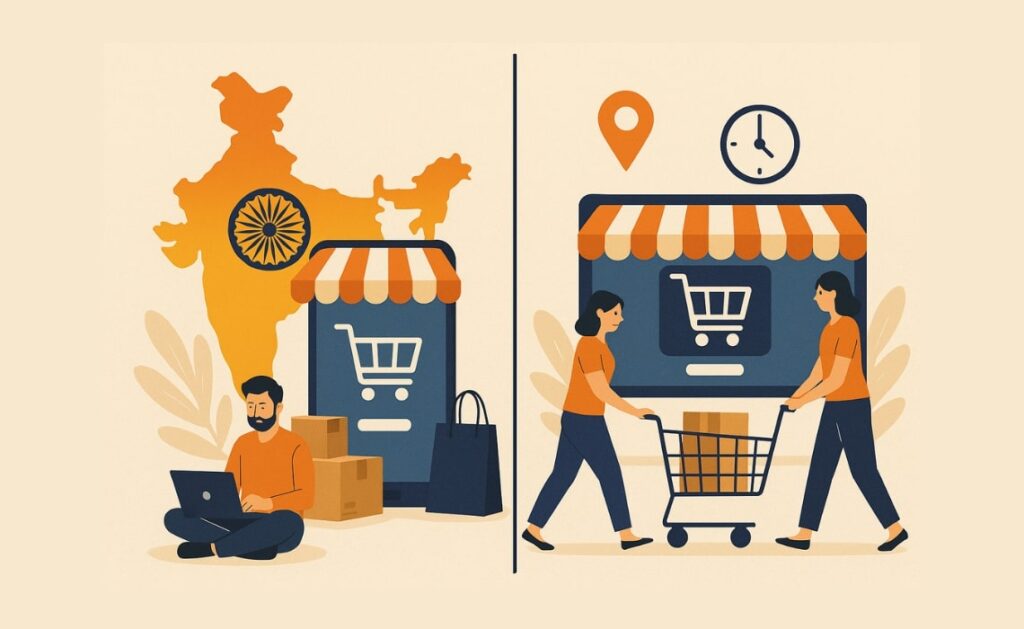
Why e-commerce marketing in India is different
India is not a single market.It is a collection of consumer markets shaped by geography, language, income, culture, digital behaviour and access.
That makes generic global marketing playbooks difficult to apply without adaptation.
Diverse consumer behaviour
A buyer in a major metro may discover a product through Instagram, while another customer in a smaller city may rely more heavily on WhatsApp, recommendations, local creators or search.
Behaviour can vary across:
- Urban and smaller-city audiences
- Age groups
- Languages
- Income levels
- Product categories
- Digital familiarity
Regional language matters
English may dominate much of India’s startup discourse, but e-commerce discovery happens across many languages.
Depending on the target market, brands can experiment with Hindi, Bengali, Marathi, Tamil, Telugu, Odia and other regional-language content.
The important principle is not simply translate everything. It is to understand how customers in that market actually communicate and search.
Trust is part of the marketing strategy
E-commerce customers have to trust a seller before completing a transaction.
Useful trust signals include:
- Authentic customer reviews
- Clear return and refund policies
- Transparent pricing
- Secure payment options
- Visible customer support
- Product information that answers real questions
Payment choice still matters
Digital payments have transformed Indian commerce, but payment preferences can still vary according to customer, product, geography and transaction value.
Marketing should therefore communicate payment options clearly rather than assuming that every customer will behave identically.
Competition makes relevance more important
Indian consumers have more brands, marketplaces and digital shopping options than ever before.
For smaller brands, competing only through advertising budgets can become difficult.Differentiation can instead come from sharper positioning, better content, stronger trust and deeper understanding of a particular customer segment.
One country does not mean one e-commerce customer
| Variable | Possible Metro Behaviour | Possible Tier-2/3/4 Behaviour |
|---|---|---|
| Discovery | Search, social, marketplaces | Search, WhatsApp, creators, communities and recommendations |
| Trust | Reviews, brands and platform reputation | Reviews plus local relevance, recommendations and visible support |
| Language | English and Hindi can often dominate | Regional language may become increasingly important |
| Offer | National promotions | Regional pricing, festivals and category relevance |
| Retention | Loyalty and convenience | Trust, relevance, service and relationship |
“In India, effective e-commerce marketing starts with understanding people — not simply choosing channels.”
The biggest e-commerce marketing mistakes in India
Copying Western playbooks without adaptation
A successful strategy in another market may contain useful principles, but its assumptions about customers, pricing, media consumption and trust may not transfer directly to India.
Treating India as one audience
National campaigns can become much more effective when the underlying audience segmentation is clear.City, language, category, income, occasion and customer maturity can all matter.
Optimising for vanity metrics
Impressions, views and likes can indicate attention.They do not automatically indicate a healthy business.
Track commercial metrics such as:
- Customer acquisition cost
- Conversion rate
- Average order value
- Repeat purchase rate
- Customer lifetime value
- Contribution margin
Ignoring trust signals
A beautiful advertisement cannot compensate for uncertainty around the product, seller, delivery or refund process.
Using the same offer everywhere
Festivals, purchasing occasions, cultural context and price sensitivity can differ across regions.
Localisation should influence the offer itself, not merely the language used in the advertisement.
E-commerce marketing strategies that can work in India
Build hyper-local storytelling
Generic brand messaging is easy to ignore.Stories connected to real customers, places, occasions and communities can make the proposition more relevant.
Consider:
- Regional customer stories
- Local cultural context
- Regional festivals
- City-specific campaigns
- Local creator collaborations
Invest in regional SEO
Search intent often becomes more commercially useful when it includes a specific product, location or need.
Examples:
- “Cotton sarees in Bhubaneswar”
- “Organic spices in Pune”
- “Handloom kurti shop in Lucknow”
The opportunity is to identify the searches that reveal genuine purchase intent rather than simply chasing large generic keywords.
Use WhatsApp as a relationship channel
WhatsApp can support customer communication across discovery, support, order updates and retention.
- Product catalogues
- Order updates
- Customer service
- Personalised offers
- Regional-language communication
The important distinction is between useful communication and indiscriminate messaging.
Make digital payments part of the conversion experience
Payment choice should be easy to understand at checkout.Where commercially appropriate, brands can test incentives for prepaid orders while keeping the economics of discounts, returns and cancellations under control.
Work with regional micro-creators
Large audiences are not automatically better audiences.A smaller creator with strong category and regional relevance can sometimes provide more useful customer attention.
Evaluate creator partnerships using commercial outcomes, audience relevance and trust rather than follower count alone.
Build around regional shopping calendars
India’s commercial calendar extends well beyond a single national festival cycle.
Depending on the target market, campaigns can consider occasions such as Diwali, Durga Puja, Onam, Pongal, Bihu, regional fairs and category-specific buying periods.
Make trust visible throughout the funnel
- Reviews
- Customer testimonials
- Transparent delivery information
- Clear refund policies
- Visible customer support
- Authentic product information
Prioritise retention after the first order
Customer acquisition is only one part of e-commerce economics.Repeat purchases can change the value of the customer relationship substantially.
- Personalised follow-ups
- Useful product recommendations
- Loyalty programmes
- Repeat-purchase incentives
- Post-purchase service
The next e-commerce advantage may be relevance, not reach.
India’s digital commerce opportunity increasingly extends beyond the largest metropolitan markets.
That changes the marketing question.Instead of asking only: “How do I reach more Indians?” brands need to ask: “Which Indians am I trying to serve, and what makes the proposition relevant to them?”
How should an e-commerce brand think about marketing budget in 2026?
There is no universal percentage of revenue that every e-commerce company should allocate to marketing.The appropriate level depends on margins, growth stage, category, customer acquisition economics and retention.
Instead of treating the following as a fixed rule, use the framework as a starting point for experimentation.
Paid acquisition
Test Meta, Google and other paid channels according to measurable commercial outcomes.
Content & SEO
Build search visibility, useful content, regional pages and evergreen customer education.
Creators & community
Test relevant creators and communities rather than automatically buying the largest audience.
WhatsApp & CRM
Build customer communication, retention and lifecycle marketing.
Trust & UX
Improve website experience, reviews, checkout and customer support.
Experimentation
Test emerging channels, formats, AI tools and new customer acquisition ideas.
“The percentages are less important than knowing what each rupee is supposed to accomplish.”
If your e-commerce business has a smaller budget
Smaller brands do not need to imitate the marketing budgets of large platforms.
The starting point can be a narrower market, clearer positioning and stronger customer relationships.
- Regional SEO
- WhatsApp marketing
- Organic storytelling
- Customer referrals
- Micro-creators
- High-quality product education
The principle is simple: relevance can compensate for limited reach.
Marketing stackTools to consider for Indian e-commerce marketing in 2026
Content & SEO
Use SEO research, content optimisation and analytics tools to understand search demand and improve useful content.
Analytics
Use Google Analytics, Search Console and behavioural analytics to understand acquisition, engagement and conversion.
WhatsApp & CRM
WhatsApp Business tools and CRM systems can support customer communication and retention.
Payments & fulfilment
Indian payment and shipping infrastructure can help brands manage checkout, fulfilment and COD-related requirements.
Creator marketing
Creator discovery and campaign-management platforms can help brands identify relevant regional and category-specific creators.
Is your e-commerce marketing ready for 2026?
- Have you clearly defined your target customer?
- Have you identified meaningful regional differences within your target market?
- Are you creating content around real customer questions?
- Are you targeting regional and long-tail search intent?
- Are you using WhatsApp appropriately for communication and retention?
- Are customer reviews and trust signals visible?
- Are you measuring CAC, AOV, repeat purchase and customer lifetime value?
- Are your offers adapted to relevant regional occasions?
- Are you testing smaller creators instead of relying only on large influencers?
- Are you learning from customer behaviour instead of simply increasing advertising spend?
India’s e-commerce opportunity is becoming more granular.
The next phase of e-commerce marketing will not simply be about reaching a larger national audience.
It will increasingly involve understanding smaller groups of customers by city, language, category, behaviour, occasion and purchasing context.
For founders, that creates an important strategic opportunity: build depth before chasing breadth.
E-commerce Marketing Strategies in India — FAQs
What are the best e-commerce marketing strategies in India for 2026?
What is the best marketing strategy for a small e-commerce business in India?
Is regional SEO important for Indian e-commerce?
How important is WhatsApp for e-commerce marketing in India?
Should Indian e-commerce brands use regional languages?
What metrics should e-commerce brands track?
What actually works in Indian e-commerce marketing?
E-commerce marketing in India is not about throwing more money into advertising.
It is about understanding the customer behind the click.
That means knowing where customers discover products, which language they prefer, what makes them trust a brand, how they compare alternatives and what brings them back after the first purchase.
For Indian e-commerce brands, especially those targeting Tier-2, Tier-3 and emerging markets, the opportunity is to become more relevant rather than simply becoming louder.
In Bharat, relevance can beat reach — when the brand genuinely understands the customer.
“In Bharat, relevance beats reach when you understand the person behind the purchase.”
WebVerbal · Bharat Consumer & Digital Economy Intelligence