

Table Of Content
- What Changed for the 2026 Edition?
- Gen Z vs Millennials in India: The 2026 Comparison
- 1. How Gen Z and Millennials Discover Products
- Gen Z discovery environment
- Millennial discovery environment
- 2. Social Commerce Is Changing the Purchase Funnel
- 3. Financial Pressure Makes the “Aspirational Gen Z” Story More Complicated
- 4. Gen Z vs Millennials and Digital Payments
- 5. Brand Loyalty: Switching Is Not the Same as Disloyalty
- For Gen Z, brands increasingly need to prove
- For millennials, brands increasingly need to prove
- 6. Gen Z vs Millennials by Purchase Category
- 7. GenAI Is Becoming a Cross-Generational Consumer Skill
- 8. The 2026 Commerce Shift: Discovery → Validation → Purchase
- 9. What Changes in Tier-2 and Tier-3 India?
- 10. A Practical 2026 Framework for Brands
- 11. What This Means for Indian Brands in 2026
- 12. The WebVerbal Takeaway
- What Is Actually Different in 2026?
- Sources & Methodology
- How this report should be cited
- Frequently Asked Questions
- Continue Reading
Complete consumer behaviour comparison guide covering digital discovery, shopping journeys, payments, price sensitivity, brand choice, social commerce, financial pressure and what these differences mean for Indian businesses.
Gen Z and millennials in India should not be treated as two simple “young vs older” customer groups. The stronger distinction is how they discover, validate and justify a purchase. Gen Z is increasingly shaped by digital discovery, creators, AI-enabled tools and fast feedback loops, while millennials remain important across planned purchases, household decisions and value-led consumption.
But the 2026 evidence also complicates the stereotype: both cohorts are becoming more financially deliberate. Deloitte’s 2026 India survey reports that 54% of Gen Zs and 44% of millennials delayed major life decisions because of their financial situation. Google and Deloitte’s 2026 commerce research projects Gen Z to account for 45% of online spend, showing why the cohort matters commercially without implying that every Gen Z consumer shops impulsively. Deloitte India · Google–Deloitte
Important: These figures come from different studies with different samples, definitions and fieldwork periods. They are not interchangeable and should not be added together. This report keeps source populations and dates visible rather than presenting a single synthetic “generational score.”
What Changed for the 2026 Edition?
The previous version of this article used a large number of precise generational percentages without consistently identifying the underlying survey, sample or fieldwork period. That makes a report look data-rich without necessarily making it citable.
This 2026 edition takes a different approach. It separates documented external evidence from WebVerbal interpretation, uses current 2025–2026 research where available, and avoids treating every behavioural difference as a universal rule.
The useful generational divide is not “impulsive Gen Z vs careful millennials.” It is the difference between discovery systems, decision contexts and financial constraints.
Gen Z vs Millennials in India: The 2026 Comparison
| Consumer dimension | Gen Z | Millennials | 2026 interpretation |
|---|---|---|---|
| Discovery | More exposed to creator-led, social and digital-first discovery. | Strong mix of search, marketplaces, reviews, recommendations and established channels. | Discovery is becoming fragmented for both cohorts; the difference is channel mix rather than a simple online/offline split. |
| Purchase validation | Social proof, creator content, short-form/video and peer signals can play a strong role. | Reviews, specifications, reputation, comparison and personal recommendations remain important. | Brands need multiple evidence formats instead of one generic product page. |
| Price | High interest in value despite aspirational consumption. | Value, household economics and total usefulness remain important. | Financial pressure affects both cohorts; “premium Gen Z” is not the same as price-insensitive Gen Z. |
| Payments | Strong familiarity with mobile-first digital payments. | Broad digital-payment adoption combined with cards, EMI and other established instruments. | Payment method is increasingly part of the proposition, not just checkout infrastructure. |
| Brand relationship | More open to discovery and experimentation, but expectations around relevance and authenticity are high. | Greater exposure to established brands and longer household relationships. | Trust, product performance and relevance can matter more than demographic targeting alone. |
| AI | High comfort with GenAI and digital experimentation. | Also rapidly adopting GenAI; Deloitte reported 85% of both cohorts using GenAI at work in its 2025 India survey. | AI familiarity is no longer a Gen Z-only signal. |
| Life-stage context | Students, early-career workers and young households coexist inside the cohort. | Household formation, children, housing, career and asset decisions are more common. | Life stage can explain behaviour better than generation label in many categories. |
1. How Gen Z and Millennials Discover Products
The biggest change in Indian commerce is not simply that more people shop online. It is that the discovery stage is moving outside the traditional search box.
BCG and Snap’s India research found that Gen Z was already reshaping consumer behaviour at significant scale, estimating that the cohort contributed about 46% of consumer spending, equivalent to roughly US$860 billion, in its 2024 analysis. BCG also identified seven values and five shopping behaviours that distinguish Gen Z from millennials. The research covered Gen Z, their parents and millennials rather than relying on a simple age stereotype.
Read the BCG & Snap India Gen Z research.
Gen Z discovery environment
- Creator and social content can introduce products before a conventional search begins.
- Video can compress discovery, demonstration and social proof into one experience.
- Peer signals and community reactions can influence consideration.
- AI tools are increasingly available inside the discovery and research journey.
Millennial discovery environment
- Search and marketplace discovery remain important.
- Detailed reviews and product information can support planned decisions.
- Recommendations from family, friends and professional networks can matter.
- Brand familiarity remains relevant for household and higher-value purchases.
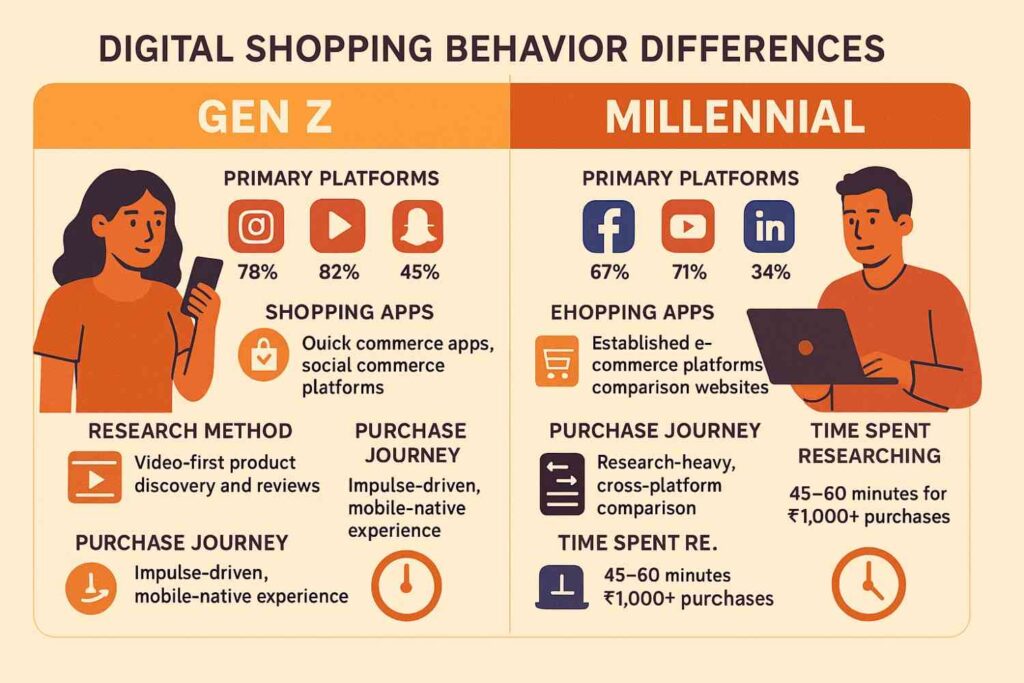
2. Social Commerce Is Changing the Purchase Funnel
For Gen Z, social platforms can operate as discovery, validation and entertainment environments simultaneously. That does not mean every Gen Z consumer completes a transaction inside a social app. The more defensible conclusion is that social content increasingly participates in the path to purchase.
Deloitte–FICCI’s 2025 India retail research reported that online marketplaces influenced 73% of purchase decisions, while YouTube reviews influenced 40% and peer recommendations 51%. The same research projected Gen Z at 43% of total consumption in 2025 with direct spending power of US$250 billion. These are Deloitte–FICCI estimates and should be read in the context of that report’s methodology.
Deloitte–FICCI retail research.
The 2026 shopping funnel is less linear: a consumer can discover a product in a video, validate it through comments, search the brand, compare prices on a marketplace, ask an AI tool a question and then return to the brand site.
3. Financial Pressure Makes the “Aspirational Gen Z” Story More Complicated
One of the most important corrections to simplistic generational marketing is financial context.
Deloitte’s 2026 India Gen Z and Millennial survey reports that 54% of Gen Zs and 44% of millennials in India had delayed major life decisions because of their financial situation. More than 60% of both groups said housing affordability affected career decisions, while 20% of Gen Z and 13% of millennials reported struggling to pay living expenses each month.
Deloitte India 2026 Gen Z & Millennial Survey.
| Question for a brand | What the 2026 evidence suggests |
|---|---|
| Will Gen Z pay a premium? | They can participate in premium consumption, but financial pressure means the premium still needs a clear reason. |
| Are millennials purely value-driven? | No. Household, experience, convenience and quality can all create willingness to spend. |
| What matters most? | The relationship between perceived value, trust, affordability and the consumer’s immediate life stage. |
4. Gen Z vs Millennials and Digital Payments
India’s payment infrastructure has changed the context for generational comparison. UPI has made digital payment behaviour routine across age groups, so the useful question is no longer simply “who uses digital payments?” but what role does payment flexibility play in the purchase decision?
Older WebVerbal versions of this report assigned precise UPI, wallet, BNPL and credit-card percentages to each generation without a consistent source trail. Those figures are therefore not carried forward as 2026 facts.
For 2026, the more defensible commercial distinction is:
- Gen Z: expects low-friction mobile experiences and increasingly encounters commerce through digital-first interfaces.
- Millennials: combine digital payments with cards, EMI and other financial tools across larger household and planned purchases.
- Both: increasingly judge checkout as part of the overall experience.
For the broader payment ecosystem, see WebVerbal’s Best Payment Gateways in India.
5. Brand Loyalty: Switching Is Not the Same as Disloyalty
Generational reports often describe Gen Z as “disloyal” and millennials as “loyal.” That framing is too crude for a 2026 consumer report.
A better distinction is what earns the right to be remembered.
For Gen Z, brands increasingly need to prove
- relevance to the consumer’s identity or use case;
- credible social and creator signals;
- product experience rather than only advertising;
- speed of response and digital convenience;
- authenticity rather than polished claims alone.
For millennials, brands increasingly need to prove
- consistent product quality;
- service reliability;
- value over the full ownership period;
- household usefulness and convenience;
- credible reputation and information.
Loyalty is moving from “brand habit” toward “evidence of continued value.” The evidence required may look different by generation and category, but both groups can switch when the perceived value equation changes.
6. Gen Z vs Millennials by Purchase Category
| Category | Gen Z opportunity | Millennial opportunity | What the brand should demonstrate |
|---|---|---|---|
| Fashion | Identity, novelty, creator discovery and social relevance. | Quality, fit, durability, versatility and value. | Visual proof + reviews + clear product information. |
| Beauty & personal care | Discovery, routines, creators and ingredient curiosity. | Trust, efficacy, repeatability and household needs. | Demonstration, ingredients, reviews and credibility. |
| Electronics | Features, content creation, gaming and experience. | Reliability, productivity, service and total value. | Specifications + comparison + real-use demonstrations. |
| Food & grocery | Convenience, discovery and digital ordering. | Value, family needs, quality and convenience. | Availability, price transparency, quality and delivery. |
| Home | Smaller-ticket identity and lifestyle purchases. | Household utility, durability and larger planned decisions. | Use cases, dimensions, quality and financing where relevant. |
| Financial products | Digital-first education and low-friction interfaces. | Trust, protection, wealth-building and household planning. | Plain-language explanation, transparency and trust. |
7. GenAI Is Becoming a Cross-Generational Consumer Skill
AI is one of the clearest areas where an old generational assumption is becoming less useful.
Deloitte’s 2025 India Gen Z and Millennial survey found that 85% of both Indian Gen Zs and millennials were already using GenAI at work. Gen Z respondents most often reported using it for design, content creation and data analysis, while millennials most often cited data analysis, content creation and project management.
AI can become part of consumer research itself: product comparison, summarisation, recommendations, translation, planning and question answering. Brands therefore need information that machines can understand and consumers can verify.
8. The 2026 Commerce Shift: Discovery → Validation → Purchase
Google and Deloitte’s 2026 commerce research projects India’s e-commerce market to reach US$250 billion by 2030, up from US$90 billion at the time of the report. It also projects a 220-million-strong Gen Z cohort to command 45% of online spend and identifies creators, AI, instant fulfilment and immersive experiences as major forces shaping commerce.
Google–Deloitte: The $250 Billion Commerce Frontier.
| Stage | What the consumer asks | What the brand must provide |
|---|---|---|
| Discovery | “Why should I notice this?” | Clear visual story, creator/community context and category relevance. |
| Validation | “Can I trust this?” | Reviews, evidence, specifications, transparent claims and social proof. |
| Comparison | “Is this better value?” | Useful comparisons, pricing clarity and product differentiation. |
| Purchase | “Can I buy this without friction?” | Reliable checkout, payment choice, delivery clarity and support. |
| Post-purchase | “Was this worth it?” | Service, fulfilment, returns, product performance and community. |
9. What Changes in Tier-2 and Tier-3 India?
Generation is only one lens. Geography, household structure, language, income, category and digital access can materially change the purchase journey.
Deloitte–FICCI reported in 2025 that Tier-II and Tier-III cities accounted for more than 60% of e-commerce transactions in its retail analysis. The finding reinforces a key WebVerbal editorial principle: Indian consumer behaviour cannot be understood through metro consumers alone.
This is especially relevant for WebVerbal’s Bharat-focused research because a Gen Z consumer in Bengaluru and a Gen Z consumer in a Tier-3 city can share a generation label while operating inside very different retail environments.
Generation tells you who the consumer is. Geography, life stage and category tell you why the consumer buys.
10. A Practical 2026 Framework for Brands
Instead of creating separate campaigns simply because the target audience is labelled Gen Z or millennial, use the following six-question test.
| Test | Question | Action |
|---|---|---|
| 1. Discovery | Where does this customer first encounter the problem or product? | Build channel-specific discovery assets. |
| 2. Proof | What evidence does the customer need before trusting the claim? | Publish reviews, demonstrations, comparisons and transparent data. |
| 3. Value | What makes the price feel justified? | Show use, durability, convenience, outcomes or experience. |
| 4. Friction | What can stop the purchase? | Reduce checkout, delivery, payment and information friction. |
| 5. Context | What life-stage or household context changes the decision? | Segment by use case, not only age. |
| 6. Retention | Why should the customer buy again? | Build service, product performance, trust and relevance. |
11. What This Means for Indian Brands in 2026
- Stop treating Gen Z as a single personality. Students, early-career professionals, affluent urban consumers and emerging-city consumers can behave differently.
- Do not assume millennials are offline-first. Indian millennials are deeply digital and are also adopting GenAI rapidly.
- Design for discovery outside Google. Social, creators, marketplaces, communities and AI interfaces can all influence consideration.
- Make evidence visible. The product page needs to answer the questions a consumer will ask before buying.
- Build affordability into the experience. Financial pressure is shaping both cohorts.
- Segment by category and life stage. A generation label is a starting point, not a complete customer profile.
- Think Bharat, not only metro India. City tier, language, logistics and local trust can change the purchase journey.
12. The WebVerbal Takeaway
What Is Actually Different in 2026?
The most important shift is not that Gen Z has replaced millennials. It is that both cohorts are becoming more digitally capable while becoming more selective about value.
Gen Z is commercially important because digital discovery and online spending are becoming increasingly influential. Millennials remain commercially important because household formation, financial decisions and planned consumption give the cohort substantial purchasing responsibility. The dividing line between them is therefore increasingly contextual.
For Indian brands, the practical lesson is simple: build one customer understanding system, then adapt the discovery, proof, value proposition and experience to the actual context of the buyer.
Sources & Methodology
How this report should be cited
This report combines current external research with WebVerbal synthesis. External statistics are attributed to the originating research organisation. WebVerbal interpretations are explicitly labelled as patterns or lenses. Figures from different studies are not combined into a single proprietary dataset.
- Deloitte India, 2026 Gen Z and Millennial Survey: India-specific findings on financial pressure, delayed life decisions, housing affordability and cohort priorities. Source
- Google & Deloitte, 2026: India e-commerce outlook, projected US$250B market by 2030, Gen Z share of online spend and commerce trends. Source
- Deloitte–FICCI, 2025: India retail outlook, online marketplace influence, Gen Z consumption and emerging-city commerce. Source
- BCG & Snap India, 2024: Gen Z’s contribution to Indian consumer spending and generational shopping behaviour. Source
- Deloitte India, 2025: GenAI adoption among Indian Gen Zs and millennials and differences in reported workplace use cases. Source
- PwC India, Voice of the Consumer 2025: Indian consumer survey covering 1,031 respondents and consumer behaviour across age groups. Source
Frequently Asked Questions
What are the main Gen Z vs millennial buying differences in India in 2026?
How much of India’s online spending is expected to come from Gen Z?
Are Gen Z consumers more price-sensitive than millennials?
Do millennials still matter in digital commerce in India?
How does Tier-2 and Tier-3 India change generational consumer behaviour?
What should brands do differently for Gen Z and millennials?
Continue Reading
Editorial note: This 2026 edition intentionally removes unsupported legacy percentages from the earlier version and prioritises traceable research, sample context, publication dates and clearly labelled WebVerbal interpretation.