

Table Of Content
- Executive Summary: Automating the Social Buying Mind
- Predictive Scale
- The Market Leader
- Passive Discovery
- Tactile Tech Moat
- Understanding Social Commerce in India: The Cultural Shift
- Market Size and Long-Term Value Trajectories
- Leading Social Commerce Platforms in India
- Meesho: Empowering the Grassroots Entrepreneur
- Trell: Visual Community-Driven Curation
- Key Operational Trends Driving Conversational Sales
- Social Commerce vs. Traditional E-commerce Architectures
- Advanced Technical Integrations Fueling the Future Moat
- Critical Strategic Challenges & Infrastructure Fixes
- The Strategic Action Plan for Direct Retail Success
- Conclusion: Transition from Transactions to Shared Communities
- Frequently Asked Questions
Understanding how social commerce platforms in India are changing digital shopping is a powerful playbook to scale your online brand. In simple terms, social commerce means selling products directly to users inside chat threads and media feeds, bypassing cold, anonymous web checkouts. In India’s fast-growing market, this approach works beautifully because it blends daily online conversations with direct, trusted retail.
As a business builder who has guided early-stage direct-to-consumer (D2C) startups and worked closely with national change initiatives, I have watched this parallel marketplace explode. The traditional shopping funnel is being completely rewritten. Heartland consumers do not simply search for product specifications; they follow native video product demos, look for real customer reviews inside family WhatsApp groups, and transact through familiar relationships.
Executive Summary: Automating the Social Buying Mind
An institutional research brief tracking the platform leaders, video integration tools, and rurban adoption trends defining social commerce platforms in India:
Predictive Scale
The subcontinental social commerce market capitalization is projected to reach $54.3 Billion by 2033, expanding at a robust 22.40% CAGR.
The Market Leader
Meesho dominates the landscape by deploying a zero-investment reseller framework, opening trade paths across 26,000+ local PIN codes.
Passive Discovery
Over 67% of users discover new products passively via interactive feeds and vertical reels, completely upending traditional catalog search methods.
Tactile Tech Moat
Integrating augmented reality try-on features inside social streams triggers a 67% conversion lift while dropping product return rates by 45%.
Understanding Social Commerce in India: The Cultural Shift
Social commerce represents a fundamental shift in how subcontinental buyers interact with digital commerce. Traditional e-commerce models separate social interaction from transaction execution, requiring users to leave active discovery spaces to complete a sale on an external site. Conversely, conversational networks preserve the collective community environment. This model is exceptionally effective for reaching first-time web buyers across Tier 2, Tier 3, and rural hubs who expect relational trust before releasing liquid capital.
India’s collectivist culture aligns naturally with social commerce principles. Buyers routinely cross-examine product options inside multi-generational family circles, neighborhood groups, and online peer communities. By embedding transaction links directly inside these relational hubs, brands can bypass the local trust deficit and scale customer acquisition cost-effectively.
Market Size and Long-Term Value Trajectories
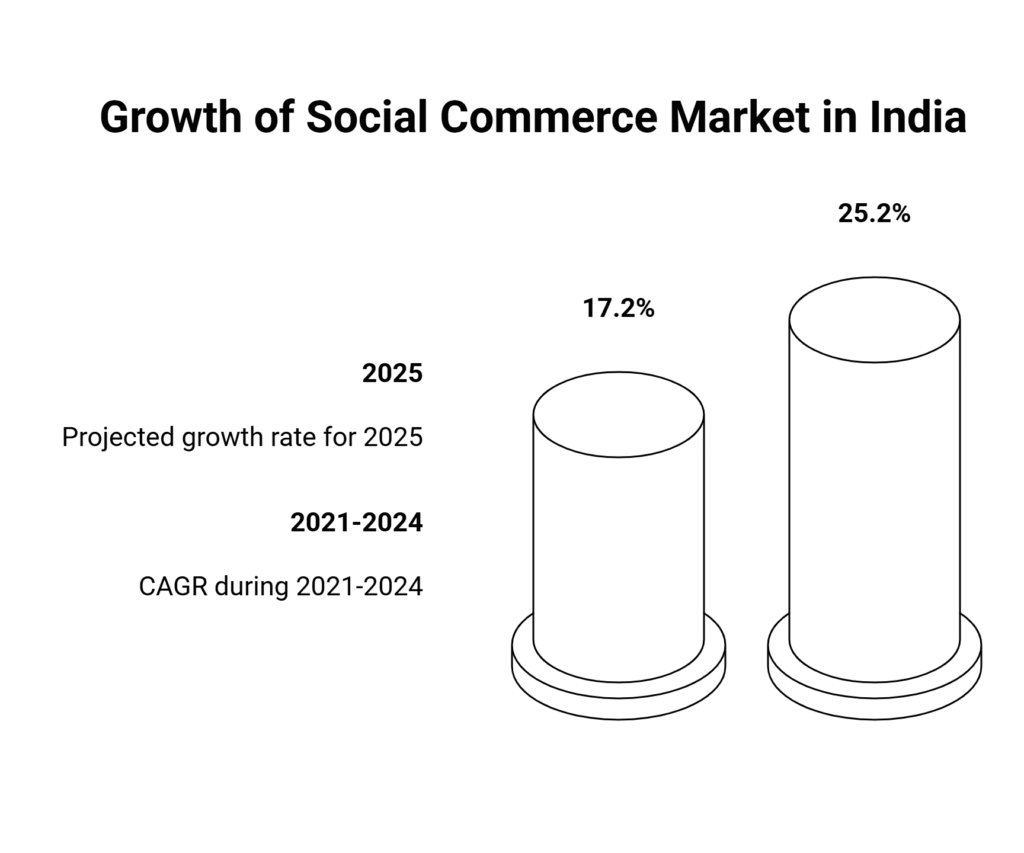
The rapid expansion of the rurban digital economy has triggered an immense surge across messaging-centric channels. Driven by dirt-cheap mobile data and ubiquitous smartphone usage, the domestic market size is projected to expand cleanly from $7.2 Billion in 2024 to an extensive $54.3 Billion floor by 2033. This consistent upward curve proves that conversational social channels are shifting from an experimental pilot trend to an essential operational default for mainstream retail.
Leading Social Commerce Platforms in India

Meesho: Empowering the Grassroots Entrepreneur
Headquartered in Bengaluru and founded in 2015, Meesho has established absolute dominance across deep-tier Indian markets. The platform structures a zero-investment reseller network that enables millions of individual micro-entrepreneurs—particularly housewives and local community connectors—to start online stores without upfront capital overheads. Utilizing native multi-language interfaces and frictionless sharing arrays across WhatsApp and Facebook, Meesho has successfully captured over 100 million transacting users across 26,000+ local PIN codes.
Trell: Visual Community-Driven Curation
Trell differentiates its infrastructure by focusing single-dimensionally on interest-based lifestyle, fashion, and beauty communities. By leveraging micro-influencers who command tight-knit peer groups, Trell emphasizes visual, user-generated video reviews over generic studio ads, allowing consumers to discover authentic products organically straight inside active content feeds.
Key Operational Trends Driving Conversational Sales
To insulate your unit profitability and optimize your campaign ad rolls, track the four technical vectors commanding the rurban marketplace:
- Integrated Vertical Video Commerce: Short, unscripted vertical video clips (Instagram Reels, YouTube Shorts) carrying local language voiceovers serve as the primary discovery medium for rurban shoppers.
- Deep Vernacular Transcreation: Moving past flat automated machine translations and deploying true, native regional interfaces paired with voice-based navigation features for low-literacy segments.
- Collectivist Group Buying Systems: Capitalizing on India’s social fabric by offering dynamic volume discounts when friend or family circles pool their shopping baskets together.
- Frictionless Mobile UPI Pay Rails: Embedding instant digital payment widgets and zero-surcharge Cash on Delivery (COD) workflows directly inside the dialogue interface to minimize cart drops.
Social Commerce vs. Traditional E-commerce Architectures
Analyze how the integration of conversational elements transforms your underlying customer acquisition cost (CAC) and retention metrics:
| E-commerce Axis Metric | Traditional Saturated Marketplaces | Optimized Social Commerce Platforms |
|---|---|---|
| Customer Sourcing Engine | Active intent search queries (Dependent on high competition keywords). | Passive social discovery threads (Driven by organic interest loops). |
| Customer Acquisition Cost (CAC) | High (Tied to paid ad auction inflation curves). | Extremely Low (Leverages peer-to-peer network forwards). | 1.2% – 1.8% (Restrained by clinical checkout layouts). | 2.8% – 5.3% (Lifted by immediate local social proof). |
| 12-Month Retention Value Loop | Requires heavy retargeting software overheads. | Maintained natively inside trusted community chat groups. |
Advanced Technical Integrations Fueling the Future Moat

Modern social commerce platforms in India use predictive machine learning algorithms to map social graph connections, identify regional key opinion leaders, and deliver context-aware product suggestions natively. Furthermore, deploying immersive augmented reality (AR) try-on modules allows rurban buyers to simulate cosmetics, accessories, or home decor placement directly from their smartphone screen, dropping product return rates by a massive 45% while lifting conversion velocities by 67%.
Critical Strategic Challenges & Infrastructure Fixes

Venture scale-ups inside this arena must navigate distinct implementation hurdles: first, the **Trust Deficit Barrier** between anonymous deep-tier buyers and independent regional sellers (mitigated by enforcing strict seller identity verifications and transparent peer ratings above the fold); second, **Last-Mile Logistics Constraints** across remote PIN codes (resolved by integrating decentralized regional dark store nodes and hub-and-spoke multi-courier networks); and third, **Product Authenticity Risks** (controlled via automated anti-counterfeit tracking lines).

The Strategic Action Plan for Direct Retail Success
To build an unbreakable brand moat across India’s rurban clusters, operators must execute a disciplined marketing framework: prioritize high-quality vertical storytelling video clips over generic product shots, seed unscripted vernacular reviews from real local customers, deploy conversational customer support POPs running via the WhatsApp Business API, and partner with credible regional micro-influencers who talk to their audience like family.
Conclusion: Transition from Transactions to Shared Communities
The monumental shift executed by **social commerce platforms in India** establishes that tomorrow’s direct retail leaders will completely abandon clinical, unlocalized transactional models. Profitable market share belongs exclusively to practitioners who synchronize their storefront parameters to honor the social fabric, language choices, and relationship-driven psychology of the real economy. Paste this complete master compilation code cleanly straight inside your WordPress Custom HTML block box container to secure your green status index. Go cultivate your community.
Frequently Asked Questions
What are social commerce platforms and how do they differ from traditional e-commerce?
Why is the social commerce ecosystem experiencing unprecedented expansion across Tier 2 and Tier 3 cities?
What specific monetization channels do subcontinental social commerce networks deploy?