
Table Of Content
- Executive Summary
- The “MVP Trap” in Bharat
- The Founder Reality Check: Execution Audit
- Are You Trapped in the Overthinking Loop?
- Key Insights: Increasing Startup Shipping Speed
- The Founder’s Takeaway
- Conclusion
- Frequently Asked Questions (FAQ)
- What is Minimum Viable Product execution?
- How does founder paralysis affect startup shipping speed?
- Why is agile building so important in Tier-2/Tier-3 markets?
- How do I know when my MVP is ready to launch?
You have been building your product in stealth mode for eight months. Every week, a new feature is added, but zero actual customers have seen it. This is founder paralysis, and it is silently killing your runway. If you do not master Minimum Viable Product execution, your startup will run out of capital before it ever meets the market.
While government frameworks like the MeitY Startup Hub (MSH) provide excellent infrastructure and incubation resources for early-stage tech ventures, the responsibility of execution speed falls entirely on the founder’s shoulders. As we decoded in our Webverbal Founder Intelligence Series, the most successful entrepreneurs in Bharat do not win because they launch the most polished app; they win because they ship, fail, learn, and iterate faster than their competitors.
Executive Summary
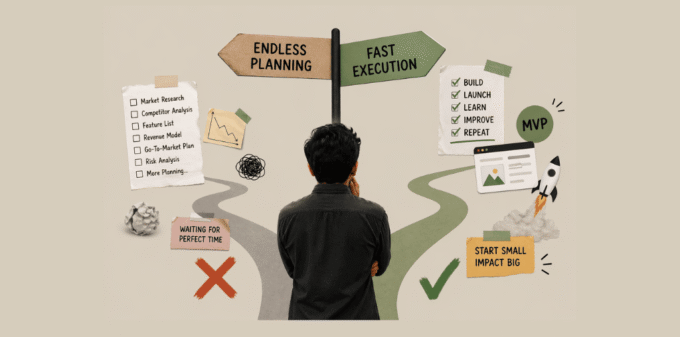
Founders frequently confuse a “Minimum Viable Product” with a “Miniature Perfect Product.” This perfectionism creates a fatal delay in startup shipping speed. To survive the grassroots economy, founders must overcome founder paralysis, adopt ruthless agile building frameworks, and push “embarrassing” initial versions to the market to gather real-world validation instead of internal assumptions.
The “MVP Trap” in Bharat
In India, founders often misunderstand the word “Viable.” In an attempt to build a flawless ecosystem, they fall into the MVP Trap—delaying their launch to add “just one more feature” to compensate for their underlying fear of market rejection.
In Tier-2 and Tier-3 markets, consumers do not care about a cluttered, feature-rich interface or a pixel-perfect aesthetic. They care about utility and trust. A WhatsApp group that solves a genuine supply chain friction for local retailers is a better Minimum Viable Product than a beautifully coded app that nobody understands. Agile building is about validating your core economic assumption as cheaply as possible, not polishing the code.
The Founder Reality Check: Execution Audit
Are you building a business, or are you just playing startup? Take this 4-question execution audit to see if you are trapped in the overthinking loop.
Are You Trapped in the Overthinking Loop?
Answer these 4 questions honestly to assess your startup shipping speed.
Key Insights: Increasing Startup Shipping Speed
To break out of the overthinking loop, you must change your definition of a product launch.
- The “Embarrassment” Rule: If you are not slightly embarrassed by the first version of your product, you launched too late. The goal of an MVP is not to impress the user; it is to find out if they are willing to pay to solve the problem.
- The “Concierge” MVP: Before writing a single line of backend code, can you do the job manually? If you are building a B2B AI matching platform, can you match the first 10 clients yourself using an Excel sheet and a phone call? If they won’t use the manual version, they won’t use the automated one.
- Timeboxing: Give yourself a strict 14-day limit to build the core feature. When the clock runs out, you ship. Constraints breed creativity; unlimited time breeds scope creep.
The Founder’s Takeaway
Execution speed is the ultimate defensive moat for early-stage founders. The large incumbents have more money, more developers, and more distribution. Your only advantage is that you can have an idea on Monday and test it with real users by Friday. Do not surrender your only advantage by acting like a slow corporate bureaucracy.
Conclusion
Building a product in a vacuum is the fastest way to kill a startup. If your audit revealed that you are paralyzed by perfectionism, it is time to drastically alter your operational cadence. Stop guessing what the market wants. Step into the Webverbal Swayam ecosystem, and let us help you execute a high-speed agile framework that forces validation over perfection.
Frequently Asked Questions (FAQ)
What is Minimum Viable Product execution?
Minimum Viable Product (MVP) execution is the process of building the absolute simplest version of your idea that delivers core value to the customer, launching it quickly, and using real market data to guide future development.
How does founder paralysis affect startup shipping speed?
Founder paralysis occurs when the fear of failure or criticism causes a founder to endlessly delay a launch. This kills startup shipping speed, depletes capital, and prevents the company from gaining necessary early traction.
Why is agile building so important in Tier-2/Tier-3 markets?
Consumer behavior in Bharat changes rapidly and is often deeply counter-intuitive to metro-based founders. Agile building allows you to test localized features, vernacular UX, and unique payment flows quickly without committing massive resources to a flawed assumption.
How do I know when my MVP is ready to launch?
Your MVP is ready the moment it solves the single biggest friction point for your target audience. If it does the one thing it promises to do, it is ready. Ignore the secondary “nice-to-have” features until after you launch.