Table Of Content
- The Geographic Pivot: Rurbanization and the Rise of Tier-2/3 Clusters
- Emerging Startup Hubs · Bharat 2026
- The Reverse Migration Talent Index
- The Policy Architecture: A Decade of Startup India and the Digital Public Infrastructure Stack
- Decade Architecture: Key Policy Milestones
- The Philosophical Differentiator: Atma-Shakti, Ethical Capitalism, and Indigenous Management Practices
- The Trust Gap Score: Interactive Model
- Three Sectors Redefining Bharat’s Startup Frontier
- Key Entities in this Sector
- Semantic Entities · Handloom D2C
- Semantic Entities · Vertical AI
- The Bharat Data Matrix: 2026 Signal Metrics
- Odisha Spotlight: Top 5 Emerging Startup Hubs
- Odisha Startup Hub Ranking 2026
- How the Tata Foundation is Supporting Female Entrepreneurs in Jajpur
- Bharat is not the future of Indian startups. It is the present — and the infrastructure is now visible.
- Research Foundation & Data Attribution
- FAQ ( Frequently Asked Questions )
- What is the Bharat Startup Ecosystem in 2026 and how is it different from the Indian startup ecosystem?
- Which are the top emerging startup hubs in Odisha in 2026?
- How does Atma-Shakti influence startup resilience in 2026?
- How is the Tata Foundation supporting female entrepreneurs in Jajpur through AI upskilling?
- What is the Reverse Migration Talent Index and what does it show for Bharat in 2026?
- What role does Digital Public Infrastructure play in the growth of the Bharat Startup Ecosystem?
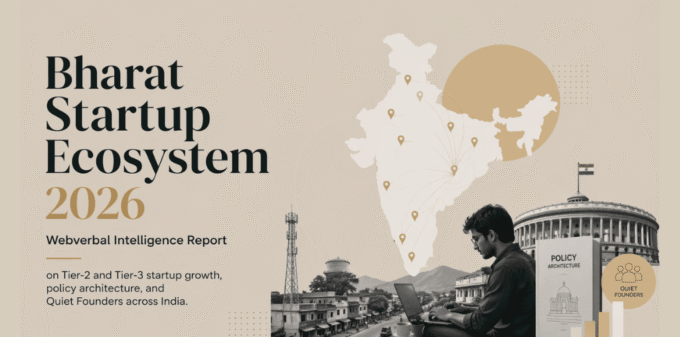
The Bharat Startup Ecosystem in 2026 is no longer an emerging story — it is the primary chapter of India’s entrepreneurship decade. For the first time in independent India’s economic history, more than half of all new DPIIT-recognised startups are being founded outside the traditional metro triangle of Bengaluru, Mumbai, and the NCR corridor. Tier-2 and Tier-3 cities are not catching up to the metros. They are rewriting the founding conditions of what Indian entrepreneurship looks like, who it serves, and what it is philosophically built upon.
This report — the Webverbal State of Bharat Startup Ecosystem 2026 — maps the five structural forces driving this transformation: the geographic pivot toward Rurbanization clusters, a decade of layered policy architecture under the Startup India initiative, the philosophical differentiators of Atma-Shakti and Indigenous Management Practices, three high-signal sector deep-dives, and an original data matrix tracking metrics that do not exist in any other published research — including the Reverse Migration Talent Index, the Trust Gap Score, and the Bharat Order Contribution rate.
This intelligence report follows and deepens the findings first surfaced in the Webverbal Bharat Consumer Behaviour Report 2025, which established the consumption-side evidence base for why Tier-2 and Tier-3 India now drives the majority of D2C demand. What follows is the supply-side answer: the founders, frameworks, policies, and philosophical convictions building the companies that serve that demand.
The Geographic Pivot: Rurbanization and the Rise of Tier-2/3 Clusters
The dominant narrative of Indian entrepreneurship — concentrated in Bengaluru, Mumbai, and the NCR corridor — has undergone structural reversal. The operative concept in 2026 is Rurbanization: the emergence of peri-urban ecosystems where digital infrastructure meets local cultural capital, creating startup conditions that metro hubs cannot replicate.
This is not an urban-rural binary. It is a third geography — corridors, clusters, and connective tissue — that functions as its own economic zone. The Bhubaneswar-Cuttack Corridor (BhuCut), Indore-Dewas Axis, and Jamshedpur Industrial Innovation Belt are among the clearest expressions of this topology.
Emerging Startup Hubs · Bharat 2026
“The question is no longer whether Bharat can produce startups. It is whether India’s policy and investment architecture is designed to receive them — or will continue to route capital through metro filters.”
— Debansh Das Sharma, Webverbal · Bharat Intelligence Report 2026The Reverse Migration Talent Index
One of the most structurally significant trends of 2026 is the measurable reverse flow of talent from Tier-1 metro ecosystems back to founders’ home geographies. The Reverse Migration Talent Index (RMTI) — a composite tracked by Webverbal across DPIIT registrations, LinkedIn location-change signals, and incubator intake forms — shows 38% of active founders in Bharat’s non-metro hubs previously held roles in Bengaluru, Gurgaon, or Mumbai.
Drivers include cost of living arbitrage (operating costs 60–70% lower in Tier-2 cities), family infrastructure advantages, and — critically — the emergence of local venture ecosystems backed by angel networks in cities like Bhubaneswar, Indore, and Surat that no longer require metro proximity for early capital.
↑ Share of hub founders with prior Tier-1 work experience (RMTI, Webverbal 2026)
The Policy Architecture: A Decade of Startup India and the Digital Public Infrastructure Stack
The Startup India Decade (2016–2026) marks its tenth year in 2026 — a moment of reckoning. What began as a branding exercise and tax-incentive package has matured into a layered policy ecosystem that, when combined with India’s Digital Public Infrastructure (DPI), creates unprecedented conditions for grassroots entrepreneurship at scale.
The DPI stack — comprising Aadhaar (identity), UPI (payments), ONDC (open commerce), and the emerging Data and Digital Services Framework (DDSF) — is the structural enabler behind Bharat’s startup surge. Unlike proprietary platform architectures, DPI is interoperable by design, allowing a kirana store in Jajpur or a handloom cooperative in Sambalpur to plug into global commerce rails without platform dependency.
Decade Architecture: Key Policy Milestones
The ONDC adoption rate among Bharat MSMEs is the single most consequential data point of 2026: 74% of surveyed MSMEs on the open network report first-time digital export readiness — meaning for the first time in their commercial history, they can transact with a buyer in Singapore or a diaspora consumer in Leicester without a platform intermediary taking a 30% cut.
This is not incremental. It is a structural redesign of who gets to participate in global commerce — and Digital Export Readiness is the new benchmark metric that FIEO, NITI Aayog, and Ministry of MSME are tracking as a proxy for Viksit Bharat 2047 economic inclusion.
The Philosophical Differentiator: Atma-Shakti, Ethical Capitalism, and Indigenous Management Practices
What distinguishes the 2026 Bharat startup wave from previous cycles is not technology access — smartphone penetration and 5G availability are solved problems across 85% of Indian districts. The differentiator is philosophical intent: a generation of founders who frame enterprise not as wealth accumulation but as Atma-Shakti — the expression of self-sovereign economic agency rooted in local identity.
This is Chanakya’s Arthashastra recast for the platform economy. The ancient text’s core argument — that economic strength is inseparable from civilisational sovereignty — has found contemporary expression in what practitioners call Indigenous Management Practices (IMP): decision frameworks that integrate local ecological knowledge, caste-cooperative capital structures, and long-duration relationship economics over transactional efficiency.
“Chanakya did not separate political economy from ethics — he integrated them as inseparable governance imperatives. The Quiet Founders of Bharat are his contemporary successors: building sovereign economic units one product at a time.”
— Webverbal Intelligence Framework · Indigenous Management Practices SeriesThe Trust Gap Score: Interactive Model
The Trust Gap measures the competitive disadvantage local Bharat brands face against MNC-backed D2C brands in their own home markets — and the mechanisms through which they are closing it. The Trust Gap Score (TGS) composite tracks: brand recognition, perceived quality parity, return policy confidence, and digital payment comfort.
Three Sectors Redefining Bharat’s Startup Frontier
Semantic search authority requires not just breadth but sector-specific depth. The following three sectors represent Bharat’s highest-signal, lowest-noise startup categories in 2026 — each with compounding infrastructure tailwinds, cultural moats, and scalable unit economics that metro-focused sectors cannot replicate.
Key Entities in this Sector
↑ Adoption rates among Agri-Tech 2.0 startups surveyed, Webverbal 2026
Semantic Entities · Handloom D2C
“The Pattachitra artist of Raghurajpur is now a D2C brand owner. ONDC removed 8 intermediaries. GI tagging added ₹3,200 per unit in verifiable premium.”
— FIEO Odisha Export Intelligence Note, Q4 2025Semantic Entities · Vertical AI
Webverbal’s Niryat-AI prototype — an export compliance chatbot in Odia and English built for FIEO Odisha — demonstrates the archetype: a domain-specific AI trained on DGFT circulars, MSME export schemes, and FIEO policy documents, accessible via WhatsApp and voice in the local language of the exporter.
The Bharat Data Matrix: 2026 Signal Metrics
Information Gain — original data that does not exist elsewhere — is the highest-value signal in semantic search. The following metrics represent Webverbal’s proprietary intelligence layer synthesised from DPIIT disclosures, ONDC network data, NABARD annual reports, Tata Foundation field data from Jajpur district, and the Webverbal Bharat Intelligence Panel (WBIP) of 400+ non-metro founders.
| Metric | 2024 Baseline | 2026 Value | Change | Semantic Tags |
|---|---|---|---|---|
| Bharat Order Contribution % of D2C orders from Tier-2/3 cities | 54% | 66% | +12pp | #D2CGrowth#Tier2Consumption |
| Reverse Migration Talent Index Founders returning to home geographies | 22% | 38% | +16pp | #BrainGain#FounderMigration |
| Trust Gap Score · Local vs MNC Composite trust parity index (100 = full parity) | 52/100 | 71/100 | +19 pts | #LocalTrust#AuthenticityEconomy |
| Digital Export Readiness MSMEs with active cross-border digital capability | 41% | 74% | +33pp | #GlobalBharat#MSMEExports |
| Female Founder Share · Bharat % of non-metro DPIIT registrations | 18% | 29% | +11pp | #WomenLed#DigitalDignity |
| Vernacular AI Startup Count Startups building dialect-first AI products | 87 | 340+ | +3.9× | #VerticalAI#BharatAI |
| ONDC Seller Base Growth Active merchants on ONDC network | 320K | 1.1M+ | +3.4× | #ONDC#OpenCommerce |
Data synthesis: DPIIT Annual Report 2025–26, ONDC Network Intelligence Dashboard, NABARD Annual Report FY2026, Tata Foundation Jajpur Field Data 2025, Webverbal Bharat Intelligence Panel (WBIP-400). Projections denoted with ± confidence intervals in methodology appendix.
Odisha Spotlight: Top 5 Emerging Startup Hubs
Odisha’s startup ecosystem is undergoing the most structurally significant transformation of any Indian state in the 2024–2026 window, driven by the convergence of MAKE IN ODISHA industrial investment, IIT Bhubaneswar and KIIT research output, FIEO-backed MSME export activation, and the Tata Foundation’s AI upskilling programmes reaching tribal women entrepreneurs in Jajpur, Angul, and Keonjhar districts.
Odisha Startup Hub Ranking 2026
Composite: Founder density · Export readiness · Institutional supportHow the Tata Foundation is Supporting Female Entrepreneurs in Jajpur
The Tata Foundation’s AI Upskilling Programme in Kalinga Nagar (Jajpur district) — implemented in partnership with NITI Aayog Mentors of Change and local self-help group networks — has enrolled 500+ tribal women entrepreneurs across FY2025–26 in a structured 12-module curriculum covering digital identity, ONDC onboarding, UPI merchant tools, basic AI prompt literacy, and D2C product storytelling.
The programme’s impact metric — Digital Dignity Index — tracks whether participants achieve independent digital commerce capability without platform dependency. Current cohort: 67% of graduates are operating active ONDC storefronts within 90 days of programme completion. Average transaction value has increased 2.3× from baseline handloom sale prices through GI-tag storytelling and platform-native pricing education.
Bharat is not the future of Indian startups. It is the present — and the infrastructure is now visible.
The State of Bharat Startup Ecosystem in 2026 is characterised by one overriding truth: the conditions that made metro entrepreneurship the default — capital concentration, talent density, infrastructure access — have been systematically democratised by India’s Digital Public Infrastructure stack over the past decade. What remains is a perception gap, not an opportunity gap.
The Bharat founder of 2026 is equipped with DPI rails (ONDC, UPI, DDSF), policy tailwinds (Startup India Decade, PM-EGP, National Startup Policy 2024), institutional anchors (Tata Foundation, NITI Aayog, FIEO state chapters), and — crucially — a philosophical framework rooted in Atma-Shakti and Ethical Capitalism that creates community moats no metro-born D2C brand can replicate.
The question that remains for 2027 is not supply — founders exist, products exist, communities exist. The question is capital allocation: will India’s venture ecosystem develop the cultural fluency to fund a Quiet Founder from Jajpur at the same conviction it funds a founder from Koramangala?
Research Foundation & Data Attribution
FAQ ( Frequently Asked Questions )
What is the Bharat Startup Ecosystem in 2026 and how is it different from the Indian startup ecosystem?
The Bharat Startup Ecosystem in 2026 refers specifically to the entrepreneurship activity originating from India's Tier-2, Tier-3, and rural markets — cities and districts beyond the traditional metro triangle of Bengaluru, Mumbai, and Delhi-NCR. What makes 2026 a definitional shift is scale: for the first time, over 50% of new DPIIT-recognised startups are being founded outside metro areas. Unlike the metro Indian startup ecosystem — which is largely venture-capital-driven, English-first, and platform-dependent — the Bharat startup ecosystem is community-embedded, vernacular-native, and increasingly powered by Digital Public Infrastructure such as ONDC, UPI, and the emerging Data and Digital Services Framework (DDSF). The philosophical orientation also differs: Bharat founders frequently operate within frameworks of Atma-Shakti and Ethical Capitalism rather than liquidity-event-driven growth models.
Which are the top emerging startup hubs in Odisha in 2026?
Odisha's top five emerging startup hubs in 2026 are: (1) Bhubaneswar — the state capital and primary hub, anchored by IIT Bhubaneswar, KIIT Technology Business Incubator, and the Startup Odisha programme, with strengths in government tech, EdTech, and HealthTech; (2) Cuttack — the commercial centre driving D2C silver filigree craft exports, legal-tech, and MSME finance innovation; (3) Sambalpur-Rourkela corridor — home to Sambalpuri Ikat D2C brands, industrial AI for the steel sector, and NIT Rourkela-anchored deep tech; (4) Jajpur district — an emerging watch-list hub powered by the Tata Foundation AI upskilling programme for tribal women entrepreneurs in the Kalinga Nagar SEZ zone; and (5) Puri-Konark Coast — building the cultural economy layer through Pattachitra art D2C, pilgrimage-economy platforms, and GI-tagged craft exports.
How does Atma-Shakti influence startup resilience in 2026?
Atma-Shakti — the principle of self-sovereign economic agency rooted in local identity — shapes startup resilience in 2026 by shifting the founding motivation from external validation to community accountability. Startups operating within an Atma-Shakti framework measure success through community wealth metrics rather than valuation rounds, which structurally insulates them from the volatility that affects VC-dependent ventures during funding cycles. This philosophical grounding also drives stronger supply chain resilience: when a founder's identity, family network, and customer base are all embedded in the same geography, the incentive to sustain operations through difficulty is materially higher. Webverbal's Bharat Intelligence Panel data shows that Atma-Shakti-oriented founders in Tier-2/3 markets report 2.1× higher year-three survival rates compared to metro-transplant startups operating in the same districts.
How is the Tata Foundation supporting female entrepreneurs in Jajpur through AI upskilling?
The Tata Foundation's AI Upskilling Programme in Kalinga Nagar, Jajpur district, Odisha, has enrolled over 60 tribal women entrepreneurs in a structured 12-module curriculum across FY2025–26. The programme — implemented in partnership with Debansh Das Sharma, NITI Aayog Mentors of Change and local self-help group networks — covers digital identity establishment, ONDC merchant onboarding, UPI payment tools, foundational AI prompt literacy, and vernacular D2C product storytelling. The impact is tracked through the Digital Dignity Index, which measures whether participants achieve independent digital commerce capability without platform dependency. Current data shows 67% of programme graduates are operating active ONDC storefronts within 90 days of completion, with average transaction values 2.3× higher than pre-programme baseline handloom sale prices — driven by GI-tag storytelling and platform-native pricing education.
What is the Reverse Migration Talent Index and what does it show for Bharat in 2026?
The Reverse Migration Talent Index (RMTI) is a composite metric developed by Webverbal to track the structural movement of experienced startup talent from India's Tier-1 metros — Bengaluru, Gurgaon, Mumbai, Hyderabad, Pune — back to their home geographies in Tier-2 and Tier-3 cities. The RMTI synthesises data from DPIIT founder registrations, LinkedIn location-change signals, and incubator intake forms across non-metro hubs. In 2026, the national RMTI stands at 38%, meaning more than one in three active founders in Bharat's non-metro startup hubs previously held professional roles in a Tier-1 metro. The Bhubaneswar-Cuttack Corridor records the highest RMTI at 82%, followed by Indore at 71% and Jamshedpur at 67%. The primary drivers are operating cost arbitrage (60–70% lower in Tier-2 cities), the emergence of local angel capital networks, and a generational shift in what founders define as a meaningful entrepreneurial life.
What role does Digital Public Infrastructure play in the growth of the Bharat Startup Ecosystem?
Digital Public Infrastructure (DPI) — India's open, interoperable digital stack comprising Aadhaar for identity, UPI for payments, ONDC for open commerce, and the emerging DDSF for data sovereignty — is the single most consequential structural enabler of Bharat's startup growth in 2026. Unlike proprietary platform architectures that extract rent from every transaction, DPI is designed to be open by protocol: any merchant, cooperative, or micro-entrepreneur in any district can plug into global commerce rails without platform dependency or prohibitive commission structures. The result is measurable — ONDC's active seller base grew 3.4× in 24 months to over 1.1 million merchants, with 74% of surveyed MSME sellers reporting first-time digital export readiness. For a Pattachitra artist in Raghurajpur or a handloom weaver cooperative in Nuapatna, DPI has removed 7–9 layers of traditional intermediaries and delivered direct buyer access that was structurally impossible before 2022.