Table Of Content
- Executive Summary: The Capital Catalyst
- The Mathematics of Government Capital
- MSME Subsidy Matchmaker
- PMEGP Scheme
- Stand-Up India
- CGTMSE
- Critical Insights for the Bharat Founder
- Conclusion
- Frequently Asked Questions (FAQ)
- Do I have to repay the PMEGP subsidy?
- I am launching a software agency. Am I eligible?
- Do I need to pledge my house as collateral for these loans?
- What is the “Own Contribution” required?
- Why does the consultant charge ₹50,000 for this?
There is a dangerous myth in the Indian startup ecosystem that the only way to scale is by raising venture capital. Meanwhile, millions of rupees in government grants and equity-free capital sit unused simply because the documentation and eligibility rules are incredibly dense. The government has built massive financial engines like the Prime Minister’s Employment Generation Programme (PMEGP), CGTMSE, and Stand-Up India, but accessing them often feels like deciphering a foreign language. That is why we built the MSME Subsidy Matchmaker—your operational Capital Catalyst.
Instead of paying a consultant ₹50,000 just to tell you which form to fill out, this intelligence tool cuts through the bureaucratic noise. Just as our Runway Index Calculator helped you protect your existing cash, this matchmaker finds the exact government capital you are legally entitled to. While the official MSME portal houses all the mandates, founders need instant clarity. Answer four rapid-fire questions below to bypass the red tape and reveal your exact subsidy eligibility.
Executive Summary: The Capital Catalyst
The Mathematics of Government Capital
When you strip away the paperwork, government funding is just an algorithm. The state wants to incentivize three things: manufacturing output, rural employment, and the empowerment of marginalized or female founders. If your business model aligns with these parameters, the government actively wants to absorb your financial risk.
For example, under the PMEGP scheme, a standard urban founder might receive a 15% subsidy. But simply being a female founder operating in a rural area instantly shifts that subsidy to 35%. That is a massive injection of free capital into your unit economics, dramatically lowering your breakeven point.
Interact with the intelligence model below. Input your foundational parameters to unlock the specific scheme, the guaranteed subsidy percentage, and the exact rupee amount the government is authorized to grant you.
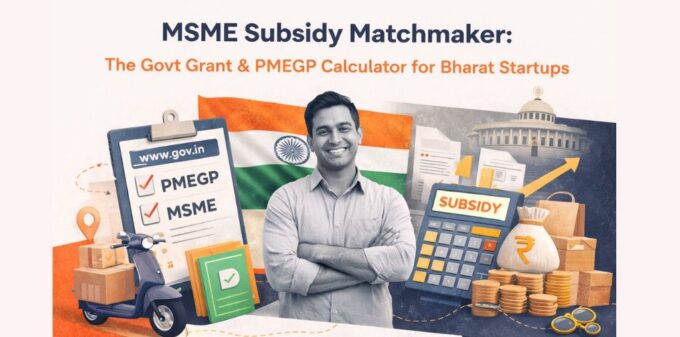
MSME Subsidy Matchmaker
Choose your scenario. We’ll show you the most relevant government capital pathway.
PMEGP Scheme
Ideal for small manufacturing or service businesses starting from scratch.
Stand-Up India
Designed for women and SC/ST founders looking for larger capital.
CGTMSE
Best for businesses exceeding subsidy limits and needing scale capital.
Critical Insights for the Bharat Founder
When you adjust the parameters in the matchmaker above, a powerful operational truth is revealed: the government heavily subsidizes geographical and demographic constraints. If you are a woman starting a manufacturing unit in a rural area of Odisha, the government is willing to hand you a 35% margin on your setup cost as a pure grant. Let that sink in. Most startups fight for years to squeeze out a 15% net profit margin; you can begin your journey with 35% of your capital completely free of equity dilution.
This is the hidden backbone of the Bharat ecosystem. Programs like PMEGP and CGTMSE are designed specifically for the founders executing Phase 2 (Jeevika) of the Swayam program. By utilizing these tools, you bypass the need for seed-stage angel investors, retain 100% ownership of your company, and establish a deeply rooted local operation with mitigated financial risk.
Conclusion
Stop assuming that venture capital is the only pathway to scale. The MSME Subsidy Matchmaker shifts your perspective from chasing private money to claiming public entitlements. As you execute the DDSF principles, leverage this government capital strategically to build your foundational infrastructure. Claim your grant, enforce strict cash discipline, and dominate your hyper-local market.
Frequently Asked Questions (FAQ)
Do I have to repay the PMEGP subsidy?
No. It is a “back-ended” subsidy. It is kept in a lock-in account for three years to ensure your business remains operational. After the lock-in period, the subsidy amount is officially adjusted against your loan, meaning it is pure, equity-free capital.
I am launching a software agency. Am I eligible?
Yes. Under PMEGP, service and IT units are eligible for projects costing up to ₹20 Lakhs. Manufacturing units are eligible for up to ₹50 Lakhs.
Do I need to pledge my house as collateral for these loans?
No. By utilizing the CGTMSE (Credit Guarantee Fund Trust for Micro and Small Enterprises) integration, the government provides a credit guarantee to the bank on your behalf, effectively acting as your collateral for loans up to ₹5 Crore.
What is the “Own Contribution” required?
If you fall under the General category, you must fund 10% of the project cost yourself. If you belong to a Special category (Women, SC, ST, OBC, Minority, Ex-Servicemen), your required contribution drops to just 5%. The bank finances the remainder, and the government subsidizes a large chunk of that debt.
Why does the consultant charge ₹50,000 for this?
Because they are monetizing the complexity of preparing the Detailed Project Report (DPR) and filling out the forms. However, identifying your exact eligibility takes seconds using the logic in our Matchmaker above.