
Table Of Content
- Executive Summary: The Profit Matrix
- The Illusion of Scale (The Vridhi Principle)
- Margin Analyzer
- Critical Insights for the Bharat Founder
- Conclusion
- Frequently Asked Questions (FAQ)
- Are Quick Commerce commissions really that high?
- Does ONDC solve this margin problem?
- Is Quick Commerce entirely bad for small brands?
- How does this tie into the Swayam framework?
- What if I don’t have the time to do local delivery myself?
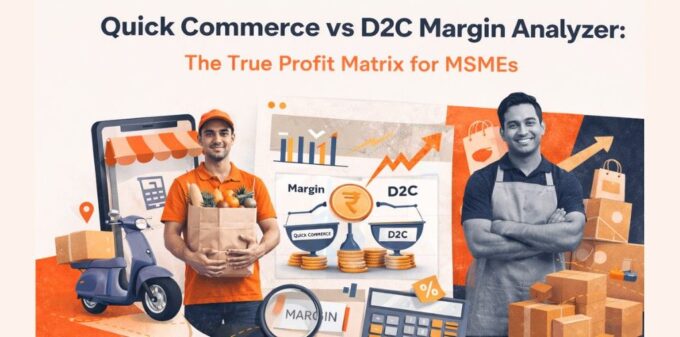
The obsession with 10-minute delivery is silently bankrupting grassroots brands across India. While getting listed on platforms like Zepto, Blinkit, or even the Open Network for Digital Commerce (ONDC) feels like a massive milestone, the hidden dark store fees, return logistics, and aggressive commissions often destroy unit economics. Before you attempt to scale, you must master the “Vridhi” principle of the Swayam program: establish strict cash discipline and local market dominance first. That is exactly why we built the Quick Commerce vs. D2C Margin Analyzer—to provide a brutal reality check on where your money is actually going.
Just as our Zero-CAC Sales Predictor proved that you can generate initial revenue without digital ad spend, this tool demonstrates that selling directly via WhatsApp or hyper-local delivery can often yield double the net profit of a quick-commerce listing. Stop chasing the vanity metric of “being everywhere” and start calculating real, bankable cashflow.
Executive Summary: The Profit Matrix
The Illusion of Scale (The Vridhi Principle)
The fourth phase of the Swayam framework is Vridhi (Growth & Scale). A critical mistake founders make is attempting Vridhi before they have locked in their cash discipline. When you hand over your distribution to an aggregator, you are essentially renting your customers at a 25% to 35% premium.
In a Tier 2 or Tier 3 city, leveraging local courier networks (like Porter or local delivery agents) and managing orders via WhatsApp allows you to retain your customer data and protect your margins. Quick commerce is a tool for convenience, not a foundation for profitability.
Interact with the intelligence model below. Input your manufacturing cost and retail price to witness exactly how aggregators slice into your profit pie compared to a direct, local approach.
Margin Analyzer
Critical Insights for the Bharat Founder
When you adjust the sliders in the analyzer above, a harsh reality emerges: low-ticket items cannot survive on Quick Commerce. If you are selling a product for ₹300, the 25% commission plus the flat handling fees will entirely consume your margin, often leaving you in the negative.
Many founders view aggregators as a marketing channel, assuming that a lower margin is acceptable if it brings in volume. This is a fatal assumption for a bootstrapped MSME. Aggregators own the customer data; you do not. You are subsidizing their platform growth with your inventory.
By utilizing local courier networks, WhatsApp catalogs, and community building—the core execution strategies of the Swayam program—you keep your data, you control your customer experience, and most importantly, you keep the cash in your bank account.
Conclusion
Scaling a business is useless if the unit economics do not scale with it. The Quick Commerce vs. D2C Margin Analyzer is your financial shield. It forces you to look at the math before you sign a vendor agreement. Embrace the Swayam “Vridhi” principles: build a local monopoly, enforce cash discipline, and only leverage third-party platforms when your margins are thick enough to absorb their fees without jeopardizing your survival.
Frequently Asked Questions (FAQ)
Are Quick Commerce commissions really that high?
Yes. While standard marketplace commissions (like Amazon) range from 8% to 15%, Quick Commerce platforms charge steep premiums—often 20% to 30%—plus dark store insertion fees, return penalties, and forced discounting events.
Does ONDC solve this margin problem?
ONDC democratizes access and lowers network fees compared to private duopolies, but you still have to pay for the buyer-side app commissions and third-party logistics. The margin analyzer still applies: direct fulfillment is almost always cheaper.
Is Quick Commerce entirely bad for small brands?
No, but it is dangerous for early-stage brands. It should be used as a premium distribution channel for high-margin products only after you have built cash reserves through direct, hyper-local sales.
How does this tie into the Swayam framework?
This tool is a direct reflection of “Vridhi” (Phase 4). Swayam teaches that true scale requires structural profitability. If your unit economics fail on a spreadsheet, they will fail exponentially faster in the real world.
What if I don’t have the time to do local delivery myself?
You don’t have to deliver it yourself. Utilizing hyper-local tech like Porter, Dunzo, or local rickshaw networks allows you to outsource the delivery for a flat fee, which is significantly cheaper than surrendering 25% of your total revenue to an aggregator.