
Table Of Content
- From Metro to Bharat.
- India’s next market is not one city. It is a change in where demand comes from.
- Tier 2 and Tier 3 cities India are redrawing the market map
- Metro → distribution → consumer
- Demand → digital discovery → distributed supply
- One India. Many emerging demand centres.
- The numbers behind the shift
- Selected non-metro market signals
- What changes when the market moves beyond metros?
- Discovery becomes more distributed
- Distribution becomes digital
- Fulfilment becomes strategic
- Context matters as much as reach
- Local businesses gain digital reach
- Infrastructure becomes market-making
- From consumption to commerce: the Bharat opportunity stack
- New categories
- Digital-first SMEs
- Logistics & fulfilment
- Local digital tools
- New investable markets
- Distributed capability
- The consumer journey is changing
- The metro playbook will not automatically work in Bharat
- Five signals worth watching next
- Tier-2+ shopper penetration
- D2C order geography
- Non-metro fulfilment economics
- Regional discovery
- Local business digitisation
- Infrastructure depth
- What this means for founders, investors and brands
- For founders
- For brands
- For investors
- For infrastructure companies
- For policymakers
- For researchers
- FAQ: Tier 2 and Tier 3 cities India and the next markets
- Sources and methodology
- From Metro to Bharat: understand where India’s next demand is coming from.
From Metro to Bharat.
Tier 2 and Tier 3 cities India are becoming an increasingly important part of the country’s next market story. The bigger story is not simply that smaller cities are buying online. It is that consumers, brands, logistics networks and digital infrastructure are increasingly connecting demand across a much wider India.
India’s next market is not one city. It is a change in where demand comes from.
For years, India’s consumer and digital economy could be read through a metro-first lens: Delhi NCR, Mumbai, Bengaluru, Hyderabad, Chennai, Pune and a handful of other large urban centres. That lens is becoming less complete.
Recent market data points to a broader geography of digital consumption. IBEF reports that India had nearly 290–300 million online shoppers in 2025, with Tier-2 and smaller cities contributing around 65% of new shoppers. Deloitte and FICCI reported that Tier-II and III cities accounted for more than 60% of e-commerce transactions. These are different datasets and should not be treated as one number, but together they show why the geography of Indian demand deserves a new lens.
Tier 2 and Tier 3 cities India are redrawing the market map
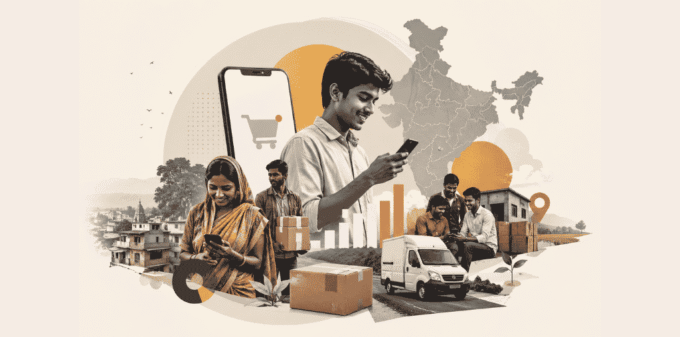
The shift is not a single migration from big cities to small cities. It is a network effect: consumers gain digital access, brands gain distribution, logistics becomes more capable, and previously fragmented demand becomes economically reachable.
Metro → distribution → consumer
Products, brands and trends often moved outward from a relatively small group of large urban markets.
Demand → digital discovery → distributed supply
Consumers in smaller cities can discover, compare and purchase products without waiting for every brand to establish a conventional physical footprint.
One India. Many emerging demand centres.
Bharat should not be treated as one homogeneous market. A city can be a consumer market, a talent market, a manufacturing node, a logistics hub, a service market or a combination of all five.
This visual is a WebVerbal conceptual framework, not a geographic ranking of cities.
The numbers behind the shift
Different studies measure different parts of the transition. The useful question is not whether every dataset says the same thing, but what each dataset reveals about the expansion of India’s addressable market.
Selected non-metro market signals
Sources: IBEF; Deloitte–FICCI; Unicommerce; PwC. These figures come from different studies and periods and are displayed as reported, not combined into a single index.
What changes when the market moves beyond metros?
Discovery becomes more distributed
Social platforms, marketplaces, creators and digital search allow consumers to encounter brands that may have little or no physical presence nearby.
Distribution becomes digital
A brand can test demand across cities before building a large physical footprint. Digital storefronts turn fragmented demand into a more reachable market.
Fulfilment becomes strategic
Non-metro growth creates operational questions around delivery density, returns, COD, inventory placement and service levels.
Context matters as much as reach
India’s regional diversity means that national distribution does not automatically create local relevance. Language, culture and category preferences shape conversion.
Local businesses gain digital reach
Small businesses and regional brands can use digital channels to reach customers outside their traditional catchment areas.
Infrastructure becomes market-making
Payments, logistics, connectivity, warehousing and digital commerce infrastructure can turn previously fragmented demand into viable commercial markets.
From consumption to commerce: the Bharat opportunity stack
The opportunity is larger than e-commerce. Once demand becomes digitally visible, several adjacent markets can develop around it.
New categories
Beauty, fashion, electronics, home, food, health, education and lifestyle products can reach consumers previously constrained by local assortment.
Digital-first SMEs
Regional businesses can move from local discovery to national discovery through marketplaces, social commerce, D2C and digital payments.
Logistics & fulfilment
More distributed demand creates demand for better inventory, delivery, returns and last-mile infrastructure.
Local digital tools
CRM, vernacular interfaces, commerce enablement, AI discovery and operational software can adapt national technology to Bharat’s context.
New investable markets
As smaller-city demand becomes measurable, investors and operators can evaluate opportunities beyond traditional metro assumptions.
Distributed capability
Emerging cities can participate not only as consumer markets but also as locations for services, talent, entrepreneurship and production.
The consumer journey is changing
PwC’s research on Indian online shopping found that consumers outside the largest metros have different access constraints and behaviours. Its study covered 2,100 people through an online survey, 100 qualitative interviews and 400 in-person interviews across India.
| Market signal | What is changing | Business implication |
|---|---|---|
| Access | Consumers can access a much wider assortment online. | Brands can reach demand without opening a store in every city. |
| Discovery | Social media and digital platforms influence product discovery. | Content and trust signals become part of distribution. |
| Trust | Ratings, reviews and brand familiarity matter. | Reputation becomes a conversion asset, not just a branding exercise. |
| Fulfilment | Delivery and returns determine the quality of the digital experience. | Operations become part of customer acquisition economics. |
| Local relevance | Language, culture and category preferences vary substantially. | National scale needs localised execution. |
Source: PwC, How India Shops Online. The business implications above are WebVerbal analysis based on the documented market signals.
The metro playbook will not automatically work in Bharat
The opportunity is large, but expansion across Tier 2 and Tier 3 cities India is not simply a matter of copying a metro strategy and changing the delivery PIN code.
- Localise the proposition. Category demand, price sensitivity, language and cultural context can differ across markets.
- Design for trust. Reviews, transparent information, reliable delivery and easy returns become critical when a brand is unfamiliar.
- Engineer the economics. Distributed demand can create higher fulfilment and return complexity. Growth must be measured after operational costs.
- Build regional discovery. National visibility does not guarantee local relevance. Search, social, creators and regional content can create new discovery pathways.
- Think city clusters, not isolated cities. Businesses can identify connected demand corridors rather than treating every emerging city as a standalone market.
Five signals worth watching next
Tier-2+ shopper penetration
IBEF notes that shopper penetration in smaller cities remains only 25–30% of internet users, indicating further room for digital commerce adoption.
D2C order geography
Unicommerce reports that Tier-2 and Tier-3 cities contributed 66% of new D2C orders in FY26. Watch whether this share remains elevated as brands scale.
Non-metro fulfilment economics
The next phase of competition will increasingly be measured through delivery speed, returns, inventory placement and contribution margin.
Regional discovery
Watch the intersection of vernacular content, creators, search, marketplaces and AI-led product discovery.
Local business digitisation
The opportunity extends beyond consumers: regional SMEs can become sellers, service providers, manufacturers and digital-first brands.
Infrastructure depth
Payments, logistics, connectivity and digital public infrastructure will influence how quickly fragmented demand becomes commercially reachable.
What this means for founders, investors and brands
For founders
Build for a specific consumer problem, but design the operating model for India’s geographic diversity from the beginning.
For brands
Do not treat Tier-2 and Tier-3 markets as discount-only markets. Study category demand, trust, language, discovery and repeat behaviour.
For investors
Look beyond metro headquarters when assessing market opportunity. The geography of customers, supply and talent can tell a different story.
For infrastructure companies
The expansion of distributed demand creates opportunities in logistics, warehousing, payments, commerce software, data and local digital services.
For policymakers
Market participation depends not only on internet access but also on reliable logistics, digital skills, trust and the ability of smaller businesses to participate.
For researchers
India needs more granular city-level and regional datasets that distinguish consumer demand, business formation, income, infrastructure and digital behaviour.
FAQ: Tier 2 and Tier 3 cities India and the next markets
Why are Tier 2 and Tier 3 cities important to India’s next markets?
Recent research shows that smaller cities are contributing a substantial share of India’s new online shoppers and e-commerce activity. IBEF reports around 65% of new online shoppers coming from Tier-2 and smaller cities in 2025, while Deloitte–FICCI reported more than 60% of e-commerce transactions from Tier-II and III cities.
How many online shoppers does India have?
IBEF reports that India’s online shopper base reached nearly 290–300 million in 2025. The figure refers to online shoppers, not India’s total internet-user population.
Are Tier 2 and Tier 3 consumers the same as rural consumers?
No. Tier classifications generally describe urban settlement categories, while rural describes a different geography. Bharat includes a wide range of urban, semi-urban and rural markets and should not be treated as one homogeneous consumer segment.
What is driving e-commerce growth beyond metros?
Digital access, broader product assortment, marketplaces, digital payments, logistics improvements, social discovery and rising consumer aspirations all contribute. The relative importance varies by category and market.
What does the shift mean for D2C brands?
It expands the addressable customer base but also makes operations more important. Unicommerce reported that Tier-2 and Tier-3 cities contributed 66% of new D2C orders in FY26, while its data also highlights the importance of returns and fulfilment economics.
What should businesses change when entering Tier 2 and Tier 3 markets?
Businesses should evaluate local demand, pricing, language, trust, discovery, fulfilment, returns, inventory and customer support rather than simply replicating a metro playbook.
Sources and methodology
This visual story combines current industry research with WebVerbal interpretation. Figures from different sources are kept separate because their populations, dates and methodologies differ.
WebVerbal analysis, conceptual maps and business implications are editorial interpretation and are not presented as independently measured national indices.
From Metro to Bharat: understand where India’s next demand is coming from.
The market is getting wider. The strategic question is becoming more granular: which consumers, cities, categories and infrastructure layers are creating the next pockets of growth?
Explore Bharat Intelligence →