Table Of Content
- Executive Summary
- The Quiet Shift Nobody Is Talking About
- The Metro Advantage Is Shrinking
- Technology Is Flattening Geography
- Trust Is Becoming the New Competitive Advantage
- The Rise of the Quiet Founder
- Investors May Be Looking in the Wrong Direction
- Why This Matters Beyond Startups
- Looking Ahead
- Final Thought
- Frequently Asked Questions
- What is the Tier 2 startup ecosystem India?
- Why are startups growing in smaller Indian cities?
- How is AI helping grassroots entrepreneurs?
The next generation of Indian entrepreneurship is emerging from Tier-2, Tier-3 and rural India—not because venture capital discovered it, but because technology, trust and necessity have created a completely different business model.
Executive Summary
For nearly two decades, India’s startup story has been associated with a handful of metropolitan cities. Yet beneath the surface, a different entrepreneurial economy is taking shape. The Tier 2 startup ecosystem India is benefiting from digital public infrastructure, AI accessibility, lower operating costs, stronger community trust, and founders who are building sustainable businesses instead of chasing valuations.
The next wave of transformative Indian companies may not emerge from the country’s traditional technology corridors. It may emerge from Bharat itself.
The Quiet Shift Nobody Is Talking About
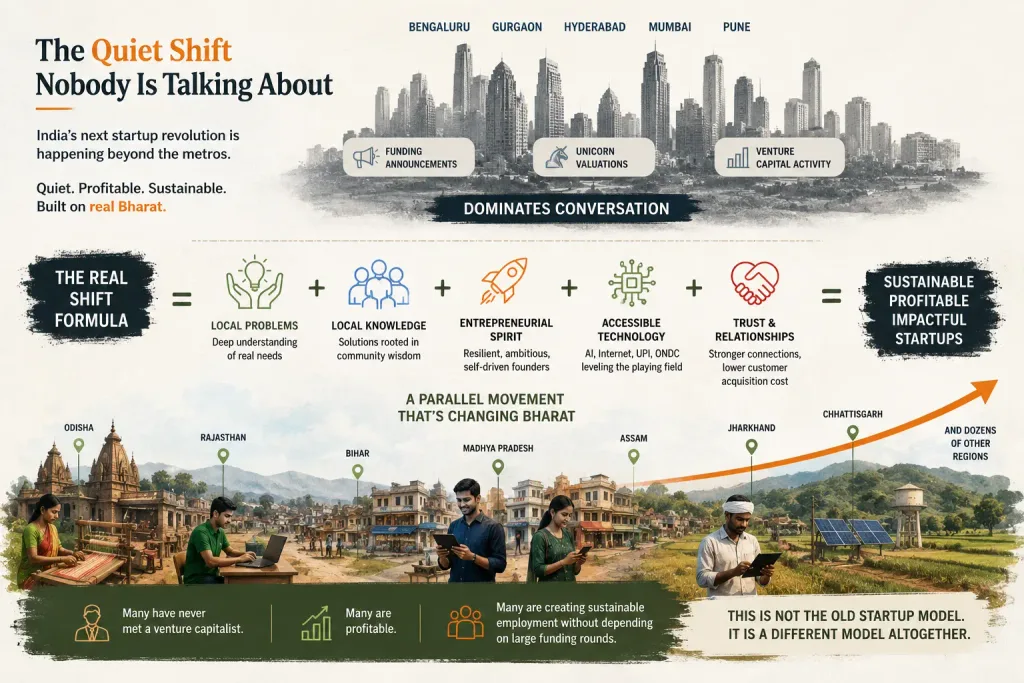
The Tier 2 startup ecosystem India is no longer an experiment. It is becoming one of the country’s most important economic developments.
Much of India’s startup conversation still revolves around Bengaluru, Gurgaon, Hyderabad, Mumbai, and Pune. Funding announcements, unicorn valuations, and venture capital activity dominate headlines. Yet these stories often overlook a parallel movement that is unfolding across smaller cities and rural markets.
Across Odisha, Rajasthan, Bihar, Madhya Pradesh, Assam, Jharkhand, Chhattisgarh, and dozens of other regions, entrepreneurs are building businesses that solve local problems with local knowledge.
Many of them have never met a venture capitalist.
Many are profitable.
Many are creating sustainable employment without depending on large funding rounds.
This is not the old startup model. It is a different model altogether.
The Metro Advantage Is Shrinking
For years, metropolitan ecosystems enjoyed obvious advantages.
They had access to capital.
They attracted skilled talent.
They offered stronger infrastructure.
They created networks where founders, investors, and mentors could collaborate easily.
But technology is reducing many of these barriers.
A founder in a Tier-3 town can now use generative AI to design marketing campaigns, build software prototypes, automate customer support, and create professional content without hiring large teams.
Cloud infrastructure has reduced the need for expensive physical offices.
Digital payments have made transactions seamless.
Social media and WhatsApp communities have made distribution more democratic.
The gap between a founder in Bengaluru and a founder in Balasore, Kota, or Dhanbad is becoming smaller every year.
Technology Is Flattening Geography
India’s digital public infrastructure may become one of the greatest enablers of grassroots entrepreneurship.
UPI transformed payments.
Digital identity systems simplified onboarding.
ONDC is attempting to create a more open commerce ecosystem.
Affordable smartphones and internet connectivity have connected millions of first-generation entrepreneurs to national markets.
Artificial intelligence is accelerating this transition.
A small business owner who once needed a team of specialists can now use AI tools for design, writing, translation, coding, accounting, and customer engagement.
Technology is no longer a privilege reserved for large companies.
It is becoming a multiplier for ordinary entrepreneurs.
Trust Is Becoming the New Competitive Advantage
One of the biggest mistakes in startup analysis is assuming that scale only comes from advertising budgets.
Bharat often operates differently.
Trust travels faster than paid campaigns.
A recommendation from a local community.
A WhatsApp group.
A self-help network.
A family relationship.
A satisfied customer.
These informal systems create powerful distribution channels that many modern startups underestimate.
The trust economy reduces customer acquisition costs and increases long-term loyalty.
For entrepreneurs in smaller cities, this is not a weakness.
It is a strategic advantage.
The Rise of the Quiet Founder
The Indian startup ecosystem has celebrated the image of the fast-scaling founder chasing exponential growth.
But another archetype is emerging.
The quiet founder.
This entrepreneur focuses on profitability before valuation.
Cash flow before headlines.
Community before virality.
Resilience before rapid expansion.
Many of these founders may never become media celebrities.
Yet they are building enterprises that survive economic cycles because they are rooted in genuine demand.
India’s next generation of successful businesses may be created by entrepreneurs who choose disciplined execution over aggressive capital consumption.
Investors May Be Looking in the Wrong Direction
Venture capital has historically concentrated around established startup clusters.
That approach made sense when infrastructure and talent were limited.
But the economic map of India is changing.
Smaller cities are producing educated young people who increasingly want to build businesses instead of leaving for metropolitan careers.
Family businesses are adopting technology.
Women-led enterprises are entering digital commerce.
Grassroots innovators are leveraging AI and online marketplaces.
Many of these opportunities remain invisible because they do not fit traditional venture capital narratives.
The next decade may reward investors who understand behavioural shifts instead of simply tracking funding trends.
Why This Matters Beyond Startups
The rise of the Tier 2 startup ecosystem India is not only a business story.
It is an economic story.
It is a social story.
It is a demographic story.
When entrepreneurship grows outside a few urban centres, wealth creation becomes more distributed.
Young people gain local opportunities.
Migration pressures reduce.
Traditional skills find modern markets.
Communities become more economically resilient.
The long-term impact extends far beyond startup valuations.
It shapes the future of Bharat itself.
Looking Ahead
The future of Indian entrepreneurship may not be defined by bigger funding rounds or more unicorns.
It may be defined by thousands of disciplined founders quietly building profitable businesses in places that rarely appear in startup headlines.
Technology is reducing barriers.
Trust is replacing expensive distribution.
Artificial intelligence is lowering the cost of innovation.
Digital infrastructure is connecting previously isolated markets.
These are not isolated trends.
Together, they are creating a completely different entrepreneurial landscape.
The Tier 2 startup ecosystem India is not an alternative story waiting for recognition.
It is becoming the main story.
Final Thought
History often remembers revolutions only after they become obvious.
The internet transformed commerce before many experts believed it would.
Digital payments reshaped finance before cashless transactions became normal.
Artificial intelligence is changing how businesses are built before many industries have fully adapted.
The next startup revolution may follow the same pattern.
It may not arrive with loud headlines from India’s biggest cities.
It may arrive quietly from the towns, districts, and communities that have spent years learning how to build with fewer resources, stronger relationships, and a deeper understanding of the people they serve.
And when that happens, Bharat will not simply participate in India’s startup story.
Bharat will redefine it.
Frequently Asked Questions
What is the Tier 2 startup ecosystem India?
The Tier 2 startup ecosystem India refers to the growing network of entrepreneurs, businesses, incubators, and innovation hubs emerging from smaller Indian cities outside traditional startup centers.
Why are startups growing in smaller Indian cities?
Lower operating costs, digital infrastructure, AI tools, and stronger local trust networks are enabling founders to build sustainable businesses.
How is AI helping grassroots entrepreneurs?
AI reduces the cost of marketing, software development, content creation, customer support, and business operations, allowing smaller teams to compete effectively.