
Table Of Content
- Executive Summary
- The Marketing Rulebook Is Being Rewritten
- Bharat Thinks Differently
- WhatsApp Has Become Bharat’s Trust Network
- Community Is Becoming a Competitive Advantage
- Why Small Businesses May Have the Advantage
- The Rise of the Trust Economy
- What Founders Should Learn
- Final Thought
- Frequently Asked Questions
- What is changing in consumer behaviour in India?
- Why is trust becoming more important than discounts for businesses?
- How can startups and small businesses benefit from the trust economy in India?
Across Tier-2 and Tier-3 India, the businesses growing fastest are often not the ones spending the most on advertising. They are the ones building trust.
Executive Summary
Consumer behaviour in India is changing. For years, businesses believed that growth depended on bigger discounts, larger advertising budgets, and aggressive customer acquisition. That approach created impressive scale, but it also created fragile business models dependent on constant spending.
A different pattern is emerging across Bharat.
Small businesses, local brands, and disciplined founders are discovering that long-term growth often comes from relationships rather than promotions. WhatsApp communities outperform expensive campaigns. Customer recommendations outperform paid acquisition. Local credibility outperforms celebrity endorsements.
This is not simply a marketing trend.
It is a behavioural shift.
Understanding this evolution in consumer behaviour in India may become one of the most important strategic advantages for founders over the next decade.
The Marketing Rulebook Is Being Rewritten
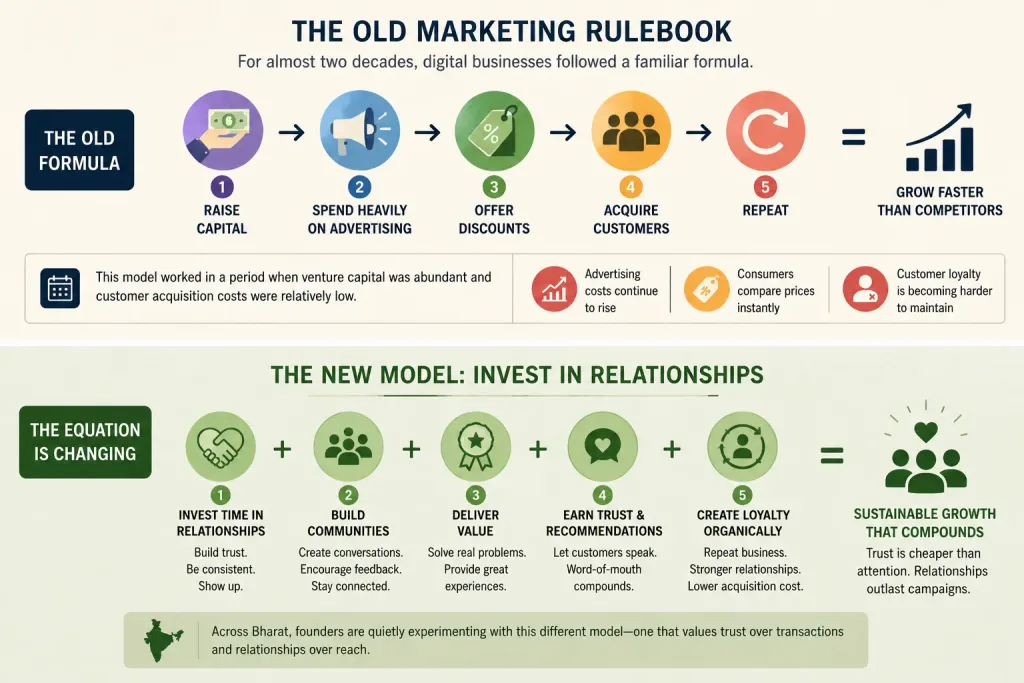
For almost two decades, digital businesses followed a familiar formula.
Raise capital.
Spend heavily on advertising.
Offer discounts.
Acquire customers.
Repeat.
The objective was simple: grow faster than competitors.
But this model was built for a period when venture capital was abundant and customer acquisition costs were relatively low.
Today, that equation is changing.
Advertising costs continue to rise.
Consumers compare prices instantly.
Customer loyalty is becoming harder to maintain.
Many businesses are discovering that buying attention is becoming more expensive than earning trust.
Across Bharat, founders are quietly experimenting with a different model.
Instead of spending more money, they are investing more time in relationships.
Bharat Thinks Differently
One of the biggest mistakes businesses make is assuming that every market behaves like a metropolitan city.
Consumer behaviour in India is deeply influenced by culture, family, local communities, and personal recommendations.
In many parts of the country, trust is not created by advertising.
It is created by familiarity.
People buy from the person they know.
They trust the shopkeeper who has served them for years.
They believe recommendations shared in family groups.
They rely on local networks before making important purchasing decisions.
This behaviour is now moving into the digital world.
Technology has changed the medium.
It has not changed the psychology.
WhatsApp Has Become Bharat’s Trust Network
Many entrepreneurs still think of WhatsApp as a messaging application.
In reality, it has become one of India’s most powerful business infrastructures.
Products are discovered in groups.
Services are recommended by friends.
Payments happen through digital platforms.
Customer support happens through conversations.
Businesses build loyalty without expensive software systems.
For thousands of entrepreneurs across Tier-2 and Tier-3 India, WhatsApp is quietly becoming the first marketing channel, the customer support desk, and the relationship management platform.
This is a completely different growth model from the one promoted by conventional startup playbooks.
Community Is Becoming a Competitive Advantage
The strongest businesses in Bharat often understand something that many modern startups forget.
People do business with people.
A local entrepreneur who delivers consistently develops a reputation.
A small D2C founder who personally engages with customers creates emotional loyalty.
A community-led brand becomes difficult to replace because customers feel connected to the people behind it.
This lowers customer acquisition costs.
It improves repeat purchases.
It creates organic referrals.
Trust compounds over time.
Unlike advertising budgets, trust continues generating value long after the initial investment.
Why Small Businesses May Have the Advantage
Large companies often rely on systems.
Small businesses rely on relationships.
For years, this was considered a disadvantage.
Today, it may become a strategic strength.
A founder who understands local culture can adapt quickly.
A neighbourhood business knows customer preferences.
A grassroots entrepreneur can solve problems that large organisations may never notice.
Technology now allows these businesses to scale without losing their human connection.
Artificial intelligence can automate repetitive work.
Digital payments simplify transactions.
Social commerce expands reach.
The combination of technology and trust creates a business model that is both efficient and resilient.
The Rise of the Trust Economy
The next phase of consumer behaviour in India may be defined by a simple shift.
People are becoming more careful with their money.
They are looking for reliability.
They seek authenticity.
They value transparency.
They prefer businesses that keep their promises.
This is creating what can be called the trust economy.
In this economy, reputation becomes a strategic asset.
Communities become distribution channels.
Relationships become marketing infrastructure.
Businesses that understand this change may build stronger foundations than those relying only on advertising.
What Founders Should Learn
Many entrepreneurs believe they must choose between growth and sustainability.
The trust economy suggests a different path.
Build credibility before scale.
Create communities before campaigns.
Solve problems before chasing valuations.
Earn recommendations before buying attention.
Technology can accelerate growth.
But trust determines whether that growth lasts.
The founders who understand this balance may create businesses that are more resilient, more profitable, and more aligned with the realities of Bharat.
Final Thought
History often changes quietly before it changes dramatically.
The companies dominating the next decade may not be the ones that offered the biggest discounts.
They may be the ones that built the strongest relationships.
Across villages, towns, and emerging cities, a new generation of entrepreneurs is proving that trust can outperform advertising and community can outperform capital.
The future of consumer behaviour in India may not belong to the businesses spending the most money.
It may belong to the businesses earning the most confidence.
Frequently Asked Questions
What is changing in consumer behaviour in India?
Consumer behaviour in India is shifting from price-driven decision making to trust-driven decision making. Customers are increasingly valuing credibility, community recommendations, consistent service, and authentic relationships over short-term discounts and aggressive marketing campaigns.
Why is trust becoming more important than discounts for businesses?
Trust creates long-term customer loyalty and reduces the dependence on expensive advertising. Businesses that build strong relationships often benefit from repeat purchases, word-of-mouth referrals, and lower customer acquisition costs, making their growth more sustainable.
How can startups and small businesses benefit from the trust economy in India?
Startups and small businesses can benefit by focusing on customer experience, community building, transparent communication, and local relationships. Leveraging platforms like WhatsApp, social commerce, and digital communities helps entrepreneurs create loyal customer bases without relying heavily on discount-driven growth strategies.