Table Of Content
- Executive Summary: The Conversational Pivot
- The Invisible Distribution Layer
- The Strategic Conversational Commerce Flow
- Ecosystem Conversion Architecture Comparison
- Why Standard Performance Marketing Fails in Bharat
- Building the “Banyan Tree” Distribution Engine
- Frequently Asked Questions About Conversational Distribution
- Conclusion: Activating the Trust Moat
Deploying a comprehensive operational framework for WhatsApp marketing and distribution in India Tier 2 Tier 3 markets is no longer just an alternative conversion tactic. It operates as the fundamental structural backbone dictating how consumer options are discovered, validated, and purchased outside metropolitan bubbles.
With hundreds of millions of registered users traversing the network throughout the sub-continent, ecosystem data reveals that the utility has quietly evolved into the country’s most powerful decentralized distribution infrastructure. But unlike standard programmatic web registries, this conversational grid doesn’t run on cold display algorithms. It runs strictly on **relational validation**.
As documented inside the Bharat Trust Report 2025, the non-metro consumer economy is fueled by localized community proof rather than anonymous, self-serve digital discovery. Integrating your go-to-market loops with this communication channel is the only structured path to unlock sustained client activation.
Executive Summary: The Conversational Pivot
- The Core Infrastructure: Messaging layers function as the primary distribution framework across regional clusters.
- Relational Scaling Moats: Product traction compounds strictly via known trust networks, completely bypassing paid ad dependency.
- Peer Validation Loops: Direct interpersonal recommendations drive over 70% of local purchase confirmation cycles.
- Capital Defense Edge: Hyper-local community commerce consistently outperforms abstract urban algorithmic discovery.
The Invisible Distribution Layer
To win the customer acquisition game across regional nodes, builders must analyze how discovery parameters flip when transitioning from metro centers to Bharat. In metropolitan environments, brand visibility is bought through automated ad networks, algorithmic search queries, and agency-driven influencer campaigns.
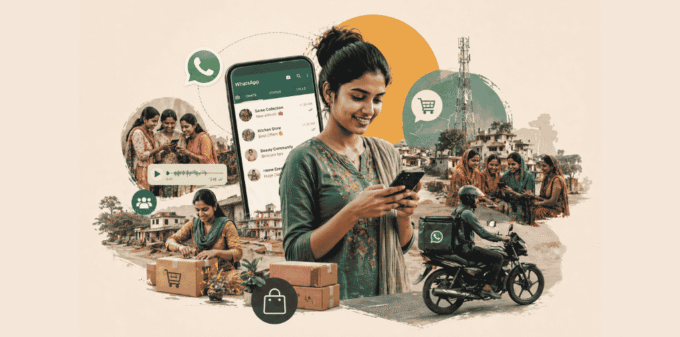
Conversely, inside Tier 2 and Tier 3 clusters, discovery loops materialize inside intimate conversational spaces: an unprompted message from a local community node, a forwarded organic product image, or a quick voice note recommendation from a verified acquaintance. This is an entirely separate system running on a separate behavioral currency.
The Strategic Conversational Commerce Flow
A typical high-retention consumer transaction across these tiers tracks along a distinct structural timeline:
- An asset link or prototype profile is shared directly inside a localized communication group.
- The micro-community cross-references the utility, vetting the product parameters.
- Interpersonal validation is cleared, completely removing transaction anxiety.
- The purchase executes smoothly via localized payment links or hybrid logistics alternatives.
This entire lifecycle completes without relying on external e-commerce platforms, complex ad-spend funnels, or shifting visibility algorithms.
Ecosystem Conversion Architecture Comparison
Why Standard Performance Marketing Fails in Bharat
Legacy programmatic ad frameworks hit clear scaling walls across non-metro regions because standard display ads carry zero structural trust. Aggregated anonymous reviews are viewed with deep skepticism, and faceless centralized platforms feel distant and unaligned with local realities. When a startup builds its acquisition model solely around urban click funnels, it burns runway without building brand recall.
Field Realities of Scaling Non-Metro Distribution Moats
Most expanding setups attempt to force-feed urban customer acquisition scripts into regional markets, treating distribution as a simple commodity to be bought via paid ads. But down within the real Bharat economy, sustainable distribution cannot be purchased—it must be earned through presence, proximity, and proof.
“If an offering cannot be explained cleanly in a single voice note or validated within a single conversation, it cannot scale across the regional clusters of India.”
Building the “Banyan Tree” Distribution Engine
To truly unlock the value matching the State of Bharat Startups 2026, founders must trade short-term growth hacks for horizontal, resilient community loops. Shifting your tech tools to accommodate assisted buying journeys—such as direct natural language voice messages and automated order tracking routed natively through the WhatsApp Business API—removes onboarding friction for first-time internet transactors. By treating messaging setups as deep relationship management hubs, you construct a local monopoly that centralized e-commerce giants cannot easily disrupt.
Frequently Asked Questions About Conversational Distribution
Why is WhatsApp marketing and distribution in India Tier 2 Tier 3 markets the real growth engine?
Can conversational commerce workflows completely replace traditional e-commerce landing pages?
How should early-stage startups optimize their messaging channels for growth?
Conclusion: Activating the Trust Moat
The future of decentralized digital commerce belongs to organizations that respect their user’s need for personal validation. By building your acquisition framework around clean conversational logic and strict unit economics, you protect your margins and anchor your operations securely. Let the updated layout parameter and schema scripts process across your web properties. In Bharat, trust remains the ultimate commercial currency.