
Table Of Content
- Executive Summary: The Trust Imperative
- The Price Sensitivity Myth Unpacked
- How Trust Functions Across Regional Ecosystems
- Why Low-Cost Offerings Fail Without Trust Anchors
- Decision-Making Priority Arrays Mapped
- Conclusion: Relational Moats are the Foundation of Commerce
- Frequently Asked Questions Regarding Non-Metro Buying Psychology
Isolating the unique, underlying mechanisms that dictate Consumer Behavior in Tier 2 and Tier 3 Cities India is frequently misunderstood as a basic exercise in managing price sensitivity. However, macro transactional data trails tell a vastly separate story.
According to structural data streams and financial inclusion adoption parameters tracked directly by the Reserve Bank of India, access points to unified digital rails have expanded exponentially—yet sustained consumer transaction velocity continues to drop out across multiple regional segments.
The missing operational variable is never affordability or product price drops. It is the systemic lack of brand credibility. As explored inside the Bharat Trust Report 2025, consumers operating throughout non-metro India are not navigating the web to optimize for the lowest price ticket. They are calculating vectors to isolate the absolute lowest risk threshold.
Executive Summary: The Trust Imperative
- Risk Mitigation Rules: Bharat consumers heavily prioritize established credibility over artificial discount codes.
- The Conversion Barrier: Low prices paired with thin trust signals yield zero transaction conversion across regional nodes.
- Premium Allocation Moats: Securing high interpersonal trust enables brands to command premium pricing tiers safely.
- Organic Growth Anchors: Real-world credibility is earned through structural community proof, not high-burn metro ad campaigns.
The Price Sensitivity Myth Unpacked
The dominant, metro-centric marketing assumption states that applying aggressive price cuts will naturally drive automated checkout conversions on a store landing page. But inside the Tier 2 and Tier 3 cities of India, a thin trust framework results in zero conversion, regardless of your price drops. Regional buyers do not decline transactions because an item strains their capital capacity—they hesitate because your interface lacks the localized data signals needed to verify that their capital is completely secure.
How Trust Functions Across Regional Ecosystems
Credibility outside major metropolitan city centers is never abstract; it functions as a highly mechanical, visible asset structured around four specific operational anchors:
- 1. Hyper-Local Community Endorsement: The buyer route is guided entirely by peer reference loops (e.g., *“Someone within my immediate social group has successfully verified this merchant connection”*).
- 2. Physical Proximity and Presence: Utilizing regional micro-agents, physical pickup nodes, and visible localized trade footprints to cross the brand isolation gap.
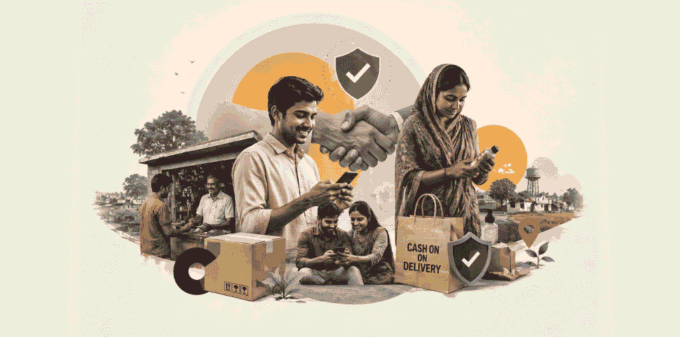
- 3. Absolute Transaction Reversibility: Protecting the buyer’s runway via Cash on Delivery options and clear, high-transparency local return policies.
- 4. Persistent Operational Consistency: Maintaining stable, uninterrupted delivery execution over macro-timelines to turn passive impressions into high-retention loyalty.
Why Low-Cost Offerings Fail Without Trust Anchors
Lowering your base product ticket does not insulate your brand from consumer perceived risk signals. In fact, dropping prices too aggressively across regional hubs frequently triggers a defensive cognitive filter. The target buyer evaluates the low cost as an indicator of product defects, asking: “Why is this transaction so heavily subsidized? Can my operation trust this origin?”
Decision-Making Priority Arrays Mapped
Ecosystem Audits Tracking Non-Metro Behavioral Filters
What mainstream performance marketers misinterpret as standard customer “price sensitivity” is, in reality, highly disciplined, **risk-optimized choice mechanics**. Non-metro buyers are not looking to evade premium tickets. They are systematically protecting their environments from unverified, unpredictable transactional outcomes.
blockquote>“If your product configuration is cheap but lacks regional trust assets, it will fail to convert. If it is trusted, it will scale sustainably even at a higher premium tier.”
Conclusion: Relational Moats are the Foundation of Commerce
The decentralized evolution of the domestic digital economy confirms one absolute reality: long-term brand equity cannot be bought in open ad auctions—it must be earned through deep regional positioning. Deploy the updated text frameworks and clean schema indices across your page modules to align Webverbal cleanly with Google’s modern evaluation criteria. In Bharat, trust isn’t an optional cosmetic feature; it functions as the definitive foundation of commerce.
Frequently Asked Questions Regarding Non-Metro Buying Psychology
Is consumer behavior in Tier 2 and Tier 3 cities India driven by price?
Why do Bharat consumer groups show heavy reliance on Cash on Delivery (COD) channels?
How can expanding startups construct defensible trust assets inside these perimeters?