
Table Of Content
- Executive Summary
- India’s Startup Story Has Always Been Built on Infrastructure
- Artificial Intelligence Should Not Remain a Metro Advantage
- The Next UPI Moment Could Belong to AI
- AI Is Lowering the Cost of Entrepreneurship
- Bharat May Benefit More Than Big Cities
- Why Investors Should Pay Attention
- Beyond Startups, This Is an Economic Story
- Looking Ahead
- Final Thought
- Frequently Asked Questions
- What is the IndiaAI Mission?
- How can the IndiaAI Mission help startups?
- Why is the IndiaAI Mission important for Bharat entrepreneurs?
The next phase of India’s startup revolution may not begin with another funding boom. It may begin with a public digital infrastructure that makes artificial intelligence accessible to every entrepreneur.
Executive Summary
India’s digital economy has repeatedly demonstrated the power of public infrastructure. UPI transformed payments. India Stack simplified digital identity. ONDC is opening commerce networks. The IndiaAI Mission could become the next major platform enabling innovation by reducing the barriers to AI adoption for startups, MSMEs, and grassroots entrepreneurs.
The long-term significance of this initiative may not lie in creating a few AI unicorns. Its real impact could come from enabling millions of founders across Bharat to use artificial intelligence as a practical business tool.
India’s Startup Story Has Always Been Built on Infrastructure
The history of modern Indian entrepreneurship is closely linked with the creation of public digital infrastructure.
Digital identity simplified verification.
UPI changed the way money moved.
Online government services reduced paperwork.
Digital payments connected even the smallest businesses to the formal economy.
Each of these developments created opportunities that entrepreneurs quickly transformed into products and services.
The IndiaAI Mission may represent the next chapter in this evolution.
Instead of focusing only on financial infrastructure, it has the potential to strengthen the country’s artificial intelligence ecosystem.
For startups, this could become a foundational shift rather than another policy announcement.
Artificial Intelligence Should Not Remain a Metro Advantage
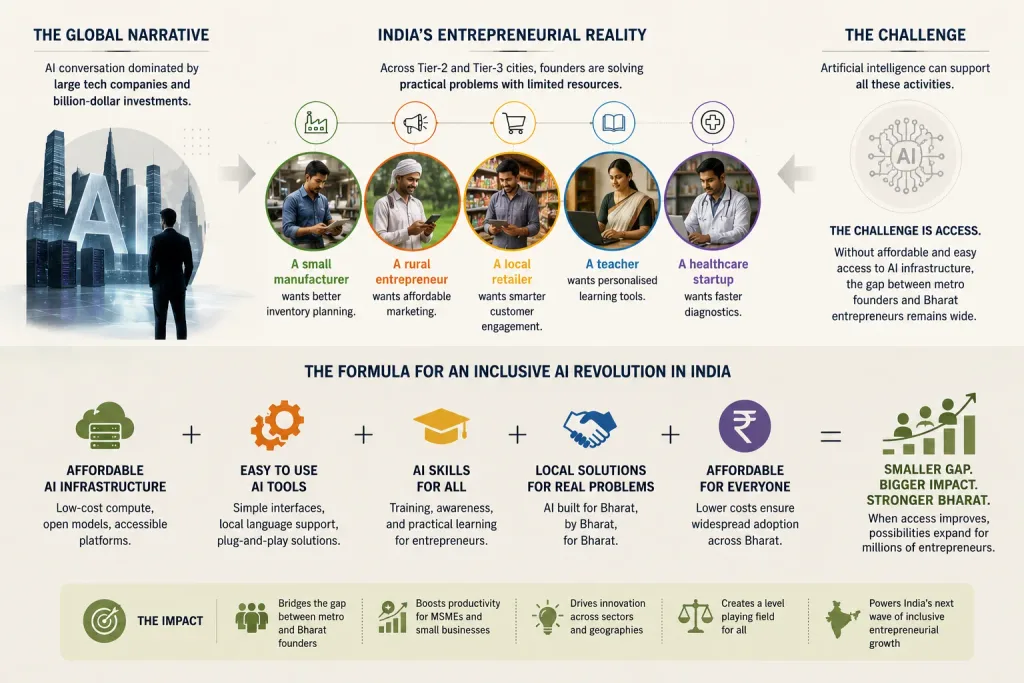
Much of the global conversation around AI revolves around large technology companies and billion-dollar investments.
But India’s entrepreneurial landscape is different.
Across Tier-2 and Tier-3 cities, founders are solving practical problems with limited resources.
A small manufacturer wants better inventory planning.
A rural entrepreneur wants affordable marketing.
A local retailer wants smarter customer engagement.
A teacher wants personalised learning tools.
A healthcare startup wants faster diagnostics.
Artificial intelligence can support all these activities.
The challenge is access.
If AI infrastructure becomes easier to use and more affordable, the gap between metro founders and Bharat entrepreneurs could shrink dramatically.
The Next UPI Moment Could Belong to AI
UPI did not simply create another payment application.
It changed how businesses operated.
Street vendors accepted digital payments.
Small shops expanded their customer base.
New fintech companies emerged.
Entire industries adapted.
The IndiaAI Mission could produce a similar effect.
Instead of transforming payments, it could transform productivity.
Founders could automate repetitive work.
MSMEs could use AI for operations.
Students could access better learning tools.
Farmers could receive smarter advisory services.
Healthcare providers could improve decision making.
The economic impact may extend far beyond the technology sector.
AI Is Lowering the Cost of Entrepreneurship
One of the greatest barriers to building a business has always been the cost of expertise.
Hiring designers.
Employing developers.
Creating marketing campaigns.
Managing customer service.
Preparing reports.
Building websites.
Today, artificial intelligence is reducing many of these costs.
A small founder with limited capital can now access tools that were previously available only to larger organisations.
This changes the economics of entrepreneurship.
Innovation becomes more accessible.
Experimentation becomes less expensive.
Small teams become more productive.
The IndiaAI Mission could accelerate this transition by creating a stronger ecosystem around AI development and adoption.
Bharat May Benefit More Than Big Cities
Large companies already have access to technology, talent, and capital.
Smaller entrepreneurs often do not.
This is why public infrastructure can create disproportionate benefits.
Across Bharat, millions of entrepreneurs operate with discipline and deep local knowledge.
What they often lack are affordable tools that help them compete.
Artificial intelligence could become that equaliser.
A founder in a small town should be able to build a brand, analyse customer behaviour, create content, and improve operations without needing a large corporate budget.
Technology can flatten geography.
AI can flatten capability.
Together, they can create a different entrepreneurial future.
Why Investors Should Pay Attention
Investors often search for the next disruptive technology.
Sometimes the larger opportunity is not the technology itself.
It is the infrastructure supporting widespread adoption.
If AI becomes easier to access across India, entirely new categories of startups may emerge.
AI for agriculture.
AI for education.
AI for local commerce.
AI for healthcare.
AI for regional languages.
AI for manufacturing.
The next generation of successful Indian startups may not build artificial intelligence models.
They may build businesses powered by artificial intelligence.
That distinction is important.
Beyond Startups, This Is an Economic Story
The IndiaAI Mission is not only relevant for technology founders.
It matters for students.
It matters for MSMEs.
It matters for women entrepreneurs.
It matters for self-help groups.
It matters for traditional family businesses.
It matters for grassroots innovators.
Every time technology becomes more accessible, entrepreneurship becomes more inclusive.
The long-term success of India may depend not only on creating advanced technology but on ensuring that ordinary people can use it to solve ordinary problems.
Looking Ahead
India’s digital transformation has shown that infrastructure often creates larger economic effects than individual companies.
Payments infrastructure enabled fintech innovation.
Digital identity simplified access.
Open commerce networks are changing retail.
Artificial intelligence infrastructure could become the next platform for growth.
The founders who recognise this shift early may gain an important competitive advantage.
Rather than viewing AI as a distant technology trend, they may begin treating it as a practical business utility.
That change in mindset could define the next decade of entrepreneurship.
Final Thought
History often rewards the countries that democratise technology instead of concentrating it.
The next startup revolution may not be driven by a handful of AI giants.
It may be driven by millions of entrepreneurs using artificial intelligence to improve productivity, reduce costs, and solve local problems.
The IndiaAI Mission could become far more than a government initiative.
It could become the digital infrastructure that helps Bharat build the next generation of businesses.
And just as UPI changed the way India transacts, artificial intelligence may change the way India creates, competes, and innovates.
Frequently Asked Questions
What is the IndiaAI Mission?
The IndiaAI Mission is a government initiative aimed at strengthening India’s artificial intelligence ecosystem through infrastructure, innovation, talent development, and broader AI adoption.
How can the IndiaAI Mission help startups?
The IndiaAI Mission can help startups by improving access to AI resources, reducing technology barriers, supporting innovation, and enabling entrepreneurs to build AI-powered solutions across different sectors.
Why is the IndiaAI Mission important for Bharat entrepreneurs?
Bharat entrepreneurs often operate with limited resources but strong local knowledge. Easier access to artificial intelligence can improve productivity, lower operating costs, and help small businesses compete more effectively in the digital economy.