

Table Of Content
- Executive Summary
- The Unicorn Era Changed Indian Entrepreneurship
- Cheap Capital Changed the Rules
- Bharat Founders Have Always Thought Differently
- The Rise of the Quiet Founder
- Profitability Creates Freedom
- Investors May Be Looking for a Different Signal
- Why This Matters for India’s Future
- Looking Ahead
- Final Thought
- Frequently Asked Questions
- What are profitable startups in India?
- Why are investors paying more attention to startup profitability?
- Why could profitable startups outperform unicorns in the future?
Profitable startups India may define the next phase of the country’s entrepreneurial journey. For years, the startup ecosystem celebrated companies that raised the most money. The next decade may belong to founders who earn the most money.
Executive Summary
The Indian startup ecosystem is entering a new phase. For more than a decade, success was often measured by funding rounds, valuations, and unicorn status. Cheap capital encouraged rapid expansion, aggressive customer acquisition, and growth at any cost.
A different model is quietly emerging.
Across Bharat, many founders are proving that profitable startups India can become a powerful alternative to the traditional unicorn model.
This is not simply an economic adjustment.
It is a philosophical shift.
The next generation of successful businesses may not be the ones that raise the most capital. They may be the ones that use capital most wisely.
The Unicorn Era Changed Indian Entrepreneurship
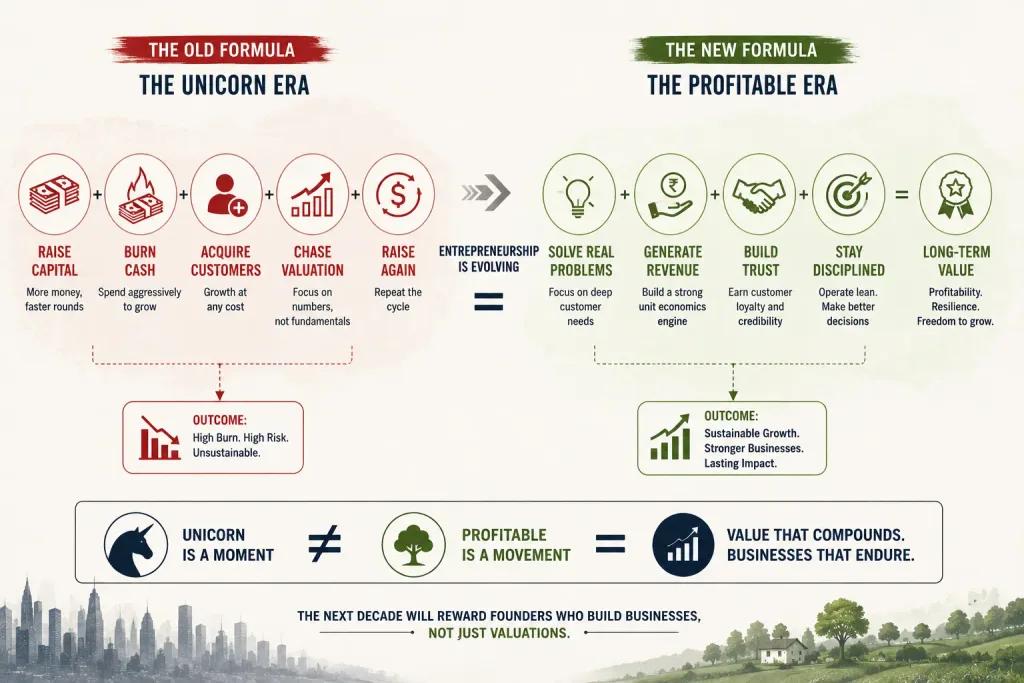
The Unicorn Era Changed Indian Entrepreneurship
The rise of the Indian startup ecosystem created enormous opportunities. As initiatives like Startup India helped strengthen the entrepreneurial landscape, capital became more accessible and innovation gained national attention.
Investors looked for rapid growth.
Companies expanded quickly.
Customer acquisition became the primary objective.
Large funding rounds became symbols of success.
This model helped create globally recognised Indian technology companies.
It encouraged innovation.
It attracted talent.
It inspired a new generation of entrepreneurs.
At the same time, a quieter movement was taking shape beyond the major startup hubs. As Webverbal explored in Why India’s Next Startup Revolution Will Not Come From Bengaluru, thousands of entrepreneurs across Tier-2 and Tier-3 India were building sustainable businesses with limited resources and a stronger focus on long-term value.
For many years, the dominant belief was that growth and profitability could wait for another day.
The next phase of Indian entrepreneurship may challenge that assumption.
Cheap Capital Changed the Rules
When money is easily available, businesses often make different decisions.
They spend heavily on advertising.
They offer large discounts.
They enter multiple markets simultaneously.
They hire aggressively.
They optimise for valuation instead of cash flow.
For many years, this strategy appeared effective because funding cycles remained strong.
But capital markets do not remain the same forever.
As investors become more cautious, founders are rediscovering an old business principle.
Revenue matters.
Profit matters.
Financial discipline matters.
Bharat Founders Have Always Thought Differently
Across Tier-2 and Tier-3 India, many entrepreneurs never had access to large funding rounds.
They learned to build businesses with limited resources.
They solved local problems.
They reinvested earnings.
They expanded gradually.
They focused on customers rather than headlines.
Many of these founders may never become public figures.
Yet they have created enterprises that survive because they are built on economic fundamentals.
This experience may become an advantage in the coming decade.
The discipline developed through necessity is becoming strategically valuable.
The Rise of the Quiet Founder
A different type of entrepreneur is emerging.
The quiet founder.
This founder does not chase attention.
They chase sustainability.
They value repeat customers over temporary growth.
They measure success through healthy cash flow.
They build strong teams.
They focus on solving real problems.
They understand that trust and profitability often reinforce each other.
The quiet founder may never dominate social media discussions.
But they may build businesses that last for generations.
Profitability Creates Freedom
A profitable business has choices.
It can invest carefully.
It can survive economic uncertainty.
It can avoid making decisions purely to satisfy external expectations.
It can focus on customers instead of constant fundraising.
Profitability also allows founders to maintain greater control over their vision.
They can grow at a pace that matches market realities.
They can experiment.
They can innovate.
Most importantly, they can build institutions rather than simply chasing valuations.
Investors May Be Looking for a Different Signal
The startup ecosystem is evolving.
Investors are increasingly asking different questions.
Can this business generate revenue?
Can it achieve profitability?
Does it solve a meaningful problem?
Can it survive difficult economic conditions?
Businesses that answer these questions positively may become more attractive than those relying entirely on future funding.
The next investment cycle may reward resilience as much as ambition.
Why This Matters for India’s Future
The rise of profitable startups in India is not only an entrepreneurial story.
It is an economic story.
Sustainable businesses create stable employment.
They strengthen local economies.
They support long-term innovation.
They encourage responsible capital allocation.
They inspire founders to build enterprises that outlive market cycles.
A healthy startup ecosystem requires both innovation and discipline.
One without the other creates imbalance.
Looking Ahead
The future of entrepreneurship may not belong to businesses that spend the most money.
It may belong to businesses that create the most value.
Technology is reducing barriers to entry.
Artificial intelligence is improving productivity.
Digital infrastructure is expanding opportunities.
At the same time, customers are demanding authenticity and investors are demanding stronger fundamentals.
These trends are creating a different entrepreneurial environment.
Founders who combine innovation with financial discipline may define the next decade.
Final Thought
History often celebrates companies after they become successful.
It rarely celebrates the discipline that made success possible.
Many of India’s next great businesses may never follow the traditional unicorn playbook.
They may grow steadily.
They may remain close to their customers.
They may build trust before scale.
They may prioritise profitability before valuation.
And in doing so, they may prove that the strongest businesses are not always the loudest ones.
The future of Indian entrepreneurship may not be built by founders who raise the most capital.
It may be built by founders who create the most lasting value.
Frequently Asked Questions
What are profitable startups in India?
Profitable startups in India are businesses that generate sustainable revenue and positive cash flow while growing responsibly instead of relying entirely on external funding.
Why are investors paying more attention to startup profitability?
Investors increasingly value profitability because financially disciplined businesses are often more resilient, less dependent on funding cycles, and better positioned for long-term growth.
Why could profitable startups outperform unicorns in the future?
Profitable startups can survive economic uncertainty, maintain strategic independence, and build sustainable customer relationships, making them well suited for the next phase of India’s entrepreneurial evolution.