Table Of Content
- India’s Startup Story Is No Longer Metro-Only
- Executive Summary
- Executive Summary
- What Is Driving the Rise of Startups in Tier 2 and Tier 3 India
- Digital Penetration and the Next 500M Users
- Lower Costs and Sustainable Burn
- Local Talent Retention Is Improving
- Bharat-First Consumer Demand
- Emerging Startup Hubs in India Beyond Metro Cities
- Startup Funding Trends in Tier 2 vs Tier 1 Cities
- Why Investors Are Backing Bharat Founders
- Types of Founders Emerging from Bharat
- Grassroots Innovators in India
- D2C Challenger Brands from Tier 2 Cities
- Returnee Founders Building from Hometowns
- Core Traits of Successful Bharat Startups
- Problem-First Thinking
- Capital Efficiency
- Deep Market Proximity
- Vernacular Advantage
- Distribution Innovation
- Resilience & Long-Term Thinking
- Case Studies of Startups from Tier 2 and Tier 3 Cities
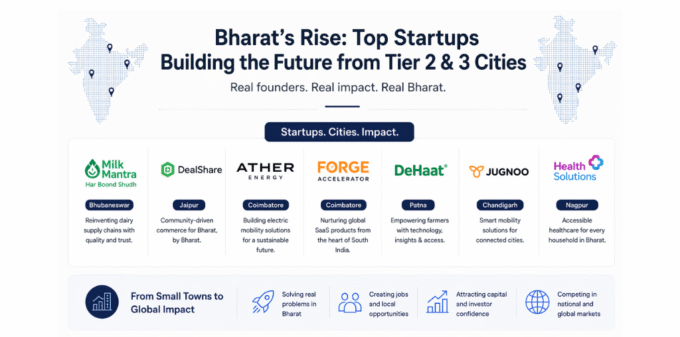
- Example of a Startup from Bhubaneswar: Milk Mantra
- Example of a Startup from Jaipur: DealShare
- Example of a Startup from Coimbatore: SaaS Exporter
- Example of a Startup from Nagpur: HealthTech Innovators
- Advantages of Building a Startup in Tier 2 and Tier 3 Cities
- Challenges Faced by Tier 2 and Tier 3 Startup Founders
- Government Initiatives Supporting Bharat Startups
- Future of Startup Ecosystem in Tier 2 and Tier 3 India
- Conclusion: The Next Wave of Indian Startups Will Be Built in Bharat
- FAQs: Startup Ecosystem in Tier 2 and Tier 3 Cities India
- Why are startups growing in Tier 2 and Tier 3 cities in India?
- Which Tier 2 cities are best for startups in India?
- How is startup funding shifting in India?
- What sectors are growing in Bharat startup ecosystem?
- Is it better to start a startup in a Tier 2 city in India?
India’s Startup Story Is No Longer Metro-Only
For years, India’s startup narrative was dominated by Bengaluru, Delhi, and Mumbai. If you were building from Bhubaneswar, Indore, or Coimbatore, you were operating outside the spotlight—away from capital, networks, and visibility.
That reality is shifting fast.
The startup ecosystem in Tier 2 and Tier 3 cities India is now emerging as a powerful force in the country’s entrepreneurial landscape. Founders across Bharat are building businesses that are not only capital-efficient but also deeply aligned with real market demand—something metro-first models often overlook.
This transformation is not accidental. Structural tailwinds like digital penetration, policy support through initiatives like Startup India, and the rise of Bharat consumers are reshaping where and how startups are built in India.
To truly understand this shift, you also need to look at the demand side. Our detailed analysis on the Webverbal explores how digital adoption, e-commerce growth, and consumption patterns across smaller towns are accelerating this momentum: Read here
What we are witnessing is not decentralization—it is a rebalancing of opportunity. And the founders who understand this early will define the next decade of India’s startup economy.
Executive Summary
Executive Summary
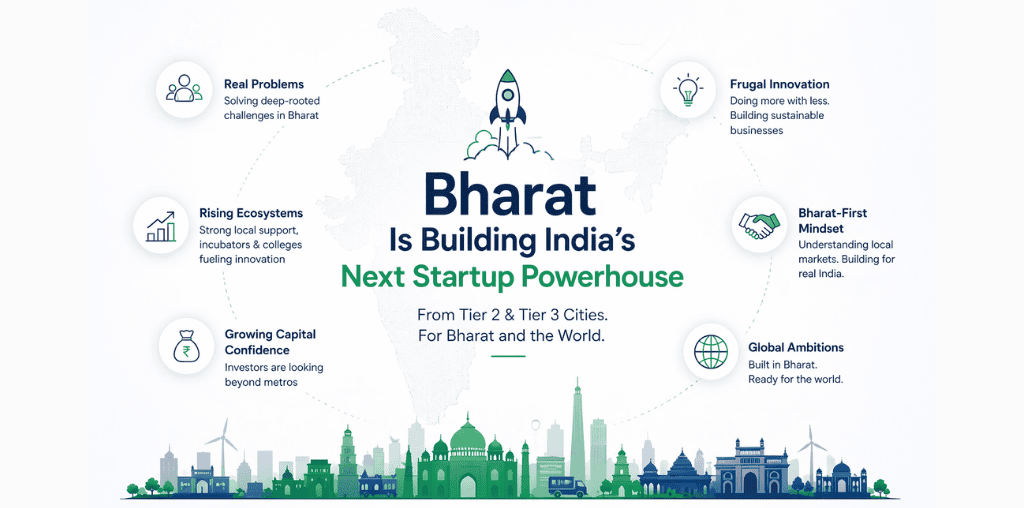
The startup ecosystem in Tier 2 and Tier 3 cities in India is transitioning from emerging to structurally significant. This report outlines the key drivers, funding shifts, and strategic advantages that position Bharat as the next growth frontier for Indian entrepreneurship.
Tier 2 and Tier 3 cities are contributing an increasing share of startup activity and innovation across sectors.
Startup funding share has expanded from ~10% in 2018 to ~24% in 2025, indicating rising investor confidence.
Key sectors include AgriTech, D2C, SaaS, and HealthTech, driven by real-world problem solving and local demand.
Lower operating costs and proximity to Bharat consumers create a structural advantage for founders.
Government initiatives and digital infrastructure such as ONDC are accelerating access to markets and distribution.
What Is Driving the Rise of Startups in Tier 2 and Tier 3 India
Digital Penetration and the Next 500M Users
India’s internet growth is no longer urban-led. The next wave of users is coming from smaller towns, shaping demand in ways metro founders often miss.
Founder Insight: If you understand Bharat users early, you don’t chase markets—you build for them before they mature.
Lower Costs and Sustainable Burn
Operating from Tier 2 and Tier 3 cities gives founders a real advantage:
- Office costs are significantly lower
- Talent is more affordable
- Burn rates are controlled
This allows longer runway and more experimentation without pressure.
Local Talent Retention Is Improving
Earlier, talent migrated to metros. Now:
- Engineers are staying back
- Remote work is normalized
- Local ecosystems are strengthening
Bharat-First Consumer Demand
Startups in smaller cities are closer to:
- Regional language users
- Price-sensitive consumers
- Trust-driven buying behaviour
This creates products that are naturally aligned with India’s mass market.
Emerging Startup Hubs in India Beyond Metro Cities
Several Tier 2 and Tier 3 cities in India are rapidly becoming startup hubs due to strong institutional support and local ecosystems.
| City | Startup Activity | Key Drivers |
|---|---|---|
| Indore | High | IIM ecosystem, logistics startups |
| Jaipur | High | D2C and marketplace innovation |
| Bhubaneswar | Growing | State policy + incubators |
| Surat | Growing | Manufacturing + D2C |
| Coimbatore | Strong | SaaS + deep-tech |
| Nagpur | Emerging | Agri + logistics |
| Chandigarh | Stable | Mobility + service startups |
Founder Insight: Ecosystems don’t start with funding. They start with founders who choose not to leave.
Startup Funding Trends in Tier 2 vs Tier 1 Cities
The biggest shift is not just in startup creation—but in capital allocation.
| Year | Tier 1 Share | Tier 2/3 Share |
|---|---|---|
| 2018 | 90% | 10% |
| 2020 | 88% | 12% |
| 2022 | 83% | 17% |
| 2025 | 76% | 24% |
Why Investors Are Backing Bharat Founders
- Rise of micro-VCs
- Angel networks in smaller cities
- CSR-backed incubation programs
- Better digital distribution (ONDC, UPI ecosystem)
Founder Insight: Capital follows conviction. Bharat founders are now building businesses that are harder to ignore.
Types of Founders Emerging from Bharat
Grassroots Innovators in India
These founders solve real problems:
- Agriculture inefficiencies
- MSME digitization
- Logistics gaps
D2C Challenger Brands from Tier 2 Cities
They understand:
- Regional identity
- Cultural positioning
- Price-value balance
Returnee Founders Building from Hometowns
Professionals leaving metros or global roles to build from their roots—bringing both exposure and intent.
Founder Insight: The strongest founders today are not chasing validation—they’re solving familiar problems deeply.
Core Traits of Successful Bharat Startups
Startups emerging from Tier 2 and Tier 3 cities in India are not accidental successes. They share a distinct set of structural traits that differentiate them from metro-first ventures. These traits are deeply rooted in proximity to real problems, capital discipline, and contextual market understanding.
Problem-First Thinking
Built around real, visible inefficiencies in agriculture, logistics, MSMEs, and local commerce—not abstract ideas.
Capital Efficiency
Lean operations, controlled burn, and longer survival cycles without early dependence on venture capital.
Deep Market Proximity
Direct access to Bharat consumers enables sharper product-market fit and faster iteration cycles.
Vernacular Advantage
Strong understanding of regional language, trust signals, and cultural context in customer acquisition.
Distribution Innovation
Leveraging WhatsApp, local networks, and ONDC-like infrastructure instead of heavy paid acquisition.
Resilience & Long-Term Thinking
Built with patience, adaptability, and a focus on sustainability over short-term valuation spikes.
Founder Insight: The strength of Bharat startups is not in speed, but in depth—depth of understanding, depth of problem, and depth of execution.
Case Studies of Startups from Tier 2 and Tier 3 Cities
Example of a Startup from Bhubaneswar: Milk Mantra
Built as a dairy brand, it evolved into a supply chain disruptor competing with national players.
Example of a Startup from Jaipur: DealShare
Scaled using WhatsApp commerce and vernacular strategies—proving Bharat-first models can win big.
Example of a Startup from Coimbatore: SaaS Exporter
Global SaaS products built from small-town India, serving international markets.
Example of a Startup from Nagpur: HealthTech Innovators
Affordable telemedicine solutions solving real access problems in underserved regions.
Advantages of Building a Startup in Tier 2 and Tier 3 Cities
- Lower operational costs
- Access to underserved markets
- Strong community trust
- Less saturated competition
- Longer survival runway
Founder Insight: In Bharat, distribution is not a problem—it’s an opportunity waiting to be structured.
Challenges Faced by Tier 2 and Tier 3 Startup Founders
- Limited mentorship access
- Investor perception bias
- Infrastructure gaps
- Talent migration (still exists)
But each year, these gaps are narrowing.
Government Initiatives Supporting Bharat Startups
- Startup India Mission
- State-level startup policies
- University incubators
- ONDC (Open Network for Digital Commerce)
ONDC, in particular, is unlocking:
- Distribution access
- Logistics integration
- Market visibility
Founder Insight: Policy doesn’t build startups—but it removes friction for those already building.
Future of Startup Ecosystem in Tier 2 and Tier 3 India
By 2030:
- 30–40% of unicorns could emerge from non-metro cities
- Bharat will define India’s consumption patterns
- Startup models will be more capital-efficient and sustainable
This is not a shift. It is a redistribution of opportunity.
Conclusion: The Next Wave of Indian Startups Will Be Built in Bharat
The startup ecosystem in Tier 2 and Tier 3 cities in India is no longer emerging—it is accelerating.
From Bhubaneswar to Indore, from Surat to Coimbatore, founders are building businesses that are:
- Closer to real demand
- More efficient
- More resilient
The next generation of Indian startups will not come from where the spotlight is.
They will come from where the problems are real—and the founders are willing to solve them.
FAQs: Startup Ecosystem in Tier 2 and Tier 3 Cities India
Why are startups growing in Tier 2 and Tier 3 cities in India?
Due to lower costs, rising digital adoption, and access to underserved markets.
Which Tier 2 cities are best for startups in India?
Indore, Jaipur, Coimbatore, Bhubaneswar, Surat, and Chandigarh are among the fastest-growing.
How is startup funding shifting in India?
Tier 2/3 cities now receive ~24% of funding, up from ~10% in 2018.
What sectors are growing in Bharat startup ecosystem?
AgriTech, D2C, SaaS, HealthTech, and MSME-focused solutions.
Is it better to start a startup in a Tier 2 city in India?
For many founders, yes—due to cost advantages, local demand, and improving ecosystem support.