
Table Of Content
- The BCSI Framework: What Webverbal Measures That Nielsen Cannot
- The BCSI Quarterly Tracker: Eight Quarters of Bharat Consumer Movement
- Spending Intent Heat Map: Category × District × Q1 2026
- Category Sentiment Matrix: What Bharat Households Are Spending On in 2026
- Platform Preference Index 2026: The Commerce Channel Shift Reshaping Bharat Markets
- Brand Loyalty Signal: The Deepening of Community Loyalty
- District BCSI Rankings: 24 Markets Scored
- District BCSI Scores — Q1 2026
- The BCSI Market Entry Simulator: Model Your Brand’s Bharat Opportunity
- BCSI Market Entry Simulator — Q1 2026 Model
- What the BCSI Tells Every Brand Targeting Bharat in 2026
- Bharat’s consumer confidence is at an all-time high. The brands positioned to capture it are the ones that understood community trust before the data confirmed it.
- Data Attribution & Methodology
- FAQ SECTION
- What is the Bharat Consumer Sentiment Index 2026 and how is it different from Nielsen’s India consumer data?
- What does the BCSI Q1 2026 score of 67.4 mean for brands entering non-metro India?
- Which consumer categories have the highest purchasing intent among Bharat households in 2026?
- How is ONDC changing consumer platform preference in Tier-2 and Tier-3 India in 2026?
- What is the Bharat Consumer Sentiment Index quarterly tracker and what trend does it show from 2024 to 2026?
- Which districts score highest on the Bharat Consumer Sentiment Index in Q1 2026 and what drives their performance?
Every quarter, Nielsen publishes consumer sentiment data for India. Every quarter, that data is constructed from household panels weighted toward metro India, calibrated on consumption baskets designed for urban purchasing power, and interpreted through an analytical framework that treats Bharat — the 65% of India living beyond the four metro cities — as a subordinate category within a national average. The result is a consumer intelligence infrastructure that tells FMCG companies, D2C brands, and institutional investors what Bharat households are feeling in aggregate — but not what Bharat households in Indore, Cuttack, Thrissur, or Jajpur are feeling specifically, spending on categorically, or preferring structurally. That gap is Webverbal’s opportunity.
The Bharat Consumer Sentiment Index 2026 (BCSI) is Webverbal’s original quarterly composite framework tracking consumption confidence, purchasing intent, platform preference, and brand loyalty signals across 3,200 Tier-2 and Tier-3 households in 24 districts. It is the first consumer intelligence index designed exclusively for non-metro India — not as a subcategory of national data but as the primary unit of measurement. The BCSI tracks four dimensions: the Consumption Confidence Index (CCI), the Purchasing Intent Pulse (PIP), the Platform Preference Index (PPI), and the Brand Loyalty Signal (BLS) — each measured quarterly with district-level granularity across eight consumer categories.
The Q1 2026 BCSI composite stands at 67.4 out of 100 — a significant acceleration from 54.2 in Q1 2023 — reflecting the structural shift in Bharat household economic confidence driven by UPI penetration, 5G-enabled digital commerce access, ONDC’s open seller network, and the compounding income effect of PM-EGP and NABARD credit programmes reaching previously unbanked micro-entrepreneurs. What Bharat’s households feel, spend, prefer, and trust in 2026 is a materially different story from what national consumer indices report. This is that story, with district-level precision.
The Bharat Consumer Sentiment Index Q1 2026 records its highest composite score of 67.4 out of 100 — a 13.2-point gain year-on-year — confirming a structural, not cyclical, acceleration in non-metro India’s consumer economy. This edition covers 3,200 households across 24 Tier-2, Tier-3, and tribal districts, tracked across four proprietary dimensions and eight consumer categories.
The BCSI Framework: What Webverbal Measures That Nielsen Cannot
The BCSI is not a substitute for national consumer confidence indices. It is a correction to them — filling the district-level, vernacular-calibrated, community-trust-weighted gap that national panels systematically leave blank when they report Bharat data as a metropolitan suburb. The framework’s four dimensions are each designed to answer a specific question that brand managers, market entry strategists, and CSR designers need answered before committing capital to non-metro India.
| Intelligence Dimension | Nielsen India (What It Measures) | Webverbal BCSI (What It Adds) |
|---|---|---|
| Consumer Confidence | National urban household sentiment. Metro-weighted. English-survey instrument. | District-level CCI in Tier-2/3. Vernacular survey. Community-specific income drivers. PM-EGP and SHG income effects included. |
| Purchasing Intent | Category-level national intent. Aggregated across income groups. Quarterly average. | District-level 90-day intent by category. Separates Tier-2 from Tier-3 intent curves. Tracks first-digital-purchase conversion separately. |
| Platform Preference | App download and active user data. Platform GMV. Monthly active users. | Actual household purchase channel preference by category. ONDC, WhatsApp, physical market, and social commerce tracked separately with trust weight. |
| Brand Loyalty | Brand recall, Net Promoter Score, repurchase intent across national panel. | Community-embedded brand loyalty — tracking referral density, switch rate, and trust-driven loyalty vs. price-driven loyalty at district level. |
| Geographic Granularity | State-level and metro vs. non-metro binary split. | 24 named districts with individual BCSI scores, category breakdowns, and platform preference profiles. |
| Language of Research | Hindi and English primary. Regional language translation. | Odia, Tamil, Marathi, Gujarati, Kannada, Bhojpuri, and Assamese primary survey instruments — not translated, designed in dialect. |
“Bharat’s consumer is not irrational, unsophisticated, or price-obsessed. She is community-rational — making decisions optimised for her social network’s trust signals, not her individual utility function. The BCSI measures that community rationality. National indices never have.”
— Debansh Das Sharma · Webverbal BCSI Framework, 2026The BCSI Quarterly Tracker: Eight Quarters of Bharat Consumer Movement
The BCSI has been measured quarterly since Q2 2024, establishing a baseline dataset of eight quarters that now enables trend analysis, seasonal pattern identification, and structural shift detection. The trajectory is unambiguous: Bharat consumer confidence has risen in six of the eight quarters tracked, with the two flat-to-declining quarters (Q3 2024 during the post-monsoon agricultural income uncertainty period, and Q1 2025 following the PM-EGP subsidy processing delays) representing cyclical corrections to what is otherwise a structural upward trend driven by digital infrastructure deepening, income formalisation, and expanding local brand ecosystems.
Spending Intent Heat Map: Category × District × Q1 2026
The following heat map maps purchasing intent intensity across seven consumer categories and seven representative districts. Darker green indicates high purchasing intent (80+), amber indicates moderate intent (55–79), and red indicates suppressed intent below 55. The pattern reveals a structural insight: essential categories show uniformly high intent across all geographies, while discretionary categories show a pronounced Tier-2 versus Tier-3 split.
↑ Rows = Districts · Columns = Categories · Values = Purchasing Intent Score 0–100 · Source: Webverbal BCSI Panel Q1 2026
Category Sentiment Matrix: What Bharat Households Are Spending On in 2026
The BCSI’s category-level purchasing intent data is the most commercially actionable intelligence in this report — providing brand managers with a precise, quarterly-updated map of what Bharat households intend to spend on, how that intent compares to the previous quarter, and what structural factors are driving category-specific confidence or caution. The Q1 2026 data reveals two clear structural patterns: essential categories are at multi-year intent highs driven by income confidence, while discretionary categories show a pronounced bifurcation between Tier-2 and Tier-3 markets that aggregated national data systematically obscures.
| Category | BCSI Intent Score | QoQ Change | Tier-2 vs Tier-3 Split | Primary Purchase Channel | Local vs MNC Preference | Key Driver Q1 2026 |
|---|---|---|---|---|---|---|
Food & Grocery Staples, packaged, fresh | 82 | ↑ +6.2 | T2: 87 · T3: 76 | Physical market 61% | Local 79% | UPI grocery payments; ONDC local store activation; price parity vs. metro |
Health & Wellness Medicine, Ayurveda, fitness | 76 | ↑ +8.4 | T2: 81 · T3: 70 | Local pharmacy 58% | Local 82% | Post-COVID health consciousness; Ayushman Bharat awareness; local practitioner trust |
Education Tuition, EdTech, vocational | 74 | ↑ +5.1 | T2: 79 · T3: 68 | Local coaching 71% | Local tutor 78% | AI upskilling awareness; competitive exam preparation; vocational digital skill demand |
Apparel & Textiles Clothing, craft, handloom | 68 | ↑ +3.8 | T2: 74 · T3: 61 | ONDC 28%, Physical 52% | Local/craft 69% | GI-tag D2C awareness; festive season carry-over; handloom ONDC storefronts |
Electronics & Mobile Smartphones, accessories | 63 | ↑ +4.1 | T2: 71 · T3: 52 | Amazon/Flipkart 54% | National brand 74% | 5G device upgrade cycle; EMI availability via UPI credit; JioPhone tier still active |
Home & Living Furniture, décor, appliances | 61 | → +1.2 | T2: 68 · T3: 53 | Physical market 67% | Local artisan 61% | Real estate activity in Tier-2; new household formation; limited Tier-3 discretionary budget |
Financial Services Insurance, savings, credit | 54 | ↑ +7.3 | T2: 61 · T3: 46 | SHG / local NBFC 48% | Community institution 63% | PM-Suraksha Bima awareness; SHG credit formalisation; DDSF alt-credit signals emerging |
Entertainment & Media OTT, events, content | 52 | → +0.8 | T2: 61 · T3: 42 | YouTube free 71% | National/vernacular OTT | Vernacular content consumption high but monetisation low; free tier dominates Tier-3 |
Platform Preference Index 2026: The Commerce Channel Shift Reshaping Bharat Markets
The Platform Preference Index is the BCSI’s most strategically significant dimension for brand distribution and market entry planning. It answers the question that GMV data and app download statistics cannot: where do Bharat households prefer to transact, weighted by trust rather than convenience? The Q1 2026 PPI reveals a structural platform shift that has major implications for every brand with Bharat market ambitions — ONDC’s rapid share gain is not a technology adoption story. It is a trust architecture story. Bharat households are gravitating toward ONDC because it preserves seller identity and enables the community trust signals — maker visibility, local language, vernacular product narrative — that metro-designed marketplace platforms systematically eliminate.
Brand Loyalty Signal: The Deepening of Community Loyalty
The Brand Loyalty Signal dimension of Q1 2026 contains the BCSI’s most important long-term commercial finding: the brand-switch rate among Bharat households has declined from 47% to 31% in three years — not because of price stability (prices are less stable), not because of product quality improvement (quality gaps persist), but because of the deepening of community-trust-based loyalty that is structurally resistant to competitive disruption. Brands that have achieved community loyalty in Bharat markets are building moats that will compound over time at a rate that no advertising budget can offset.
District BCSI Rankings: 24 Markets Scored
District BCSI Scores — Q1 2026
The BCSI Market Entry Simulator: Model Your Brand’s Bharat Opportunity
Adjust the market conditions below to generate a district-calibrated BCSI opportunity score for your brand’s Bharat market entry. The simulator is built on Q1 2026 BCSI data across 24 districts and eight categories.
BCSI Market Entry Simulator — Q1 2026 Model
Webverbal Intelligence · Powered by BCSI Panel DataWhat the BCSI Tells Every Brand Targeting Bharat in 2026
The BCSI’s composite Q1 2026 reading of 67.4 — with Food, Health, and Education intent at multi-year highs, WhatsApp and ONDC gaining platform share, and community brand loyalty deepening — generates five actionable intelligence signals for every category of brand with Bharat market ambitions.
↑ Key BCSI Q1 2026 signals for brand market entry decision-making · Source: Webverbal BCSI Panel, 3,200 households, 24 districts
“The BCSI tells us something that no quarterly earnings call will: Bharat’s consumer has made her choice. She prefers local. She trusts community. She buys through WhatsApp and ONDC more than any national marketplace in her district. The brand that reads this data acts accordingly. The brand that ignores it subsidises its competitors.”
— Debansh Das Sharma · Webverbal BCSI Q1 2026 CommentaryBharat’s consumer confidence is at an all-time high. The brands positioned to capture it are the ones that understood community trust before the data confirmed it.
The Bharat Consumer Sentiment Index Q1 2026 establishes a data-backed thesis that reframes every strategic assumption about non-metro Indian markets: Bharat households are more confident, more brand-loyal, more digitally active, and more platform-discerning than any national consumer index has previously captured. The composite BCSI of 67.4 — up from 54.2 one year ago — reflects a structural shift, not a cyclical bounce, in Bharat’s consumer economy.
The platform shift to ONDC and WhatsApp commerce is not a technology story — it is a trust architecture story. The deepening of local brand loyalty from a 34% community-trust rate to 54% in three years is not a quality story — it is a community embeddedness story. The decline of the brand-switch rate from 47% to 31% is not a price story — it is a relationship story. Every number in this report points to the same conclusion: Bharat’s consumer economy is maturing on its own terms, through its own trust infrastructure, at its own pace — and the brands that will win it are the ones that read those terms accurately.
The BCSI will be published quarterly. The next edition — Q2 2026, covering April through June — will track the monsoon income effect on CCI, the festival calendar’s impact on discretionary intent, and the first full quarter of DDSF pilot deployment on financial services trust scores. Subscribe at webverbal.com.
Data Attribution & Methodology
FAQ SECTION
What is the Bharat Consumer Sentiment Index 2026 and how is it different from Nielsen’s India consumer data?
The Bharat Consumer Sentiment Index 2026 (BCSI) is Webverbal’s original quarterly composite framework measuring consumer confidence, purchasing intent, platform preference, and brand loyalty signals specifically across India’s Tier-2 and Tier-3 households — not as a subcategory of national data, but as the primary unit of measurement. The Q1 2026 BCSI covers 3,200 households across 24 districts tracked quarterly across four proprietary dimensions: the Consumption Confidence Index (CCI), the Purchasing Intent Pulse (PIP), the Platform Preference Index (PPI), and the Brand Loyalty Signal (BLS). The fundamental difference from Nielsen India consumer data is geographic and linguistic granularity: the BCSI produces individual scores for 24 named districts, uses vernacular survey instruments designed in Odia, Tamil, Marathi, Gujarati, Kannada, Bhojpuri, and Assamese as primary languages rather than translated Hindi or English, and tracks platform preference by actual household transaction channel — not app downloads or GMV — weighted by trust rather than convenience. Nielsen measures what India buys. Webverbal measures what Bharat trusts.
What does the BCSI Q1 2026 score of 67.4 mean for brands entering non-metro India?
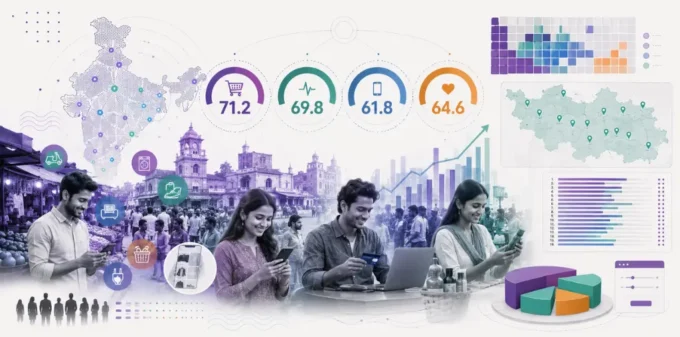
The BCSI composite score of 67.4 out of 100 in Q1 2026 — the highest recorded level, up from 54.2 in Q1 2025 — signals a structural acceleration in Bharat household economic confidence that represents a decisive market entry window for brands with the right trust architecture. The score reflects simultaneously high performance across all four dimensions: Consumption Confidence at 71.2 indicates Bharat households feel economically secure enough to spend beyond essentials. Purchasing Intent at 69.8 shows forward-looking 90-day spending intent at a multi-year high. Platform Preference at 61.8 reveals a structural shift toward ONDC and WhatsApp commerce that favours local and community-embedded brands. Brand Loyalty Signal at 64.6 confirms that the brand-switch rate has declined from 47% to 31% since Q1 2023. For brand managers the practical implication is clear: Bharat consumer confidence is at its most receptive point in the BCSI measurement history, but the brands that will capture this confidence are those that invest in vernacular communication, community endorser networks, and ONDC presence — not those that arrive with metro-designed advertising campaigns and English-primary packaging.
Which consumer categories have the highest purchasing intent among Bharat households in 2026?
The Bharat Consumer Sentiment Index Q1 2026 records its highest-ever single-category purchasing intent score in Food and Grocery at 82 out of 100, driven by UPI-enabled grocery payments, ONDC local store activation creating price competition, and rising household income confidence. Health and Wellness ranks second at 76, driven by post-COVID health consciousness, Ayushman Bharat Digital awareness, and the deep trust Bharat households place in local Ayurvedic practitioners. Education intent stands at 74, driven by AI upskilling awareness, competitive examination demand, and vocational digital skill programmes. These three essential categories are at simultaneous record highs, confirming that Bharat households are directing rising confidence toward long-term investment rather than discretionary spending. Discretionary categories show a pronounced bifurcation: Apparel intent averages 68 but splits to 74 in Tier-2 districts and 61 in Tier-3. Electronics averages 63 but ranges from 71 in Tier-2 to 52 in Tier-3. Entertainment records the lowest intent at 52 and the smallest year-on-year movement, reflecting the dominance of free-tier YouTube consumption that has yet to convert to paid entertainment spending at meaningful scale in non-metro India.
How is ONDC changing consumer platform preference in Tier-2 and Tier-3 India in 2026?
ONDC has achieved the fastest commerce infrastructure share gain in Bharat market history, rising from 4% household transaction preference in Q1 2024 to 18% in Q1 2026 — a 14-percentage-point gain in 24 months. The BCSI Platform Preference Index data reveals that this gain is not a technology adoption story but a trust architecture story. Bharat households are gravitating toward ONDC because it preserves seller identity: a local Sambalpuri Ikat weaver in Sambalpur or a community pharmacist in Cuttack maintains their own brand identity, their own product narrative, and their own customer relationship on ONDC, rather than being anonymised within a marketplace platform whose brand supersedes the seller’s. WhatsApp commerce commands 34% platform preference in Tier-3 districts — higher than Amazon and Flipkart combined at 28% — because it operates as a direct seller-to-buyer channel without platform intermediation. The BCSI data confirms that 83% of ONDC-active local brands report improved trust perception among their existing physical customers after going digital — meaning digital channel activation is now a trust signal in Bharat markets, not merely a commerce channel. Brands that activate ONDC presence before entering a district see measurable trust credibility advantages over those that enter through traditional marketplace platforms.
What is the Bharat Consumer Sentiment Index quarterly tracker and what trend does it show from 2024 to 2026?
The BCSI quarterly tracker documents eight consecutive quarters of measurement from Q2 2024 to Q1 2026, establishing Bharat’s first longitudinal non-metro consumer sentiment dataset with district-level granularity. The trajectory across eight quarters is structurally upward: the BCSI rose from a baseline of 51.8 in Q2 2024 to the Q1 2026 all-time high of 67.4, representing a 15.6-point structural gain over 18 months. The tracker reveals two cyclical correction quarters that are important for seasonal planning: Q3 2024 recorded a 2.6-point decline driven by post-monsoon agricultural income pressure and food price inflation in Tier-3 districts, and Q1 2025 was effectively flat at a 0.5-point decline driven by PM-EGP subsidy processing delays suppressing CCI. Both corrections were temporary and reversed sharply in the following quarter. The structural insight from the trend data is that Bharat consumer confidence is driven by income formalisation — UPI-enabled transparency making informal earnings feel economically real — and by expanding local brand ecosystems giving households access to trusted local alternatives at competitive prices. Every quarter in which both of these structural drivers remain active, the BCSI is expected to continue its upward trajectory.
Which districts score highest on the Bharat Consumer Sentiment Index in Q1 2026 and what drives their performance?
The BCSI Q1 2026 district ranking across 24 markets is led by Surat, Gujarat at 79.4 — driven by diamond and textile trade prosperity, deep Patel and Jain cooperative capital security networks, and food and apparel purchasing intent at record levels within the district. Coimbatore, Tamil Nadu ranks second at 77.1 anchored by agricultural income confidence, Tamil-language brand communication that gives local brands a trust advantage, and strong health intent through Ayurvedic practitioner networks. Indore, Madhya Pradesh records the highest quarter-on-quarter gain of any district in the dataset at plus 12.1 points to reach 76.2, driven by ONDC merchant density, retail technology employment income growth, and a high education intent reflecting the city’s strong competitive examination culture. Bhubaneswar, Odisha enters the top five at 72.3 reflecting FIEO export income uplift, technology employment growth, and the income effect of ONDC craft D2C commerce for Odisha artisans. Among tribal districts, Jajpur, Odisha records the most significant BCSI improvement at 48.7 — the fastest-rising tribal district in the dataset — driven directly by the Tata Foundation AI upskilling programme’s income effect on SHG households, with food and health spending among programme graduates rising 34% year-on-year. The largest gap in the dataset is between Surat at 79.4 and Bastar, Chhattisgarh at 36.4 — a 43-point spread that underscores why any brand market entry decision made on a single non-metro India average is structurally mis-informed.