
Table Of Content
- Executive Summary: The Quiet Founder Economy
- The Resilience Playbook: Bootstrapped Business Models in Tier 2 and Tier 3 Cities in India
- Survival as a Metric: The 78% Moat
- Atma-Shakti: Scaling Without Equity
- Local Impact: The Job Creation Engine
- // QFI 2026: BOOTSTRAPPED RESILIENCE TRACKER
- The Webverbal Opinion: Measuring What Matters
- Frequently Asked Questions: The Quiet Founder Economy
- Frequently Asked Questions
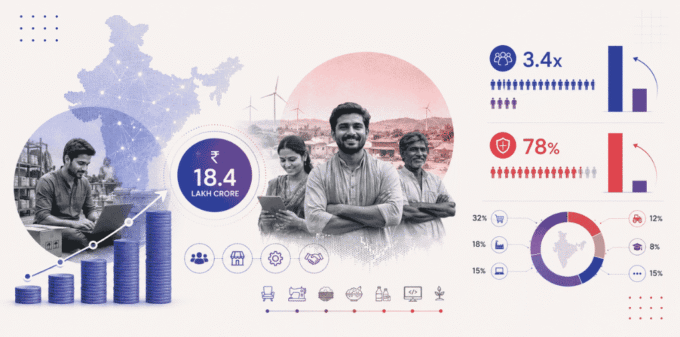
In the high-decibel world of Indian entrepreneurship, the “Unicorn” narrative—defined by venture capital (VC) infusions, rapid burn rates, and metro-centric growth—has long claimed the spotlight. However, the Quiet Founder Index 2026 reveals a different reality operating below the surface. While metro-born, VC-backed startups struggle with a 34% survival rate at Series A, a vast “invisible economy” in Bharat is thriving with a 78% five-year survival rate.
These “Quiet Founders” represent a ₹18.4 Lakh Crore bootstrapped economy—roughly 14.2% of India’s GDP—that receives less than 1% of mainstream media coverage. From profitable small business ideas for Bhubaneswar and Indore to manufacturing clusters in Ludhiana, these entrepreneurs are practicing sustainable entrepreneurship without venture capital in India. They don’t just build companies; they build “Atma-Shakti” (self-sovereign) enterprises rooted in community trust and the discipline of slow growth.
For a deep dive into the metrics of this invisible engine, explore our full Quiet Founder Index 2026 report. To understand how this fits into the broader digital shift, visit the Startup India portal for official government recognition pathways.
Executive Summary: The Quiet Founder Economy
The Signal: Quiet Founders in Tier-2/3 India demonstrate a 78% survival rate, more than double the 34% seen in VC-backed startups.
The Scale: An estimated 11.2 million Quiet Founders generate ₹18.4 Lakh Crore in annual revenue, contributing 14.2% to India’s GDP.
- Efficiency: Quiet Founders create 3.4x more local jobs per ₹1 Cr revenue than their VC-funded counterparts.
- Capital: 91% of these entrepreneurs use zero external equity, relying on family savings and community trust networks.
- Moat: High “Rootedness” (81/100) serves as a primary competitive advantage, with 94% of revenue recirculated locally.
The Resilience Playbook: Bootstrapped Business Models in Tier 2 and Tier 3 Cities in India
Survival as a Metric: The 78% Moat
In Bharat, survival is not the baseline; it is the strategy. The Quiet Founder Index highlights that “Slow Growth” (averaging 7.3 years to reach the ₹1 Cr revenue milestone) creates structural wisdom. By avoiding the “growth-at-any-cost” trap, these founders build cost structures calibrated to real market conditions, resulting in a 78% survival rate that dwarfs the metro-startup average.
Atma-Shakti: Scaling Without Equity
The question of how to scale a bootstrapped startup in Bharat is answered through “Trust Velocity”. Quiet Founders invest in relationship depth rather than customer acquisition costs. In hubs like Surat (QFI 84/100) and Ludhiana (QFI 81/100), community capital via cooperative networks replaces the need for VC deal flow.
Local Impact: The Job Creation Engine
While unicorns often focus on individual liquidity events, Quiet Founders measure success in community wealth. They generate 3.4x more local employment per ₹1 Cr of revenue compared to VC-funded equivalents. This “Rootedness” is the ultimate competitive moat for profitable small business ideas for Bhubaneswar and Indore, ensuring that 94% of revenue circulates back into local supplier networks.
// QFI 2026: BOOTSTRAPPED RESILIENCE TRACKER
Select a Dimension to view Quiet Founder Performance vs. VC-Funded Peers:
Insight: High resilience is driven by cost structures calibrated to real market revenue rather than capital burn.
The Webverbal Opinion: Measuring What Matters
India celebrates its unicorns, but it should study its Quiet Founders. The ₹18.4 Lakh Crore bootstrapped economy is the nation’s true engine of economic resilience. At Webverbal, our research direction—from the Quiet Founder Index to the Reverse Migration Talent Index (RMTI)—is focused on making this invisible economy visible to those who need to understand it most.
The future of Viksit Bharat 2047 does not live in Koramangala alone. It lives in the 11 million founders across Sambalpur, Tirupur, and Jajpur who have never been ranked but have never stopped building.
Frequently Asked Questions: The Quiet Founder Economy
Frequently Asked Questions
Q: Who exactly is a ‘Quiet Founder’?
A: An entrepreneur operating a ₹1–50 Cr bootstrapped business in non-metro India, untracked by traditional VC databases.
Q: Why do they outperform VC-funded startups in survival?
A: Because they use revenue-first models. Their 78% survival rate comes from avoiding growth-at-any-cost traps.
Q: What is the scale of this ‘Invisible Economy’?
A: It generates ₹18.4 Lakh Crore annually, accounting for roughly 14.2% of India’s GDP.