Table Of Content
- Executive Summary: The Vernacular AI Mandate
- The Architecture of Bharat-Native AI
- Why General LLMs Fail the Bharat MSME
- Building the “Vertical AI” Alternative
- The Bhashini Platform Integration for Startups
- // BARI 2026: VERNACULAR INFRASTRUCTURE AUDIT
- The Webverbal Opinion: From Atma-Nirbhar to Atma-Shakti
- Frequently Asked Questions: Vernacular AI
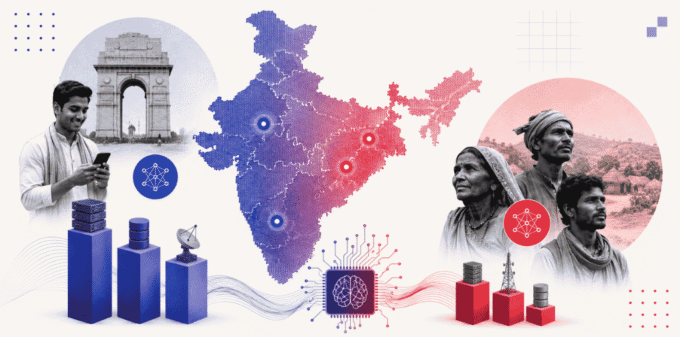
The global AI race is sprinting at breakneck speed, but for 900 million citizens of Bharat, that race is being run in a language they don’t speak. While Silicon Valley and Bengaluru celebrate billion-dollar LLMs, the Bharat AI Readiness Index 2026 reveals a staggering 61% vernacular coverage gap. Languages like Odia, Bhojpuri, and Santali remain at the frontier of “AI illiteracy,” excluded not by a lack of demand, but by a structural “language equity gap” in training data.
For the regional MSME—the Odia-speaking exporter in Cuttack or the Bhojpuri-speaking farmer in Varanasi—general-purpose LLMs are often more of a riddle than a resource. To bridge this, the focus must shift from horizontal, “know-it-all” models to Vertical AI: domain-specific systems built for Bharat’s economic reality. This shift is already being championed by initiatives like the Bhashini Platform, which provides the National Language Translation Mission’s infrastructure to power a truly inclusive digital India.
At Webverbal, our field research into Social Impact AI suggests that the next decade of growth won’t come from teaching Bharat English, but from teaching AI the dialects of the Mandi, the loom, and the trade corridor.
Executive Summary: The Vernacular AI Mandate
The Problem: 61% of India’s scheduled languages currently lack production-ready AI tools, creating a structural barrier for 65% of the population. [cite: 6, 18, 19]
The Solution: A shift from general-purpose LLMs to Vertical AI—domain-specific systems built for Bharat’s economic reality, such as Odia-language export compliance tools. [cite: 93, 197, 198]
- Task Completion: Dialect-first tools achieve a 3.1x higher task-completion rate than Hindi/English tools for non-metro users. [cite: 29, 30]
- Infrastructure Gap: Odia remains the highest priority gap with sub-30% AI infrastructure depth despite 45 million speakers. [cite: 124, 139]
- Impact Potential: Scaling social impact AI to tribal districts could unlock ₹47 Cr in annual commerce for women entrepreneurs. [cite: 247, 323]
The Architecture of Bharat-Native AI
Why General LLMs Fail the Bharat MSME
General-purpose models perform poorly in low-resource languages because they are trained on “Internet-scale” data, which is disproportionately English. When an Odia-speaking rice farmer asks about PMFBY (Pradhan Mantri Fasal Bima Yojana) claim procedures, a general LLM might provide a generic translation that misses the specific soil types of coastal Odisha or the nuances of regional mandi price movements.
Building the “Vertical AI” Alternative
Vertical AI narrows the problem. An AI tool for an exporter doesn’t need to write poetry; it needs to understand DGFT (Directorate General of Foreign Trade) circulars and ONDC cross-border protocols in the user’s native tongue.
- Odia NLP Applications for Agriculture: By training models specifically on regional agronomic data, engagement levels jump significantly.
- Voice-First AI Interfaces: For rural India, the keyboard is the barrier. Voice-to-voice systems allow tribal women entrepreneurs, like those in Jajpur, to interact with AI as naturally as a conversation.
The Bhashini Platform Integration for Startups
Startups must move away from building proprietary base models and instead integrate with India’s Digital Public Infrastructure (DPI). Bhashini offers the ASR (Automatic Speech Recognition) and NLP layers that make “how to build vernacular ai tools for indian msmes” a matter of engineering integration rather than research-heavy investment.
// BARI 2026: VERNACULAR INFRASTRUCTURE AUDIT
Select a language to view AI infrastructure depth[cite: 140]:
Status: Production-Ready
Stable deployment for commercial use cases.
Source: Webverbal BARI Language Audit 2026. [cite: 140, 345]
The Webverbal Opinion: From Atma-Nirbhar to Atma-Shakti
Building for Bharat is not an act of charity; it is a recognition of a ₹18.4 Lakh Crore invisible economy. Our work with Niryat-AI and the Swayam Programme has shown that when you remove the language barrier, the “Trust Gap” closes instantly.
We believe that Digital Dignity—the right to access AI in one’s own language—is the prerequisite for Viksit Bharat 2047. The goal is Atma-Shakti: AI tools that build independence rather than dependency. The future of AI in India isn’t just “Made in India”—it’s “Spoken in Bharat”.
Frequently Asked Questions: Vernacular AI
Q: What is the primary barrier to AI access in Bharat?
A: The 61% vernacular coverage gap across India’s scheduled languages. [cite: 18, 19]
Q: Why is Vertical AI recommended for MSMEs over general LLMs?
A: Because domain-specific tools achieve 3.1x higher engagement in dialects than general Hindi/English tools. [cite: 30, 93]
Q: What is ‘Digital Dignity’ in AI?
A: It is the right to access technology in one’s native language without institutional or linguistic barriers. [cite: 295, 296]