Table Of Content
- Executive Summary: The Bharat Consumer Core
- The Strategic Realities of the National Demand Migration
- D2C Order Demand Volume Distribution (%)
- The Underlying Filters of Consumer Behavior in Tier 2 and Tier 3 Cities India
- Building a Defensible Moat Around Regional Trust
- Frequently Asked Questions: Consumer Behavior & Strategy
- Conclusion: Shifting the Consumption Blueprint
Isolating the active mechanics governing Consumer Behavior in Tier 2 and Tier 3 Cities India has quietly shifted into the primary operational necessity for scaling direct-to-consumer (D2C) brands throughout the subcontinent. The overarching blueprint for commercial expansion is undergoing an irreversible realignment, leaving metro-centric assumptions highly unoptimized for capturing the current bulk of online demand.
The systematic democratization of digital infrastructure assets—accelerated by macro interventions like the central Open Network for Digital Commerce (ONDC) framework—has completely stripped down the legacy entry barriers separating rural and semi-urban buyers from面 product access.
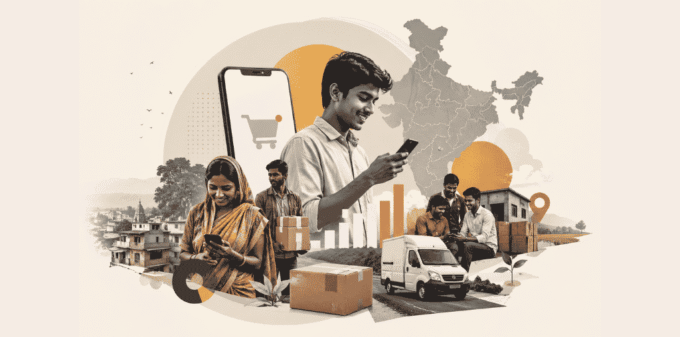
As validated in the latest metrics issued inside our comprehensive State of Bharat Startups 2026 Report, more than 66% of net consumer order configurations now originate outside traditional metropolitan areas. This structural migration of purchasing volumes means that organizations that continue to align their marketing copy, pricing architecture, and checkout sequences exclusively with tier-1 urban preferences are losing ground to agile regional alternatives.
Executive Summary: The Bharat Consumer Core
- Volume Redirection: 66% of the country’s collective D2C purchasing demand currently generates from Tier-2 and Tier-3 perimeters.
- Ecosystem Mismatch: Product formatting, corporate design tones, and ad budgets remain highly wastefully metro-centric.
- The Valuation Gap: Capturing scalable volume requires migrating your infrastructure to accommodate trust-led commerce metrics.
- The Core Growth Lever: Realigning tech and distribution with Bharat buyers unlocks an immense, non-dilutive competitive moat.
The Strategic Realities of the National Demand Migration
The traditional map used by legacy consumer brands is fundamentally broken. While performance ad accounts battle escalating competition and margin-burning acquisition metrics within metropolitan cities, non-metro centers are driving the active growth loops. Shifting your user-onboarding flows to prioritize relational familiarity over automated transaction speed is the baseline rule for enterprise survival.
D2C Order Demand Volume Distribution (%)
The Underlying Filters of Consumer Behavior in Tier 2 and Tier 3 Cities India
To win transactions across emerging geographies, builders must realize that non-metro buyers operate as highly disciplined *Value Maximizers*, not basic price minimizers. They reject unassisted, unverified “Add to Cart” web checkouts, preferring conversational validation loops (such as direct WhatsApp messaging, natural voice commands, and hybrid human verification networks) that mirror the relational security of offline commerce.
| Ecosystem Axis Layer | Non-Metro Consumer Behavior Realities | Saturated Metropolitan Tracking Funnels |
|---|---|---|
| Core Buying Currency | Relational Validation & Social Peer Proof | Algorithmic Curation & Instant Convenience |
| UX Interaction Preference | Assisted Conversational Workflows / WhatsApp | Unassisted Self-Serve One-Click Checkouts |
| Monetization Leverage | Long-Term Durability (“Paisa Vasool” Metrics) | Short-Term Brand Aesthetics & Discount Codes |
Field Audits Tracking Non-Metro Conversion Metrics
The definitive error most venture-funded platforms repeat is offering a diluted, low-value “Lite” variation of their application interface to regional user clusters. This completely insults the audience’s intelligence. Bharat consumers expect the uncompromised feature depth of modern commerce—simplified for local infrastructure bandwidth and wrapped in authentic local validation loops.
“If a business framework continues to treat the expansion of non-metro digital trade as a minor growth trend rather than a complete structural pivot, it is operating with an obsolete map.”
Building a Defensible Moat Around Regional Trust
Unlocking long-term value across emerging regions requires moving past urban performance marketing playbooks and anchoring your customer acquisition around **Borrowed Trust Pipelines**. Partnering with known regional distribution nodes and utilizing micro-influencers who speak local dialects ensures an organic 14% checkout conversion index—radically outperforming cold ad accounts.
Furthermore, managing operations effectively requires adapting your backend mechanics to process hybrid fulfillment requests seamlessly. Reducing high Return-to-Origin (RTO) penalty overloads through automated interactive voice confirmation calls and incentivizing instant UPI clearings with targeted trust discounts keeps your operating runway positive.
Frequently Asked Questions: Consumer Behavior & Strategy
Why does trust matter more than price in consumer behavior in tier 2 and tier 3 cities India?
Are metropolitan markets completely irrelevant for expanding D2C brands?
How can startups effectively structure their UX to match Bharat consumer behavior?
Conclusion: Shifting the Consumption Blueprint
The decentralized future of the domestic trade grid is already active. Winning sustainable market share across the country requires abandoning metropolitan cash-burn playbooks and adapting your corporate infrastructure to respect the relational nuances of regional consumers. Let the clean backend visual systems and synchronized data graphs settle across your domains.